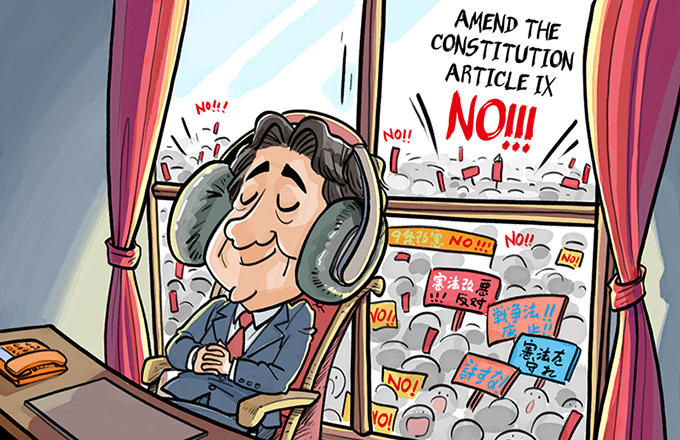
Abe's exclusive initiatives are contrary to the trend of times
Japan plans to revive the quadrilateral security dialogue with the United States, Australia and India to "handle" the region extending from the Pacific to the Indian Ocean. Japanese Prime Minister Shinzo Abe is expected to propose the idea to visiting US President Donald Trump during their talks in Tokyo on Monday.
In an interview with Japan's Nikkei Shimbun on Oct 26, Japanese Foreign Minister Taro Kono explicitly said China's Belt and Road Initiative was the justification for the grouping, which is supposed to "promote free trade and defense cooperation across the land and sea to Southeast, South and Central Asia, and beyond to the Middle East and Africa".
The four countries' security dialogue, a quasi-alliance known as "Quad", had breathed briefly in 2007-08. Born out of what was termed the Trilateral Security Dialogue between the US, Japan and Australia in 2002, the Quad incorporated India in 2007 at Abe's initiative.
During his brief tenure as Japan's prime minister in 2006-07, Abe was committed to building "an arc of freedom of prosperity" along the outer rim of Eurasia. In fact, he even delivered a speech titled the "Confluence of the Two Seas" in the summer of 2007.

In an op-ed article in the Project Syndicate in December 2012, Abe called Japan one of the oldest sea-faring democracies in Asia, saying China is increasingly transforming the East China and South China seas into "Lake Beijing". He called for creating a "strategic diamond" of Japan, the US, Australia and India to "safeguard the maritime commons stretching from the Indian Ocean region to the Western Pacific".
He added that Japan's relationship with its biggest neighbor, China, is vital to the well-being of many Japanese. "Yet, to improve Sino-Japanese relations, Japan must first anchor its ties on the other side of the Pacific."
The Quad, which looked like an Asian version of NATO, held some joint naval exercises in the Bay of Bengal. It disbanded after Australia, led by then prime minister Kevin Rudd, withdrew as it refused to be a pawn in what some termed as the new "Great Game".

Japan is already in a trilateral alliance with the US and the Republic of Korea. It has a trilateral strategic dialogue with the US and Australia and is also part of a three-way partnership with the US and India.
After a strategic dialogue among Japan, the US and Australia on Aug 6, the foreign ministers of the three countries issued a joint statement on "the importance of upholding the rules-based order", and called on all states to respect freedom of navigation and overflight and other internationally lawful uses of the seas, saying they will continue to fly, sail and operate wherever international law allows. And for the first time, they held joint submarine drills in the waters south of Japan in September.
Despite all that, Japan has been taking part, along with the US and India, in the annual Malabar military exercise since 2015.
Abe has been mobilizing Japan's economic and diplomatic resources to make the country a stronger player on the global stage. His efforts to revive the Quad will infuse distrust between Japan and China. And the Abe administration has worked to develop its strategic partnerships beyond the anchor of the Japan-US alliance, forging closer ties with like-minded governments in the Indo-Pacific region and elsewhere.
From now on the Japan-US alliance in effect will act like a network, as Abe said in 2013, broad enough to ensure safety and prosperity encompassing the two oceans (Pacific and Indian). "The ties between Japan and America's other allies and partners will become more important than ever before for Japan," he said.
While Japan works to build an exclusive network, China's initiatives are inclusive.
As proof of China-proposed initiatives' inclusivity, Jin Liqun, president of Asian Infrastructure Investment Bank, said in an interview with the Nikkei Shimbun on Tuesday that the AIIB remains open to Japan and the US.
The author is China Daily Tokyo bureau chief. caihong@chinadaily.com.cn