Modernity with Chinese characteristics
At the start of the 19th National Congress of the Communist Party of China on Oct 18, General Secretary Xi Jinping unveiled his "two-stage development plan" to turn China into a "modern socialist state" basically by 2035. Since then, commentators have been furiously debating the theme of "China rising".
In fact, Xi's plan is far more comprehensive and forward-looking than most observers seem to think. Much like his predecessors Mao Zedong and Deng Xiaoping, Xi has established a strategy for transforming China into a "prosperous, strong, democratic, culturally advanced, harmonious, and beautiful" country over the next decades. The key to success will be the balance between modernity and CPC-led socialism.
When Xi became Party general secretary in 2012, the Chinese economy was facing some problems. China's rapid industrial growth had brought rampant corruption, growing income inequality, and high levels of pollution. Western countries, too, were facing rising inequality, as they reeled from a global crisis of their own making-a crisis that, among other things, weakened their appetite for Chinese imports.
Recognizing that sustainable development would be possible only within a context of social stability and credible, transparent governance, Xi has devoted the last five years to an unprecedented anti-corruption campaign that has brought down 440 senior officials. He has also implemented more than 1,500 reform measures designed to rebalance the economy, thereby stabilizing GDP growth at a "new normal" rate of 6.7 percent, on average, during his first term.
Xi's first term thus laid the groundwork for the ambitious plan that he unveiled at the 19th Party Congress. That plan sets a clear and realistic short-term objective of making China a "moderately prosperous society" by 2020, including by increasing per capita income to more than $12,000 a year, the World Bank threshold for a high-income economy.
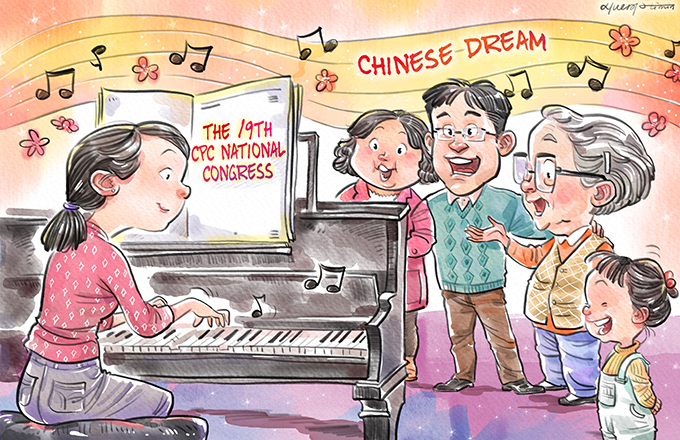
Xi's report also sets out a longer-term strategy for realizing the Chinese Dream, that is, the nation's "rejuvenation" and establishment as a global leader, on par with the United States and other advanced countries by 2050. According to Xi's vision, a transparent, accountable, empowered and socially responsible Party will act as the guardian of this transition.
It is a perfectly logical, albeit complex plan. Yet it seems somewhat incomprehensible to people outside China. This may be because, unlike the standard Western model of competitive party politics that uses periodic elections to direct policy, the Chinese development model relies on a one-party leadership's ability to learn and adapt its agenda accordingly.
For a country as large and diverse as China, this approach makes sense, as it balances stability with flexibility. The country's development is guided not by outcomes in decentralized markets, but by the choices of a central leadership, which presides over the provision of public goods, sets rules and manages institutions. In order to avoid the types of social disruption that political competition could entail, the central leadership also appoints key provincial and municipal officials and resolves disputes among regions.
Besides, regional and municipal governments engage in policy experimentation at the local level, where markets and communities interact, with the results of those experiments informing national policy. Regional competition not only fuels overall economic growth, but also ensures that the particular needs of each area, from megacities like Beijing to the tiny villages that dot China's countryside, are met. As the situation on the ground changes, with new solutions often creating new and unforeseeable problems, continual adaptation at every level is vital.
Of course, the predominance of the State does not mean that markets do not have an important role to play. But that role is often misunderstood. In recent decades, China used State-owned enterprises to build key infrastructure, in order to support the development of China's markets.
SOEs still play an important role in social engineering and research and development, but their business models are under pressure from globalization and disruptive technologies. That is why Xi has included in his plan measures to support the continued opening of markets, including the use of competition law to enable markets to dictate prices, improve resource allocation, and boost productivity.
But market liberalization, in a context of globalization and rapid technological change, has also given rise to another potentially damaging trend: the emergence of a few ultra-dominant tech giants. Moreover, market liberalization has often outpaced progress in regulation and enforcement, allowing for abuses like speculation and tax avoidance.
Given this, the Chinese government has, in recent years, strengthened regulation and enforcement in virtually all sectors. It is this apparent contradiction-between the stated objective of liberalizing markets and the reality of tightened regulations-that seems to confuse outsiders. But the fact is that rising social imbalances can be addressed only by effective government intervention that avoids state capture or the kind of paralysis that can arise from excessive political competition.
In the eyes of Westerners, another seemingly contradictory element of Xi's plan is its insistence on Party leadership in all national affairs, alongside a pledge to strengthen the rule of law. But, again, a closer look reveals a straightforward logic: the transition to a future in which the rule of law is paramount will require China to overcome its legacy of bureaucratic silos that entrench resistance to reform from vested interests. Doing so will demand strong leadership.
In a world comprising a diverse array of countries, each with its own complex, dynamic, and evolving system, there can be no one-size-fits-all development path. Although countries may all aspire toward similar lifestyles, business environments and social systems, they will get there in their own way, determined according to their particular needs, preferences, structures and legacies. For China, that way has now been mapped, with the understanding that the map can and will be revised as needed.
Andrew Sheng is a distinguished fellow at the Asia Global Institute at the University of Hong Kong and a member of the UNEP Advisory Council on Sustainable Finance, and Xiao Geng, president of the Hong Kong Institution for International Finance, is a professor at the University of Hong Kong.
Project Syndicate
 |
| Li Min/China Daily |