New thought will impact the world
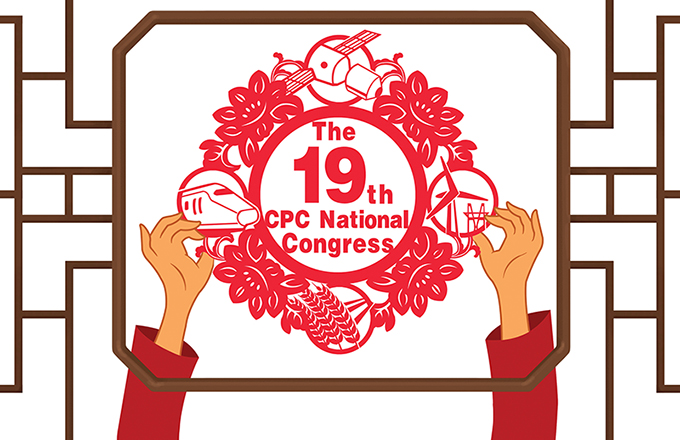
At the opening of the 19th National Congress of the Communist Party of China on Wednesday, General Secretary Xi Jinping delivered a report about building a moderately prosperous society for a new era.
In his speech, Xi delivered a blueprint for China's development till the middle of this century. In the process, he defined the thinking for a new era. In the 1980s, Deng Xiaoping launched the economic reforms and opening-up policies that created the foundation for China's revival. Jiang Zemin's Three Represents opened the Party to more people, including business people. In turn, Hu Jintao's "Scientific Outlook on Development" sought to crystallize the key aspects of the quest for a harmonious society through development.
Nevertheless, these doctrines rested on the foundation of Deng's legacy of industrialization, which had first been ignited under Mao Zedong in the 1950s and reignited in the 1960s with the "Four Modernizations" in agriculture, industry, defense, as well as science and technology.
And under Deng's leadership China finally enabled the industrial revolution to take off in China.
The progress since has been stunning. In 1980, Chinese GDP per capita, adjusted to purchasing parity, was barely 2.5 percent of the US per capita income. When Xi became CPC Central Committee General Secretary in 2012, Chinese per capita income had increased tenfold to 23 percent of the US per capita income.
That was the old China of investment and net exports; China as the "world factory" of low costs and cheap prices. But it was also the China of overcapacity and local debt; a China that grew with foreign capital and domestic imitation, amid deep income polarization and great damage to the environment.
In the past half a decade, China has begun a massive rebalancing of its economy toward innovation and consumption. In the new era, China faces rising costs and prices, but now growth driven by indigenous innovation and premium domestic brands.
This involves supply-side structural reforms and restructuring, painful but necessary transitions across industry sectors and geographic regions, particularly in the northeastern "Rust Belt." It involves deleveraging and means excessive debt is no longer sanctioned.
Today, development is no longer perceived as a win-lose struggle between man and nature, but as a quest for an ecological civilization.
In the new era, prosperity is no longer seen as the conspicuous privilege of few, but as the moderate goal for many. It is a nation in which the Chinese Dream means a moderately prosperous society and the eradication of poverty in line with the current standard.
The new era will never again allow internal disintegration or foreign intrusions. It highlights the importance of the rule of law, and the struggle against corruption by both "tigers and flies" - the only effective way to put people first.
In the new era, direct investment is no longer a foreign monopoly. Now Chinese capital is moving across borders and contributing to modernization not just in China and emerging Asia - but increasingly across the world.
Internationally, the new era promotes more inclusive global governance and institutions that look more like the world they pledge to serve. If the US-led Bretton Woods, Marshall Plan and NATO defined the divisions of the Cold War, China promotes international cooperation, assistance and peaceful development in the 21st century.
Today, globalization proceeds through the Belt and Road Initiative, supported by the BRICS New Development Bank and the Asian Infrastructure Investment Bank; multilateral development banks that represent the interests of emerging and developing nations - not just those of advanced economies.
As the new road map will be carried out across China, per capita income could climb to 35 percent of the US per capita income in 2022. In relative terms, that corresponds to US living standards in the early 1990s and those in Western Europe in the late 90s. In advanced economies, such progress took two centuries; in China, just four decades.
The author is the founder of Difference Group and has served as research director at the India, China and America Institute (USA) and visiting fellow at the Shanghai Institutes for International Studies (China) and the EU Center (Singapore).