US must not link trade with DPRK issue
 |
|
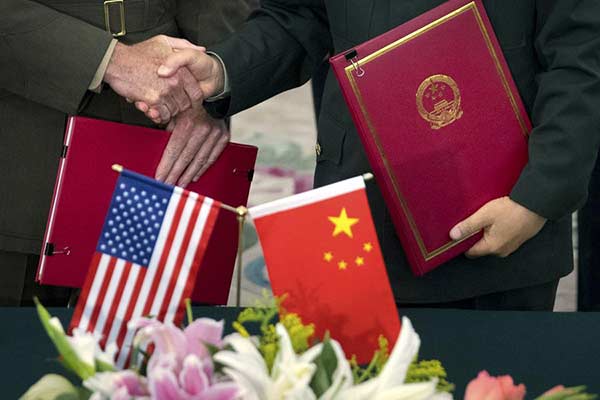
Joint Chiefs Chairman Gen. Joseph Dunford and Chief of the General Staff of the Chinese People's Liberation Army Gen. Fang Fenghui shake hands after signing an agreement to strengthen communication between the two militaries amid tensions concerning DPRK at the Bayi Building in Beijing, August 15. [Photo/Agencies] |
One day before US President Donald Trump signed a presidential memorandum allowing the US Trade Representative to consider launching an investigation into "unfair Chinese trade practices", National Security Advisor H.R. McMaster said China's help was vital to resolving the Korean Peninsula nuclear issue and the United States was not looking for a trade conflict.
Refusing to link trade with the Democratic People's Republic of Korea's nuclear program, McMaster said the operative word is not "punish" but "to compete effectively", "to demand fair and reciprocal trade and economic relationships with not just China but with all countries".
The top US security advisor's remarks seem to be at odds with that of his president, who has time and again made that link. Briefing reporters last week, Trump spoke of losing "hundreds of billions of dollars" a year in trade with China, hinting that he would "feel a lot differently toward trade" if Beijing helped Washington counter Pyongyang.
This is a poor yet unsurprising attempt to make China the scapegoat for the escalating tensions on the Korean Peninsula, not least because President Xi Jinping spoke with Trump over the phone on Saturday and reiterated China and the US share a common interest in achieving denuclearization. Perhaps Trump is using such ploys to distract public attention from the dramatic personnel changes in the top echelons of the US administration and the major policymaking setbacks he has suffered in fields as varied as healthcare and immigration.
In the face of mounting questions over his capability to govern, Trump has ramped up his rhetoric, not just criticizing the latter's progress in miniaturizing nuclear warheads for missile delivery but also whining about Beijing's "indifference".
Ironically, on the same day that Trump signed the memorandum allowing the US to use a statute that has rarely been used since the 1990s and could lead to punitive tariffs on Chinese imports, China's Ministry of Commerce announced that it was placing "a full ban" on imports of iron ore, coal and marine products from the DPRK that would come into effect on Tuesday.
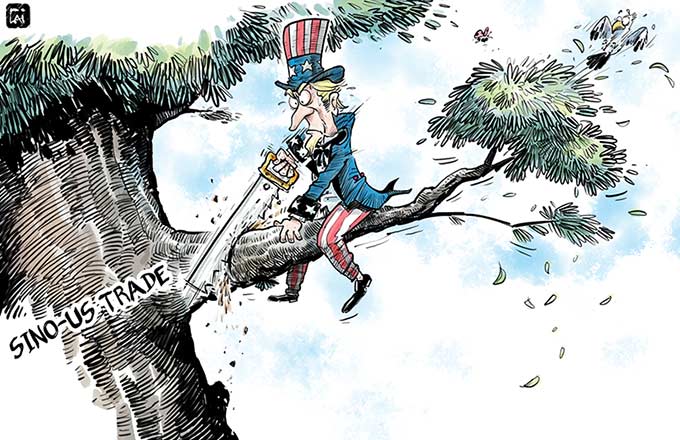
Trade policy formed the bulk of Trump's rhetoric on his campaign trail last year, particularly his China-bashing rhetoric. He refrained from putting economic pressure on China during his first six months in office. But interest groups, which benefited in the presidential election, now seem to be coercing him into fulfilling his campaign promises.
The possible use of Section 301 of the US Trade Act of 1974 marks a fresh attempt to make the complex regional security issue China's exclusive problem. It also indicates the US "expected more" from the 100-Day Action Plan agreed at the Xi-Trump meeting at Mar-a-Lago, Florida, and the China-US Comprehensive Economic Dialogue in Washington last month.
There is no reason for Beijing to let retaliation get the better of its judgment, although it needs to oppose Washington's protectionist moves such as the 232 investigations into imports of aluminum and steel, which mainly target Chinese products. Of course, Beijing should demand clarification from the Trump administration and make clear that any rash action by the US in the name of "standing up for American businesses and workers" is bound to backfire.
Even if the Aug 14 initiative prompts an immediate probe into China's practices in the intellectual property sector, it is likely to take more than a year to complete and would include negotiations with Beijing. Besides, the results may not necessarily be against Beijing.
While China needs to exercise patience, it should demand convincing promises that the Trump administration will not link bilateral trade with the DPRK nuclear issue in practice.
Yu Xiang is the director of the department of American economic studies at the Institute of American Studies, China Institutes of Contemporary International Relations. The article is an excerpt from his interview with China Daily's Cui Shoufeng.