Overwhelmed oceans are crying out for help
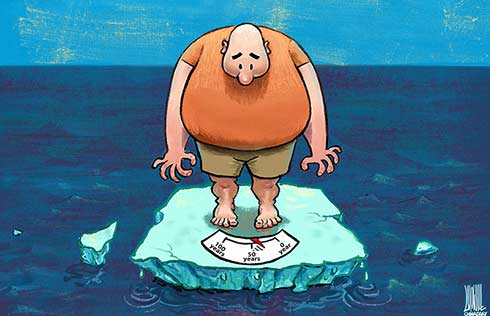
Scientists watching a major rift in the Antarctica, which has grown in the past few years, say it will soon cause a section of the ice shelf to break off and "collapse" into the ocean. The ice sheet that could break off from the West Antarctica, known as Larsen C, is the size of the US state of Delaware, or about 5,000 square kilometers.
Project Midas, which provides frequent updates on the Larsen C shelf, says in its latest report that when the ice sheet breaks off, the Larsen C shelf will lose more than 10 percent of its area to leave the ice front "at its most retreated position ever recorded". This event will fundamentally change the landscape of the Antarctic Peninsula. Project Midas has previously shown that the new configuration will be less stable than it was prior to the rift, and that Larsen C may eventually follow the example of its neighbor Larsen B, which disintegrated in 2002 after a similar rift-induced calving event.
This may not appear catastrophic to the world at large, which seems busy celebrating the opening of new shipping lanes in the Arctic, the other "ice land" which many scientists believe has entered a vicious circle of summer and melting. More icebreakers to explore and exploit the oil and gas reserves, and manpower and equipment to tap the wide variety of minerals and forest resources in the Arctic appear to be the order of the day.
Oceans and their resources - and the Arctic and Antarctic ice sheets are fundamental resources that sustain life on Earth - we believe are there to be exploited. It is because of this misplaced belief that we have also been using the oceans as garbage dumps - dumping more than 165 million tons of plastic.
Still, we are not bothered that by 2050, plastic in the oceans will outweigh fish, if the forecast by the Ellen MacArthur Foundation proves accurate.
All this matters, not least because the melting of the entire Larsen ice shelf, which is about 50,000 sq km, could raise the sea level by 10 centimeters. That in itself may not be a major threat to coastlines across the world, but shows the future path other ice shelves could take: the unpinning of the ice sitting on land which can activate the ice that rests on bedrocks and make it unstable, and eventually force it to float and melt because of the continuously warming oceans.
This scenario appears more likely after US President Donald Trump pulled out of the Paris climate change agreement, meaning, instead of controlling emissions, the United States will now release more toxic gases into the atmosphere and thus accelerate climate change.
In terms of plastic, some countries, including China, have introduced legislation forbidding supermarkets and groceries from providing plastic carrier bags to customers for free to reduce the use of plastic bags. Sadly, such legislation has not succeeded in reducing the use of plastic bags, simply because they are cheap.
Perhaps the time has come to include the environmental costs and raise the price of plastic bags in order to curb their use and reduce the dumping of plastic into the oceans.
China and some other countries and regions are now at the forefront of the fight against climate change. Sadly, though, their efforts may not be enough if the world continues on the current trajectory of economic development, which rests on continuous increase in profits.
That we can still prevent the world from this spiraling out of control because of increasing exploitation of natural resources and dumping of waste into landfills and water bodies is something we already know.
It's an irony that we know what the solutions for most of our problems are, yet we continue doing just the opposite. We have to curb climate change to slow down, if not stop, the melting of ice sheets and stop dumping plastic in the oceans. Or else, more plastic than fish in our oceans will add to the problem of rising water levels and fast-receding coastlines.
The author is a senior editor with China Daily.
oprana@hotmail.com
(China Daily 06/24/2017 page5)