Building a new type of Sino-US relationship
 |
|
President Xi Jinping tells visiting US Secretary of State Rex Tillerson that the nations should enhance exchanges at all levels. They met on Sunday at the Great Hall of the People in Beijing. [Photo/Xinhua] |
The Obama administration's response to the proposal was mixed. It did not oppose the idea, even agreed to it at times. But most of the time, the Obama administration avoided using the term. For instance, the immediate response of Obama at the Sunnylands meeting was, "the two countries shall make new cooperation".
That is why some US policymakers were perplexed by Tillerson's use of China's idea to define future Beijing-Washington relations. For quite some time, US policymakers have stuck to so-called political correctness by distancing themselves from any Chinese attempt to frame bilateral relations, possibly because China has persistently asked the United States to honor its commitment to the three joint communiqués.
Perhaps the US feels such commitment would restrain it from defining and interpreting Beijing-Washington relations according to its requirements.
The US' aversion to the three communiqués indicates it wants to use its "power" to devise a framework for bilateral ties, probably because it "fears" they could undermine its interests. But the fact is, the communiqués have not undermined any legitimate US interests. And since by accepting the three communiqués, whose core is the one-China policy, the US has helped build a solid foundation for bilateral cooperation in business and security matters, both at regional and global levels, there is no reason for it to shy away from them.
To some extent, the "new type of major-country relationship" is similar to the one-China policy. And Washington needs not be averse to it, as it will never lead to any conflict, confrontation, non-respect or zero-sum relations.
If the US cannot accept China's framework for bilateral relations, it has to create its own version. In this context, however, Obama's "rebalancing to Asia" strategy was ill-defined and never worked. This means Trump has to devise a new framework, if he doesn't accept China's idea, for the crucial China-US relationship.
But that Tillerson "reiterated" China's proposal just before Trump meets Xi at Mar-a-Lago Resort in Florida indicates the US State Department has accepted, at least in principle, the Chinese vision of how bilateral relations should move forward.
Hopefully, Tillerson's statement is a genuine reflection of the US State Department's view. It seems the US has prepared well for the Xi-Trump meeting in Florida, where the two leaders should reaffirm their common grounds and search for new avenues of cooperation and collaboration on the basis of the "new type of major-country relationship".
Beijing, on its part, should emphasize the importance of the one-China policy, and reaffirm that Taiwan is an inalienable part of China. As Trump has already promised to honor the one-China policy in his phone conversation with Xi, it should not be a challenge for him to reaffirm it.
As for his vision of "Buy American, Hire American", there will be ample room for the two sides to figure out how they can take their cooperation forward.
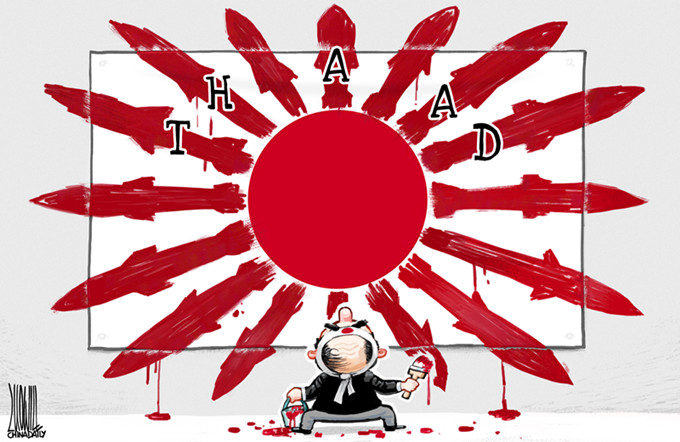
China and the US agree that the Korean Peninsula should be free of nuclear weapons. But since the Democratic People's Republic of Korea continues to push the envelope and the US is proceeding with its goal of deploying the Terminal High Altitude Area Defense anti-missile system in the Republic of Korea, Beijing and Washington have much to talk about to make "the new type of major-country relationship" a mutually fruitful policy.
The author is a professor at and associate dean of the Institute of International Studies, Fudan University, Shanghai.