Only cooperation benefits Sino-US trade
 |
|
President Xi Jinping tells visiting US Secretary of State Rex Tillerson that the nations should enhance exchanges at all levels. They met on Sunday at the Great Hall of the People in Beijing. [Photo/Xinhua] |
Before US Secretary of State Rex Tillerson wrapped up his recent visit to China, he made it clear that Washington is ready to develop relations with Beijing on the principles of no confrontation, no conflict, mutual respect and win-win cooperation.
That on his very first visit to China he reiterated the important principles proposed by China in 2013 should come as a reassuring sign. But now it is up to Washington to take the right approach to China-US trade ties.
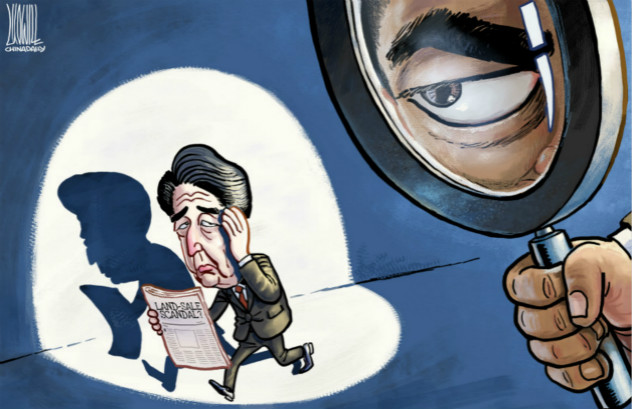
About a week before President Xi Jinping meets with his US counterpart Donald Trump in the United States, senior White House officials are reportedly preparing to "confront" China over its "unfair handling" of the auto industry.
However, the US economy will thrive only if the US strengthens cooperation with China, because it will eventually help job seekers in the US. In the case of automobile trade, the US does have a serious deficit problem, which many trade hawks claim is a result of China's high tariffs on auto imports and requirement to form joint ventures with Chinese auto companies. The solution, they argue, is lower tariffs and 100 percent ownership.
The truth is that US automakers struggle in China and other overseas markets mainly due to the lack of competitive auto products, and foreign companies in joint ventures with their Chinese counterparts have made huge profits from the Chinese market. Automobile accounts for only a small proportion of the China-US trade, and Chinese car exports to the US remains limited. Playing the "fair trade" card and imposing retaliatory tariffs on Chinese imports will hurt both sides, adding to the risk of vicious competition.
Bad policymaking by Trump's predecessors is no doubt responsible for most of the economic woes of the US. For 16 years Washington has been fighting several long-lasting wars at the cost of trillions of dollars. And the fact that the Barack Obama administration offered financial aid to Wall Street banks and insurers after the 2008 financial crisis further stoked the anti-elite sentiment among US citizens.
President Trump was a business tycoon, and has a practical attitude toward trade and economics. But taking on the more than 90 economies with which the US has trade deficits will be an impractical move and one that will almost certainly backfire. China does enjoy a huge surplus with the US, but that has more to do with the trading structure than Beijing's "mercantilism".
Staple Chinese exports to the US market are low value-added commodities, while the US mainly exports high value-added products to China. Although the US urges China to grant full market entry to less-attractive manufacturing sectors such as automobiles, Washington refuses to export its high-tech products to Chinese customers. Such a double standard is not likely to "balance" bilateral trade.
Generally, the trade between the two countries is highly complementary and has helped improve the US' employment rate. A fact that has been deliberately played down by some US economic advisers is that the extensive use of automation and artificial intelligence has made redundant a sizable number of blue-collar workers, particularly in the "Rust Belt" states.
The phenomenon has been often noted in technologically advanced economies such as the US, and should be taken seriously enough by some of Trump's key economic planners.
President Xi's visit will be a timely opportunity for China and the US to bridge the gaps and agree on the importance of cooperation, not confrontation, on bilateral trade.
The author is a professor of US studies at China Foreign Affairs University.