Free trade a way to promote global prosperity
|
|
|
Chinese Vice-Premier Zhang Gaoli delivers a speech at the opening ceremony of the BFA Annual Conference 2017 in Boao, South China's Hainan province, March 25, 2017. [Photo by Feng Yongbin / China Daily] |
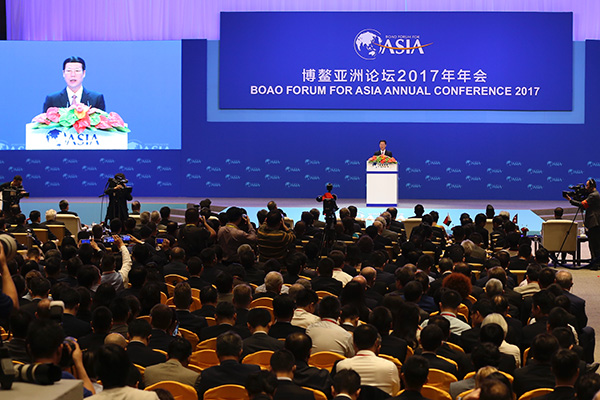
The Boao Forum for Asia (BFA) annual conference was held in Boao, Hainan, focusing on “Globalization and Free Trade: The Asian Perspectives” from March 23-26, 2017.
President Xi Jinping sent his message to endorse his support for globalization and free trade and the country’s responsibility in promoting inclusive and mutually beneficial development for all the nations.
Vice-Premier Zhang Gaoli delivered the opening address, clearly spelling out China’s attitude and approach toward free trade in Asia and the rest of the world through bilateral as well as multilateral cooperation, despite the current difficulty in the global economy and the anti-globalization sentiment under the US Trump administration and the uncertainty in Europe where the UK has formally started its decoupling process from the EU.
The Asian economy has endured and survived the Asian financial crisis toward the end of the 20th century and the world financial crisis triggered by the US sub-prime crisis in 2007-08. In the aftermath of the latest crisis, most Asian economies, particularly China, India, Vietnam and South Korea, have shown strong resilience to the crisis. In 2016, the Asian economies contributed about half of the world economic growth, and China alone, accounted for more than 30 percent.
For Asia and China, the Asian and world financial crises were two double-edged swords. On the one hand, the crises slowed down their economic progress. On the other hand, these economies became more mature and resilient to extreme external shocks. In particular, the relative income gaps between the rich western countries and the Asian developing economies narrowed sharply in the last two decades.
In retrospect, Asia’s economic success exemplified by China’s extraordinary economic expansion for almost four decades would have been impossible without globalization and free trade. China first opened widely its door since Deng Xiaoping’s famous Southern Tour in 1992 to welcome foreign investors and absorb massive amount of foreign capital as well as knowhow to greatly improve its manufacturing and export capabilities.
One decade later, China joined the World Trade Organization in 2001. In the following decade, despite the world financial crisis, China’s exports grew more than 20 percent per year for 13 consecutive years up to 2014, making China the largest trading nation in commodities and the largest manufacturer in the world economic system.
China cannot forget the benefit of globalization and has wasted no time in helping other countries doing the same. Ten years ago, China was almost unknown for capital outflows. By 2016, it became the number two largest investor in other countries. Even the US, the EU and Japan have all benefited from China’s outward foreign direct investments.
If the Trump administration cares about jobs and manufacturing in the US, then the US should not ignore the fact that bilateral trade between China and the US had reached $519 trillion last year. The US high-end exports to China and the numerous manufacturing facilities owned by the US largest multinational companies are equally important for the job security of countless US workers.
US consumers also benefit greatly from China’s exports. On average, each US citizen can save $860 of consumer surplus through buying “made-in-China” instead of buying “made-in-the rest of the world”.
China has promoted the “One Belt One Road” initiative since 2013. It has engaged with over 100 less developed nations along the road and belt. In 2016, the volume of trade between China and the countries covered by the initiative reached almost $1 trillion, and the importance of these countries to China’s exports and investment is increasingly noticeable in the last three years.
The Chinese leadership led by Xi firmly believes that China has been helped by globalization and free-trade, and it is now its term to help as many countries as possible to promote global prosperity through trade and inclusive growth.
In response to this national policy, China has actively engaged in many multilateral dialogues and fora, including BFA, which is permanently based on a beautiful seaside town in Hainan Island. Xi himself has attended the forum a couple of times before and his personal messages have been consistent, that is, China will continue its openness policy, and it will do its best to help not only the advanced economies that have been hit hard by the current world financial crisis, but also the less developed nations in Asia, Africa and other parts of the world to promote common prosperity through free trade and other forms of exchanges.
In the first two months of 2017, China’s foreign trade expanded by 20.6 percent, with exports growing by 11 percent and imports 34.2 percent. This is the first time that China has experienced such a fast growth in foreign trade for the last three years. In particular, it is also the first time that China endured a large trade deficit for the same period, signifying that China is promoting free trade not just through its expression of interest, but through its real actions.
Shujie Yao, Chueng Kong Special Chair Professor of Economics, Chongqing University and the University of Nottingham.