BRICS: A new trend in multilateralism?
 |
|
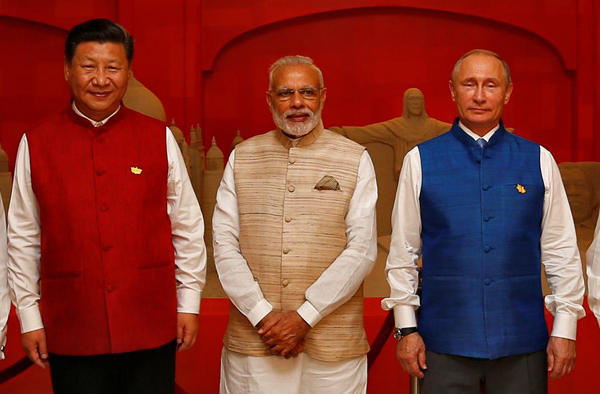
(L-R) Chinese President Xi Jinping, Indian Prime Minister Narendra Modi and Russian President Vladimir Putin pose infront of a sand sculpture ahead of BRICS (Brazil, Russia, India, China and South Africa) Summit in Benaulim, in the western state of Goa, India, October 15, 2016. [Photo/Agencies] |
One of the most significant contemporary developments in international politics involves the growing importance of emerging powers within global governance. The emerging powers such as China, India, Brazil and Russia, already wield considerable influence in their own regions and have expanded their roles in various multilateral institutions such as the G20, the India-Brazil-South Africa (IBSA) Dialogue Forum, the Brazil, South Africa, India, China (BASIC) group of countries, and the BRICS.
The emerging powers thus, presuppose a number of characteristics which raise important questions about their nature of rise, factors shaping their behavior and the extent to which they will challenge existing institutions and practices, constituting the international economic order.
While some scholars view the rise of emerging powers from a 'power shift' narrative, the others understand it as a shift from Western predominance to a more diverse international system, in which there is a deepening interdependence among the established and new actors.
While analyzing the nuances of BRICS formation and its agenda, some analysts apply centre-periphery formulations in which the BRICS as a 'semi-peripheral states' are gradually replacing the 'centre powers'.
For instance, the decline of the US dollar and its ability to provide exchange rate stability to countries that peg their currencies to it suggest the failure of the US to safeguard international monetary and fiscal stability and the emerging market economies like that of BRICS countries, especially China with its current account surplus, have a growing manufacturing capacity which increasingly supply to developed countries with manufactured goods.
The BRICS have been involved in an accelerated integration into these globalised production and financial structures and the policies that the bloc has been pursuing, seek to further this integration. Also, the interests of the leading capitalists and elites in the BRICS countries lie in advancing the interests of transnational corporations and global financial institutions rather than pursuing local accumulation.
However, the extant interpretation of BRICS formation and its implications for the global order have been centered on multi-polarity in global political economy. One set of scholars arguing within this framework believe that multi-polarity generates a higher premium on policy cooperation between sovereign states than a uni-polar system does and therefore, the BRICS countries would seek for greater multilateral cooperation with the established powers to collectively bring about a transformation in the global economic governance.
The other category of political economists argue that although the rise of BRICS signify multi-polarity in economic and financial affairs, but the significant differences in terms of preferences, beliefs and interests between the BRICS nations and the developed countries make cooperation both difficult to achieve and sustain.
In their opinion, the newly empowered states would not prefer to compromise their interests in order to reach cooperative agreements with the developed countries. The examples include negotiation in the Doha rounds, exchange rate issues, climate change etc. which indicate that the multilateral cooperation between the inter-states have either stalled or failed to produce any significant outcomes.
Thus, it cannot be denied that the increase in relative capabilities of the BRICS nations have been a noticeable development in international circles and many analysts argue it as developments transforming the multilateral system. The slow recovery of the west from the global financial crisis have the major powers realized that the world economy and its institutional structures require a more coordinated response and this cannot be achieved alone by the G-7 countries.
Although the extant scholarship on BRICS suggest that the emerging economies desire a larger share in global governance in terms of greater voice, representation, leadership positions within the intergovernmental institutions, they so far have worked towards greater multilateral cooperation, while creating global influence for themselves.
The developmental multipolar discourse, since the mid-2000s, created the conditions for the emergence of BRICS. It is China and India who initiated the discourse through actively promoting South-south cooperation. They have also become the major proponents, emphasizing the need to transform the existing structures of economic governance.
In this context, China has identified itself as 'the major developing country' that would promote the interest of other developing countries in an international system marked by the transition to multipolarity.
For any institutional grouping, inter-regional coalitions are the order of the day. However, these coalitions are never without leadership, who represent the concerns of the coalition, take initiatives and negotiate its interests in the larger forum. In BRICS, China remains the undeclared leader, despite the group's opposition to unipolarity.
Additionally, there are issues related to both intra-regional and inter-regional differences which challenge the cohesiveness of the grouping.
First, the BRICS are geographically, politically and economically a diverse group with little commonality in terms of values and interests. These political differences often form the basis of their differing positions on various other forums of global governance, thus, revealing the inherent fractures within the BRICS community.
Second, with regard to economy, China and India are commodities importers, China specialises in manufactures and India in services. By comparison, Russia and Brazil are commodities exporters, Russia is rich in natural resources and Brazil in agriculture. Since the drivers of economic growth differ in these countries, they take different approach with respect to key issues in the WTO.
Also, these institutional arrangements are rife with insecurities. The factors, discussed above, act as major barriers to the emerging market powers as they seek adjustments in their course of reforming the global order. Therefore, BRICS responses to the tensions of continuity and discontinuity, contested neoliberal norms, and regional differences will bear greatly on the evolution of global order in the coming decades.
The transition also suggests a hybrid system of global governance, where the provision of collective goods is no longer confined to the hands of the superpower but has become a matter of collective goodwill.
Priyanka Pandit is a Visiting Fellow at the Chongyang Institute for Financial Studies, Renmin University of China (RDCY).
- China vows to boost BRICS financial cooperation: ministers
- Preparatory work well underway for BRICS Summit in Fujian
- BRICS bank loans favor technological innovation projects: VP
- Indian diplomat: BRICS summit in Xiamen to have Chinese imprint
- Open economies role seen for BRICS
- China urges BRICS to work on openness of global economy