China will show how to tackle things differently
 |
|
US President Donald Trump delivers his first address to a joint session of Congress in front of Vice-President Mike Pence (left) and Speaker of the House Paul Ryan.[Photo/Xinhua] |
Most of the world's hopes for the outcome of the annual sessions of the National People's Congress and the Chinese People's Political Consultative Conference National Committee can be summed up in three words: stability, stability, stability.
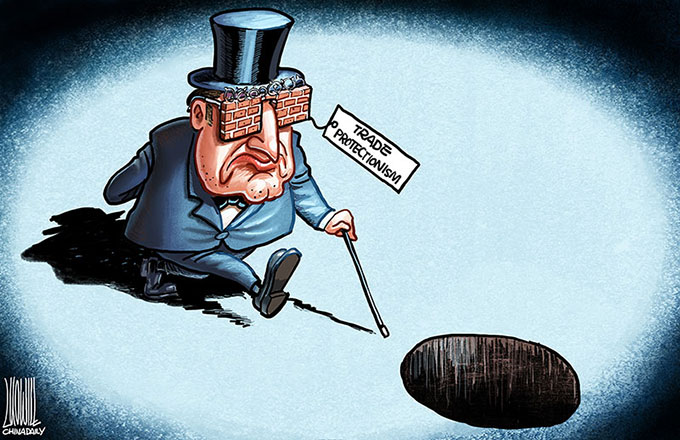
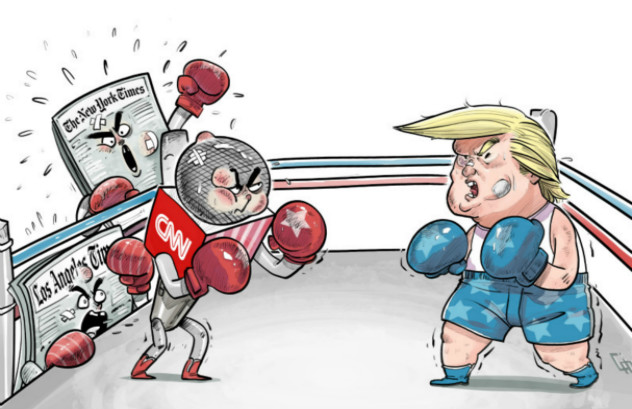
Global uncertainties prompted by the election of Donald Trump as US president and the rise of nationalism in Europe have spread beyond the West to ruffle an already shaky international order. Amid the garbled messages of Trump's first 100 days in office, it is impossible to predict how far his threats of a return to protectionism will be put into practice and to what extent it will cause US-China relations to deteriorate.
The danger of US isolationism is that its effects will not be isolated; it will affect the rest of the world in terms of trade, economic growth and security.
Trump's victory has prompted a revival of the well-worn cliche that when the US sneezes, the world catches a cold. It is borrowed from 19th century Austrian politician Klemens von Metternich, who coined the original phrase when it was France doing the sneezing and Europe catching the cold. The modern adaptation of Metternich's phrase is a reminder of the fate of empires.
A 21st century Metternich might say the continued good health of China is the determining factor in the well-being of its global partners. Therefore, the guidance on future policy that will emerge from the two annual sessions will be closely watched in foreign capitals.
Western politicians have already welcomed President Xi Jinping's renewed commitment to globalization and international trade, while Asian leaders have welcomed Beijing's moves to fill the vacuum created by the US' abandonment of the Trans-Pacific Partnership agreement. As Pakistan's Ambassador to China, Masood Khalid, told China Daily recently, "China's march toward progress and prosperity will not only improve the lives of Chinese people but also provide valuable impetus to global development."
In the West, current attention on the evolution of policy in China is focused overwhelmingly on economic issues. Economists and analysts will dissect the speeches of Chinese leaders to study such issues as the effects of domestic stimulus measures and the outlook for growth. And overseas investors will look for further details in the assurances given by China that it will focus on stable development of its capital markets in 2017, while further opening up its markets to overseas companies.
There has been no shortage of predictions about what is in store. A survey of economists by Bloomberg revealed a shared expectation that China would set lower economic growth and monetary expansion targets this year as part of the efforts to curb excessive credit growth. The report quoted Yao Wei, chief China economist at Societe Generale, as saying: "Beijing will try to stay on the growth path in 2017. Stability will be once again the main focus." Goldman Sachs, predicting modest deceleration of growth in 2017, said: "Chinese policymakers are focused on stability ...."
There's that comforting word "stability" again.
Some observers have suggested that, in light of policy developments in the US, the "Chinese model" may replace the one the US has sought to impose on other economies. Sebastian Heilmann, president of Mercator Institute of Chinese Studies in Berlin, recently told The New York Times that he had changed his mind on the issue of whether China could serve as a model for others.
"For many years, I would have said no," Heilmann said, "but many countries are struggling with how to deal with pressing basic problems like maintaining internal security, building physical infrastructure and providing jobs. These are the basis of populist movements around the world." China, he said, was now often cited as an example of how it can deal with things differently. "China's experience is thus a permanent question mark for the world when they ask if the Western model is the best."
The writer is a senior media consultant for China Daily.
editor@mail.chinadailyuk.com
(China Daily 03/04/2017 page8)