United States will not win a trade conflict
 |
|
US President Donald Trump is flanked by Ben Carson (2nd L), his nominee to lead the Department of Housing and Urban Development (HUD), Carson's wife, Candy Carson (L), Trump's daughter Ivanka Trump (2nd R), and US Senator Tim Scott (R-SC) (R) as he delivers remarks after visiting the National Museum of African American History and Culture on the National Mall in Washington, US, February 21, 2017. [Photo/Agencies] |
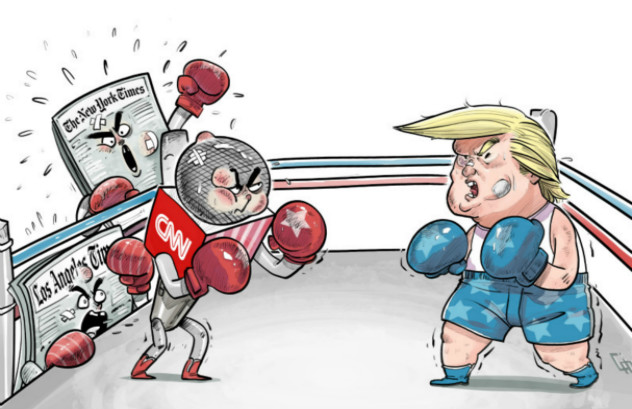
If the hardened positions of the US and China were to lead to a trade war, it would undoubtedly hurt both sides. But there is reason to believe that the US has more to lose, because China seems to know precisely which weapons to use in such circumstances.
China could stop purchasing US aircraft, impose an embargo on US soybean products, and dump US Treasuries' other financial assets. Chinese enterprises could reduce their demand for US business services, and the government could persuade companies not to buy "Made in America" products. The bulk of numerous Fortune 500 companies' annual sales come from China.
Beyond being the US' second-most important trading partner, China is also its main jobs supplier. A trade war could thus cost the US millions of jobs. If China switched from Boeing to Airbus, for example, the US would lose some 179,000 jobs. Reduction in US business services would cost another 85,000 jobs. And soybean-producing regions such as Missouri and Mississippi could lose about 10 percent of local jobs if China halted imports.
Moreover, though the US exports less to China than vice-versa, it is China that controls key components in global supply chains and production networks. Consider the iPhone. While China provides just 4 percent of value added, it supplies the core components to Apple at low prices. Apple cannot build an iPhone from scratch in the US, so it would have to search for alternative suppliers, raising its production costs considerably. This would give Chinese smartphone businesses an opportunity to seize market share from major players.
Today, 80 percent of global trade comprises international supply chains. Declining trade costs have allowed firms to splinter their production lines geographically, with goods processed and value added in multiple countries along the chain. If China threw a handful of sand in the gears of these chains, it could disrupt entire production networks, doing serious damage to the US. An escalating trade war, with each side building symmetric import barriers, would fuel inflationary pressure in the US, potentially driving the US Federal Reserve to raise interest rates higher and faster than it would otherwise. That, together with diminished growth prospects, would depress equity markets, and declining employment and household income could lead to a sizeable loss of GDP in both the US and China.
A more likely scenario, however, is that both countries would initiate disputes in specific sectors, particularly traditional manufacturing industries such as iron and steel production. Trump is likely to continue accusing China of manipulating its exchange rate, ignoring the recent downward pressure on the renminbi, not to mention that many governments intervene to manage their exchange rates.
The trade confrontation between the US and China will also affect bilateral investment flows. The US may cite national security concerns to block Chinese investments. It may also stop government purchases from Chinese companies such as Huawei, and force Chinese companies and wealthy individuals to reduce investments that have hitherto bolstered US asset prices.
A high-quality US-China bilateral investment treaty would create a level playing field for US companies, giving them better access to China's large market. But those talks will invariably be pushed back, while disputes over intellectual property rights and cybersecurity will be reinvigorated.
But for now, Chinese leaders seem convinced they have little reason to bend to US pressure. And even if a trade war erupts, Chinese leaders assume, it probably would not last long, given the income and job losses that both sides would suffer. But they have no intention of sending any signal of weakness to a leader so intent on testing other's limits.
For the past five years, China has sought to establish a growth model that is less reliant on exports and more reliant on domestic consumption. While Trump's policies will be bad for China in the short term, they may provide the impetus China needs to stop subsidizing exports and perpetuating distortions in the domestic economy. If that were to happen, China may actually emerge from the Trump era better off than before.
The author, a professor of economics at the London School of Economics, is a World Economic Forum Young Global Leader and a member of the Richemont Group Advisory Board.
Project Syndicate
- China, US agree to work for greater development of relations
- Chinese State Councilor urges China, US to step up ties
- Wang, Tillerson talk raises hope on China-US ties
- Trade, investment remain stability source for China-US relationship: USCBC president
- Xi-Trump phone talk a good first step in fostering China-US dialogue
- US ambassador to China nominee says to work to enhance China-US ties
- China, US can tackle global food needs