Real leadership requires true globalization
|
 |
|
A Davos logo is seen before the annual meeting of the World Economic Forum (WEF) in Davos, Switzerland January 15, 2017. [Photo/Agencies] |
After 2008, world trade, investment and migration have come to a standstill. What the world requires is responsible leadership, which rests on inclusive globalization.
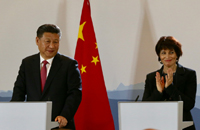
During his first state visit to Switzerland and the World Economic Forum (WEF), President Xi Jinping hoped to inject a positive impetus for the recovery of the world economy.
Amidst rising economic uncertainty and market volatility, Xi offered China's vision on economic growth and free trade in a global economy overshadowed by protectionism.
The old path of globalization led by advanced economies, which are now turning inward, no longer works – as evidenced by the dire state of current global economic integration.
From slowdowns to elevated negative risks
Globalization can be measured by world trade, investment and migration. By the 1870s, capital and trade flows rapidly became substantial, driven by falling transport costs. However, this first wave of globalization was reversed by the retreat of the US and Europe into nationalism and protectionism between 1914 and 1945.
After World War II, trade barriers came down, and transport costs continued to fall. As foreign direct investment (FDI) and international trade returned to the pre-1914 levels, globalization was fueled by Western Europe followed by the rise of Japan. This second wave of globalization benefited mainly the advanced economies.
After 1980 many developing countries broke into world markets for manufactured goods and services, while they were also able to attract foreign capital. This era of globalization peaked around China’s membership in the World Trade Organization (WTO) in 2001 and the global recession in 2008. During the global financial crisis, China and large emerging economies fueled the international economy, which was thus spared from a global depression.
But as the G20 cooperation has dimmed, so have global growth prospects, too. With the incoming Trump administration in the US, the downside risks have grown elevated, as even the International Monetary Fund (IMF) has recently warned.
Stagnating world investment
Before the global crisis, world investment soared to almost $2 trillion. But those days have been gone, for almost a decade. In 2016, global FDI flows are expected to decline by 10–15%, reflecting the fragility of global economy, continued weakness of demand, sluggish growth in commodity exporting countries, and a slump in multinational companies’ profits.
According to the UN, global FDI flows are projected to resume growth in 2017 and to surpass $1.8 trillion in 2018 over the medium-term. Yet, such projections remain almost 10% below the pre-crisis peak.
In advanced economies, FDI activity seemed to recover in 2015. But as the upturn is unlikely to be sustained, the sentiment is turning less optimistic. In the West, large emerging economies have recently portrayed as yesterday’s promises, yet FDI flows to BRICs economies could return to growth, increasing by some 10%.
In the current landscape, the only bright spots are large emerging economies and developing nations that are the last to industrialize.