What more to expect with Trump in office?
 |
|
US President-elect Donald Trump gestures as he speaks during a USA Thank You Tour event in Mobile, Alabama, US, December 17, 2016. [Photo/Agencies] |

The gap between China and the United States in terms of national strength and international influence has further narrowed this year. China's interactions with the US on the regional security and economic orders, combined with its political stability and relatively decent economic growth, speak volumes about Beijing's proposal at major events such as the G20 Leaders Summit in Hangzhou, East China's Zhejiang province, to build an inclusive global order. And given the increasing number of economies recognizing the importance of China's proposal and Beijing's enhanced leadership capability, Sino-US ties are moving toward a more balanced state.
On its part, the US has a long way to go to address the deep divisions at home exposed by Donald Trump's election as the next president. The US' attempts to contain the rise of China, epitomized by the Trans-Pacific Partnership Agreement that Trump has vowed to scrap on his first day in office, have been futile and discarded by most regional powers.
Besides, Trump's call to US allies such as Japan and the Republic of Korea to pitch in to sustain the US' military presence on their soil raises further questions on Washington's self-proclaimed capability of being the Asia-Pacific region's leader.
Neither Beijing nor Washington has made any compromise in handling sensitive issues, especially the disputes in the South China Sea, the planned deployment of the Terminal High Altitude Area Defense anti-missile system in the ROK, and cross-Straits relations, adding more uncertainties to Sino-US ties.
Since before the July "arbitral ruling" on the South China Sea dispute between China and the Philippines the US has been playing up the "China threat" fallacy and dispatching warplanes and cruisers close to China's territorial waters in the name of "safeguarding the freedom of navigation". Seeing China as a strategic threat, the US also has become more aggressive-the deployment of THAAD in the ROK and attempts to intervene in cross-Straits affairs are just two such examples.
China-US relations have witnessed unexpected twists this year, as frictions have increased over trade, long considered a cornerstone of bilateral cooperation, although the two countries seem to have resolved some disputes over what should be done to dissuade the Democratic People's Republic of Korea from building nuclear weapons.
The Barack Obama administration, a champion of the TPP and other exclusive agreements in the Asia-Pacific, has over-politicized the China-US relationship. It has also restricted the entry of Chinese enterprises such as Huawei Technologies Co and ZTE to the US market, saying they pose a national security threat to the country.
Yet the two countries, as permanent UN Security Council members, have agreed on fresh sanctions on the DPRK.
Despite the challenges, both nations basically remain committed to cooperation, as shown by the dozens of bilateral deals inked after leadership meetings in Hangzhou and Lima, Peru, where this year's APEC meeting was held.
What the Trump administration's China policy will be is unclear. Unlike many of his predecessors, he lacks proper understanding of the complexity of Beijing-Washington ties. No wonder he has nominated many officials with no executive experience in government to lead key departments and has been indulging in "Twitter diplomacy".
Given by Trump's campaign promise to fix economic woes at home and create more jobs, however, one can say that his China policy will focus on trade-related issues, ranging from the Chinese currency's exchange rate to trade deficits. But since the new US administration, thanks to a slew of conservatives, is expected to take a hawkish stance on China over the South China Sea and THAAD issues, more frictions could be seen in both trade and security cooperation.
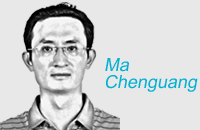
The author is a professor of US studies at China Foreign Affairs University.