TPP 'demise' prompting a global pivot
US President Barack Obama's landmark Trans-Pacific Partnership Agreement was already on life support before his successor, Donald Trump, promised American voters worried by the impact of globalization that he would kill it and bury it.
Now that the Republican-dominated Congress has announced it will not discuss ratification of the TPP during the remainder of Obama's term, all that is left for the outgoing president to do is to read the funeral oration for the proposed Pacific Rim trade pact that had been the keystone of his administration's so-called "pivot to Asia" strategy.
That may come when Obama joins other leaders for the Asia-Pacific Economic Cooperation meeting in Lima, Peru, on Saturday and Sunday.
The demise of the TPP, which was to group 12 Asia-Pacific economies in a wide-ranging, US-led trade alliance, offers an opportunity for China to assume leadership of an alternative free trade area. President Xi Jinping, who will also be in Lima for APEC Economic Leaders' Meeting, is widely expected to press for a Pacific partnership that, unlike the TPP, will include China and Russia both.
Obama's sponsorship of the TPP had been viewed by Beijing as an attempt to write the trade rules for the benefit of the United States in the face of China's growing economic might. As things have turned out, the US administration's failure to secure domestic support for the deal is likely to leave it marginalized in future regional trade agreements.
Trump's opposition to the TPP, which he described during his election campaign as a disaster "pushed by special interests who want to rape our country", won the backing of voters in traditionally industrial states who blame foreign competition, particularly from China, for job losses. In an otherwise divisive campaign, it was a theme that united the candidates. Hillary Clinton, who lost the presidential election to Trump, maintained silence on a pact that she had previously supported.
The potential US partners in the TPP will almost certainly decide that there is no point moving ahead with the trade pact in the absence of what would have been its most powerful partner. Peruvian President Pedro Pablo Kuczynski, the APEC meeting host, has said of the moribund pact: "It can be replaced with a similar deal, but without the US." Speaking to Russia Today, he said: "I think it would be best to have an Asia-Pacific deal that includes China, and includes Russia as well."
That alternative is likely to come in the context of negotiations on the Regional Comprehensive Economic Partnership. Talks on the RCEP, a mega grouping that could embrace almost half the world's population, were launched four years ago.
As the results of the US election came through, Australian Foreign Minister Julie Bishop said: "We see TPP as an important economic manifestation of the US' presence in our region. Should it not go ahead, then the vacuum that would be created is most likely to be filled by RCEP."
Raul Salazar, a senior Peruvian trade official, told the Xinhua News Agency earlier this month: "China has contributed largely to pushing the idea of a free-trade area. Peru holds the position that we need an Asia-Pacific free-trade area."
What might be termed the "pivot to China" became apparent as a result of the uncertainties over trade prompted by the US political campaign. Philippine President Rodrigo Duterte, for example, said during a visit to Beijing in October that he would reduce long-standing ties with the US in favor of better relations with China.
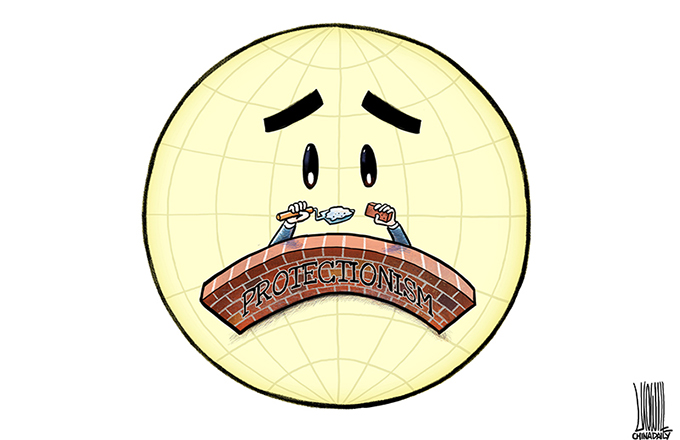
With the US on the retreat, and with a protectionist president heading for the White House, the way appears open for China to take the lead toward a proposed Free Trade Area of the Asia Pacific that Beijing has long championed as an alternative to the US-dominated TPP.
The author is a senior media consultant for China Daily UK.

(China Daily 11/19/2016 page5)