Election reflects America's identity crisis
 |
|
A girl poses for photos with Hillary Clinton and Donald Trump posters at Hofstra University in New York, the United States on Sept. 26, 2016. [Photo/Xinahua] |
As a student of U.S.?politics based in Beijing, I am utterly surprised by the amount of attention that Donald Trump has generated among Chinese journalists, pundits and ordinary people. No presidential candidate, as far as I can remember, has enjoyed as much attention in China. Many of my colleagues and friends seem truly excited about his candidacy. In fact, quite a few of them told me that they would vote for him if they were U.S.?citizens.
Trump's rock-star status stands in sharp contrast with Bernie Sanders' near anonymity in China. Sanders couldn't match Hilary Clinton when it comes to resume or name recognition, but it would be unwise to neglect him, particularly if we want to understand the trends of American politics. In my opinion, between Trump and Sanders, we are seeing an unprecedented crisis of American identity.
America's identity—i.e., the soul-searching question of "who are we"?—has three components: political, ethno-racial, and global.
Democracy lies at the heart of America's political identity; it is what makes America exceptional. America and democracy are synonymous with each other.
For nearly two hundred years, the United States?was defined ethno-racially as White, Anglo-Saxon, and Protestant (WASP). Other groups were expected to assimilate—voluntarily or otherwise—into the WASP culture through the invisible "melting pot."
Since the end of the Second World War, America's identity has been profoundly shaped by its status as a global power (and the world's only superpower since the breakup of the former Soviet Union in 1991). For many Americans, to settle for anything other than the world's No.1 is to be un-American.
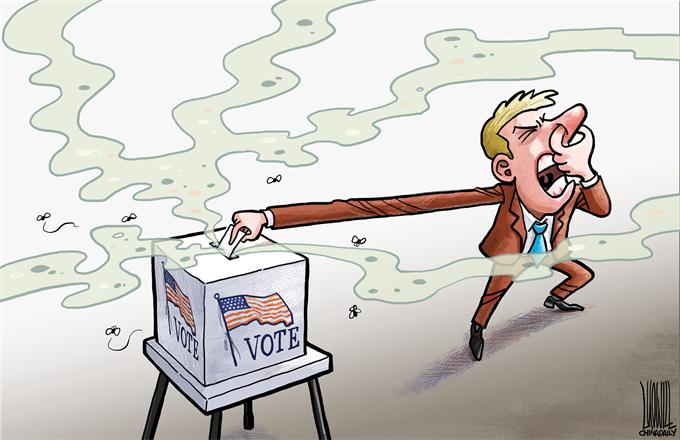
Now each of the three components is being challenged. Few would dispute the decline of American democracy, or what Francis Fukuyama called "political decay." Signs of decay are hard to miss. Public approval of Congress has reached a historical low. The two polarized political parties prioritize obstruction over cooperation and brinkmanship over compromise. Infrastructure is in woeful condition in many cities.
Political decay is most conspicuous in terms of income inequality. The United States has probably the highest Gini coefficient—a commonly used measure of income distribution—among the industrialized democracies. Numerous studies—notably the French economist Thomas Picketty's bestselling?Capital in the 21st?Century—have adduced convincing evidence that the income of the middle class has stagnated in the past three decades, while that of the top 1?percent?has increased nearly twofold. Small wonder that America is now variously described as a "civil oligarchy" or an "unequal democracy," where "winner-take-all-politics" has made the rich richer and the poor poorer.
Alarming inequality, deadlocked government and polarized political parties have significantly eroded many Americans' faith in democracy. Sanders' democratic socialism proved immensely popular, precisely because it resonates with those who are deeply disappointed by the malfunctions of American democracy.
Meanwhile, America's ethno-racially defined identity is being threatened by the massive influx of immigrants, legal and illegal. Various projections show that by mid century non-Hispanic whites will become a majority-minority, accounting for less than 50?percent?of the total U.S. population. Meanwhile, the population of Hispanic origin is projected to make up for nearly 30?percent?of the U.S. total.
The prospects of living in a non-WASP America undoubtedly have deeply unsettled a significant number of American voters. They feel anxious, resentful, and insecure; they long for somebody who can be their voice and savior. And they found Donald Trump, whose inflammatory anti-immigration rhetoric struck a strong chord with them. This "white backlash," it is fair to say, was a major factor behind Trump's success.
Americans are also used to their country being the world's most powerful - militarily, economically and culturally. The United States is still the preeminent power, but its global influence seems to be on a downward trajectory. The rapid rise of the rest—particularly China—has brought about significant changes in America's relative power. Meanwhile, chaos in Iraq, the Syrian crisis, the rise of the Islamic State, instability in Turkey and tensions in the South China Sea have highlighted the limits of American power.
Thus Trump's campaign slogan "Make America Great Again" is an explicit attempt to tap into many Americans' growing uncertainties about their country's place in the world. Yet unlike Ronald Reagan, Trump promises to make America great again by shutting its door to the outside world, renegotiating international agreements and shirking its obligations to allies. His America is one of protectionism and isolationism. His foreign policy proposals represent a fundamental break from post-Second World War U.S. foreign policy.
Sanders lost the Democratic nomination, and Trump may get trumped by Hilary Clinton in November. Regardless of the fates of the two candidates, their extraordinary popularity puts America's identity crisis into sharp focus. Neither of them has a silver bullet for the three-dimensional crisis. Explicitly or implicitly, they all promise to make America great again. America will perhaps be great again, but it will probably no longer be the same America that most Americans–and their foreign counterparts–are?used to.
Xie Tao, professor of political science at the School of English and International Studies, Beijing Foreign Studies University.