 |
|
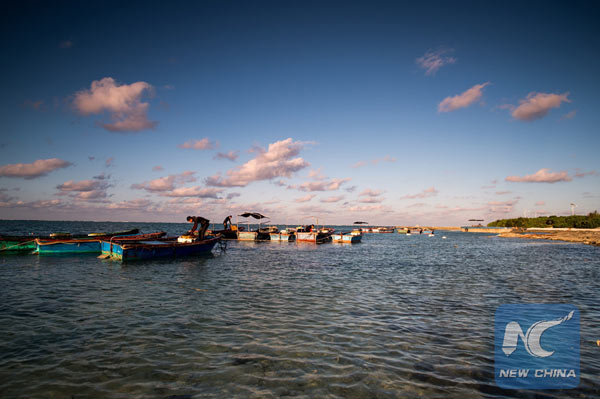
This photo taken on Dec. 11, 2015 shows uniquely beautiful winter scenery of the Zhaoshu Island in the South China Sea. [Photo/Xinhua] |
On July 1, the first day of Japan's one-month presidency of the 15-member United Nations Security Council, Japanese Ambassador to the UN Koro Bessho voiced "deep concern" about maritime disputes between China and some of its neighbors. He also said the Security Council would take up issues on the request of its members or other UN members. This shows Japan's eagerness to raise the so-called South China Sea issue on the international stage.
Unlike the East China Sea, where Tokyo and Beijing have a dispute over the Diaoyu Islands, Japan has no territorial claims in the South China Sea. Nevertheless, Japan, like the United States, is fueling and exploiting the tensions in the South China Sea to advance its own economic and strategic interests in Southeast Asia.
In January, Japan's Ministry of Defense announced the rerouting of its military aircraft returning from anti-piracy operations in the Horn of Africa. Instead of refueling at their traditional stopovers like Singapore and Thailand, the two P-3 Orion maritime patrol and anti-submarine aircraft landed in countries such as Vietnam, Malaysia and the Philippines. Those aircraft carried highly sophisticated equipment, designed to monitor and track vessels, including submarines.
In April, two Japanese Maritime Self-Defense Force warships made a historic port call to Vietnam's strategic Cam Ranh Bay port, which faces the South China Sea. In fact, many US analysts believe the Japanese military's new refueling stopovers are clearly part of a broader plan to establish a more permanent Japanese presence in Southeast Asia.
In March, Tetsuo Kotani, a senior fellow at the Japan Institute of International Affairs, said at the Foreign Correspondents' Club of Japan in Tokyo that Japan and other countries should join the US to carry out freedom-of-navigation patrols in the South China Sea, claiming the rise of China is the most serious challenge for Japan.
In response, speaking at the Japan's National Press Club in Tokyo on June 24, Yu Tiejun, associate professor at the School of International Studies of Peking University, warned that Japan's intervention in the South China Sea will make the issue more complicated and dangerous. That the Chinese and US militaries, according to the Chinese expert, have experienced 10 face-offs from May 2015 to May 2016 gives an idea of the gravity of the situation.
Yu said China and Japan, as well as the US have more important areas to put their efforts and energies in, but the South China Sea is not one of them. Since the South China Sea is not part of China-Japan relations, Tokyo has every reason to stay away from it.
"Japan's involvement in the South China Sea is not in anyone's interests," Yu said. "It is posing new challenges to the strategic mutual trust China and Japan are trying to build." Playing host to the summit of the world's seven most industrialized nations in May, Japan put the South China Sea issue on its agenda and orchestrated a closing statement from G7 that, without mentioning China by name, said countries should refrain from taking "unilateral actions which could increase tensions" and should avoid using "force or coercion in trying to drive their claims".
After assuming the UN Security Council presidency for one month, Japan is once again trying to internationalize the South China Sea issue in the world body. But its efforts will not bear fruit.
The author is China Daily Tokyo bureau chief.
caihong@chinadaily.com.cn



Copyright 1995 - . All rights reserved. The content (including but not limited to text, photo, multimedia information, etc) published in this site belongs to China Daily Information Co (CDIC). Without written authorization from CDIC, such content shall not be republished or used in any form. Note: Browsers with 1024*768 or higher resolution are suggested for this site.
License for publishing multimedia online 0108263 Registration Number: 130349