|
|
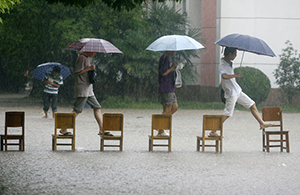
Firefighters search for people stranded in the floods in Poyang county, Jiangxi province, on Tuesday. WANG QI/CHINA DAILY |
Climate variability is increasing the frequency and intensity of extreme weather events such as droughts and floods. Linked to El Ni?o, the recent floods in Central and Southern China are a reminder to the negative impacts of climate change-it is feared the floods are the worst in decades.
These severe and devastating floods have costly impacts. According to media reports, about 33 million people have been affected so far, close to 200 have lost their lives and more than 40 are missing. The economic losses have been just as distressing. More than 50,000 homes have been destroyed, forcing many to evacuate, and about 1.9 million hectares of cropland damaged, leading to losses of over 38 billion yuan ($5.7 billion). Many farmers have had to abandon their property and livestock. And there is little doubt food security and nutrition of poor households will be affected.
Recurring floods increase the vulnerability of the poor, especially small farmers. Extreme weather events threaten not only their livelihoods, but also their food security and nutrition. It is true that China has made tremendous progress in coping with weather shocks. The infrastructure, such as flood control facilities, was strengthened following the devastating floods of 1998. By subsidizing agricultural insurance, the government also has ensured that smallholders are protected, making their incomes more resilient. Additionally, climate adaptation was incorporated into the country's National Comprehensive Agriculture Development Program.
Yet China's agriculture sector remains vulnerable and smallholders continue to face high weather-related risks. So more needs to be done.
How can China's agriculture sector be made more resilient? It is important to continue to invest in infrastructure such as flood control and irrigation, and the development of drought-tolerant crop varieties. Just as importantly, disaster insurance and agricultural insurance will continue to play a big role. Scaling up agricultural insurance is particularly needed to safeguard farmers against weather shocks.
Agricultural insurance uptake or reach of smallholders has been low because of several reasons. For example, insurance products are not tailored to farmers' needs. Many crop insurance schemes offer low indemnity (at the most, 200 to 300 yuan per mu or 666 square meters). And many farmers don't have enough confidence in the current insurance system, because it lacks transparency and there is a high likelihood of fraud.
Moreover, insurance companies lack incentives to design products that fit farmers' needs and follow the right procedures because of high transaction costs. Also, agricultural insurance premiums in China have increased tremendously since 2007-gross written premiums rose from $89 million in 2007 to $5.1 billion in 2014.
There is a clear need for better coordination and an efficient mechanism to protect small farmers while incentivizing insurance companies to meet their needs. In the United States, for example, the government administers the National Flood Insurance Program while private insurers manage policies and process claims. Through the Standard Reinsurance Agreement and Livestock Price Reinsurance Agreement, the US government provides reinsurance and subsidies on eligible crop insurance contracts offered by insurance companies.
Private sector involvement is critical to scale up agricultural insurance in China. Incentives that reduce transaction costs could improve transparency, lessen the risks of fraud and increase uptake by farmers. Greater experimentation, improvements in product design and implementation of more innovative products can also help promote gains for farmers and insurers. Developing index-based weather insurance, for example, can allow farmers to receive compensation based on the value of a specific weather variable. Researchers from International Food Policy Research Institute propose offering an array of products, known as "weather securities", to reduce the complexity of and customize index insurance for farmers with different risk profiles, which would increase farmers' understanding of and demand for insurance.
There is an immediate need for China to take precautionary measures against weather-related agricultural risks. The last few years have shown that natural disasters are some of the biggest threats to China's agricultural productivity, food security and people's nutrition. To build the resilience of small farmers, the provision of agricultural insurance at scale with government support together with market-based mechanisms is the key.
The author is director general of International Food Policy Research Institute.



Copyright 1995 - . All rights reserved. The content (including but not limited to text, photo, multimedia information, etc) published in this site belongs to China Daily Information Co (CDIC). Without written authorization from CDIC, such content shall not be republished or used in any form. Note: Browsers with 1024*768 or higher resolution are suggested for this site.
License for publishing multimedia online 0108263 Registration Number: 130349