Phubbing is okay when restrained as to occasion
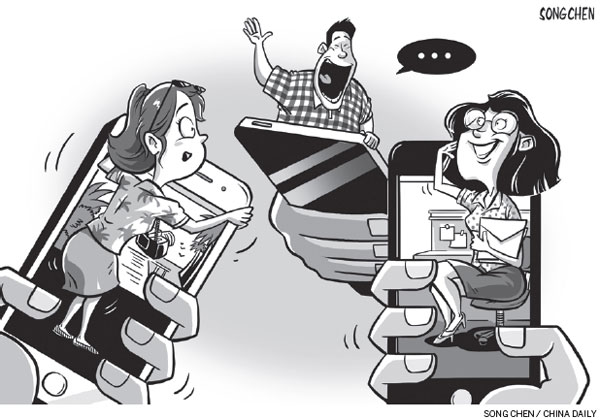
The word phubbing means ignoring the person you are with in favor of your phone. Many believe that our smartphones have become so deeply a part of our lives that they have started threatening our social lives.
The phubber phenomenon occurs when two or more people are in a social setting and interact with their mobile phone (s) and not the person (persons) they are with. We have all probably encountered or been a part of the phenomenon. We notice it as well when distracted drivers or pedestrians have so immersed themselves in smartphones as to disregard traffic and environmental cues to which they should pay attention.
A team of language experts assembled by McCann and Macquarie Dictionary first coined the word "phubbing" in 2012 as a way, they say, to help the world address a growing social problem and, at the same time, help the company sell copies and subscriptions of its new dictionary.
But is phubbing a reflection of a world that is becoming more disconnected in which the art of conversation is disappearing? Is it a problem at all? Is phubbing something we have a slightly disdainful attitude toward, that is, as seeing someone spitting would be in the West, or has it, like spitting, become so commonplace as in China, to not even register with us consciously?
Psychologists who study human behavior in order to understand, predict and modify it are certainly interested in questions like phubbing, which relate to human development. Sociologists would want to know whether the phenomenon is contributing to a breakdown in the social order of society.
At first blush, it certainly seems that the act of ignoring our companions in social settings is rather antisocial and deleterious.
Deeper inspection, however, suggests that the phubber phenomenon may be a rather benign continuation of activities put in place long before smartphones became the rage. In questioning the modern adaptation, consider activities predating phubbing.
For example, groups of people have for many years gotten together to go to movies, a social activity. But then those people spend an hour or two singularly wrapped up in the cinematic world. True, those same people will often discuss the movies afterwards and they have, unlike phubbers, shared a common experience.
But families have gathered around TV sets for many years, lost in their individual reveries, and the likelihood of post-TV-watching discussions about what the people have viewed are minimal. Although the TV experience has been shared, no meaningful familial exchanges occur.
While psychologists have for years debated the virtues and vices of the boob tube, the general consensus seems to be that like other behaviors such as gambling or drinking, TV is okay in moderation and under appropriate conditions.
For example, a family or friends might be eating dinner together and all checking e-mails, texting, working apps or discoursing with other friends. No one in the group is really harmed or excluded by such an activity, and conversations, albeit not among those gathered, are still taking place. We are indeed socializing, but on a grander scale.
Conversely, were a job applicant to disengage with a prospective boss during her interview because of a smartphone infatuation, we could certainly conclude that she had a problem, assuming she wanted to be hired.
If one of our friends was clearly bereft because of a relationship failure and we ignored his obvious distress to text an emoticon to a colleague, we might question whether we had swung on our hypothetical phubbing spectrum from amusing diversion to unhealthy addiction.
However, rather than demonize the phubbing phenomenon, we should probably draw a similar conclusion as with other potentially harmful behaviors: phubbing is okay when restrained as to amount and occasion.
The author taught psychology for many years in California and used to write a web column for China Daily. He now writes a regular column on psychology for the Phuket Gazette in Phuket, Thailand, where he lives.