Middle-income group vital
Expanding the size of this social group and increasing their consumption capability will drive economic development
Any great power's rise is closely related to its growing middle-income group, and, to some extent, the development maturity of the middle class determines a society's progress and prosperity. The middle-income group is also the key for China to attain an olive-shaped income distribution society, without which China cannot sustain its dynamic growth.
The middle-income group used to be the majority of the population in developed countries, but that has changed in recent years. With the acceleration of the globalization process, the income gap has widened in developed countries and the inequality in their societies has become more serious, which has led to the shrinking of the global middle-income population. Especially after the financial crisis in 2008, with continuously increasing unemployment and a growing debt burden, the middle-income group faces "collapse" in developed countries, and income distribution is changing from an olive-shaped pattern to a M-shaped one, a polarized society with an extremely rich group and an extreme poor group.
For example, the prosperity of US economy in the past two or three decades was largely based on the over-consumption of its middle class supported through credit and loans. That is why "saving the middle class" became an important part of the Obama administration's bailout plan. With the US real estate market reviving and its stock market soaring, the situation for the middle class has considerably improved.
China should not be so optimistic about its own situation. Although different organizations have made various statements about the size of its middle-income population, there is no authoritative data and the criteria for being middle class is still changing. According to the General Social Survey carried out by Chinese Academy of Social Sciences, the incomes of the middle class are $11,800 to $17,700 per year, which means the middle class makes up around 23 percent of China's total population, far lower than the percentage in developed countries, and lower even than some other emerging countries.
In fact, with the income distribution gap becoming wider in China, it is difficult for the middle-income population to increase rapidly. China's income disparity between the rich and the poor has become serious in the past decade. According to the World Bank, China's Gini coefficient has been more than 0.4, which is seen as the warning line, since 2000. Residents' incomes and labor payments as part of the national income distribution have declined, with the income gap widening between urban and rural residents and among different areas and industries.
Moreover, expanding the middle class is closely linked to the structure of the economy. Improvements in productivity are mostly led by capital productivity rather than labor productivity, so in the primary distribution the proportion of capital income in the total income distribution has increased. As capital has a more powerful position than human resources, it actually takes away the income that the rising productivity of labor should get.
That the middle-income group cannot afford to spend is one of the major reasons for the low consumption in China. In fact, the middle-income group in China is only slightly better off than the lower-income group, and most of them have become "mortgage slaves" because of the high costs of housing, education and healthcare bills. For instance, globally, housing accounts for 20 to 30 percent of a middle-income group household's income, and the ratio of housing price to income is around 3 to 6, which means it takes an average person's total wages of three to six years to buy an average dwelling. However, in China the ratio is much higher, and buying a house can sometimes overdraw the wealth earned by three generations.
Therefore, expanding the size of the middle-income group is not only the key for China to become an olive-shaped society, it is also the hinge for upgrading the economy. The government should initiate reform of national income distribution as soon as possible.
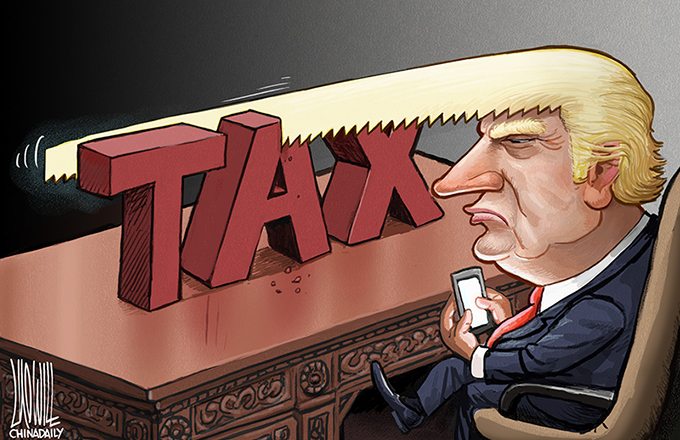
It should improve the primary and secondary tax systems, and structurally reduce people's tax burdens in order to realize the goal of adjusting the high-income group, expanding the middle-income group and raising up the lower-income group.
There should also be thorough reform of the housing system. It is necessary to launch a double-track pricing system in the housing market. The purchasing needs of investment and high-end demand should be taken care of by the market, while the government should consider regulating the consumption of self-occupation housing, and there should be reasonable institutional arrangements in land and financial policies to meet different housing needs.
Except for the accumulation of material wealth, the basis for increasing the size of middle class is to pay more attention to human capital. The government should invest more in cultivating human resources, by, for example, increasing the input into education. It is also quite important to establish a social mobility mechanism by reforming the household registration and social insurance systems, which can break the barriers among different income groups. In this sense, expanding the middle-income group is crucial to economic vitality, avoiding the middle-income trap and driving the rise of China as an emerging great power.
The author is the deputy director and associate research fellow of World Economy Study at the Economic Forecast Department of the State Information Center.
(China Daily 07/22/2013 page8)