Ties may take a turn for the better
When US president Richard Nixon and his secretary of state Henry Kissinger first sought an opening with China in 1971, Eisaku Sato, Japan's prime minister at that time and a stalwart supporter of Washington, was entirely unaware until the last minute. The "Nixon shock" was devastating, but also inspiring as Kakuei Tanaka, Sato's successor, normalized relations with China in September, 1972, more than six years ahead of the United States.
Less than two weeks after the "informal" summit between President Xi Jinping and US President Barack Obama in California on June 8 and 9, Shotaro Yachi, former vice-foreign minister and a long-time ally of Japan's Prime Minister, Shinzo Abe, made an "unofficial" visit to Beijing. Yachi might have been on a mission to break the logjam in Japan's relations with China, as Chief Cabinet Secretary Yoshihide Suga admitted that Yachi's Beijing trip was under Abe's consent.
Yachi was said to have talked with Chinese officials on how to repair the bilateral ties between Japan and China - the thorn in their relations being, of course, the Diaoyu Islands.
Despite former chief cabinet secretary Hiromu Nonaka, telling Chinese officials in Beijing on June 3 that leaders from Japan and China had agreed to shelve the row over the islands when they normalized relations, Japanese officials, such as Foreign Minister Fumio Kishida, have denied that Tokyo ever made such an agreement with Beijing.
Direct official contact between top government figures of the two countries have stopped since the cabinet headed by former Japanese Prime Minister Yoshihiko Noda nationalized three of the islands. Abe, Noda's successor, has pledged to take a tough stance over the dispute.
Speaking to Japan's parliament in February, Abe quoted comments by former British premier Margaret Thatcher about the Falklands War with Argentina when he mentioned Japan's territorial dispute with China, and he has proposed the first rise in Japan's defense spending for 11 years "in the context of repeated incursions by Chinese ships into waters around the islands".
However, when Obama spoke to Abe by telephone on June 13 to share details of the China-US summit, they agreed on the importance of Japan "pursuing dialogue" with China over the islands.
Together with Abe's comment on a possible meeting with President Xi, the visit to Beijing by Yachi has raised speculation that the two countries may be in unofficial talks to arrange a summit.
Shortly after becoming prime minister for the first time in 2006, Abe visited Beijing and broke the ice his predecessor, Junichiro Koizumi, created by repeatedly worshiping at the controversial Yasukuni Shrine.
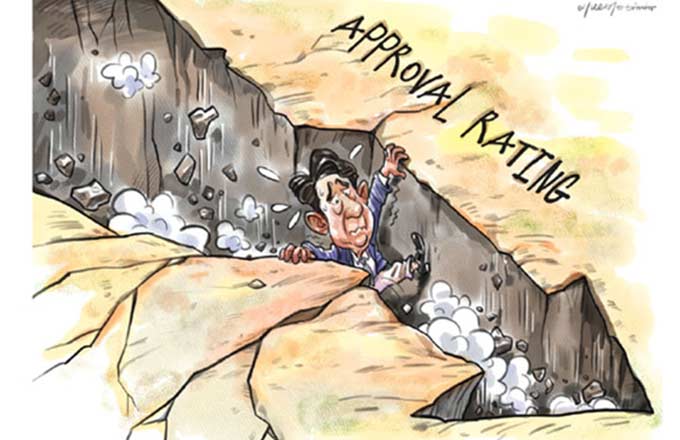
Abe has refused to make peace with China since starting his second stint in office.
In this he' s been making a desperate attempt to revive Japan's economy, which has stagnated for nearly two decades. Elucidating his economic policy in London on June 19 after the G8 summit, he called his country's negative growth as the ultimate recipe for "beggar thy neighbor".
But the inward-looking and nationalist tide is arresting the drift in Japan's diplomacy for East Asia, or to be specific, it has blighted relations with China and South Korea.
People have read signals from the Chinese government that it is seeking to repair relations with Japan. Yang Jiechi, a former ambassador to Washington, has been named the state councilor. And Wang Yi, a Japan hand and former ambassador to Japan, is the new foreign minister.
Influential Japanese political figures such as former prime minister Tomiichi Murayama and Natsuo Yamaguchi, leader of the New Komeito Party, visited Beijing in the first half of this year.
The flurry of visits signals a willingness among the sober Japanese public to mend relations with China, and were widely interpreted as the beginning of a thaw in the ice between the two neighbors.
Japan's Chief Cabinet Secretary Suga said that the Abe administration is always considering various options to improve relations with China.
The signs are encouraging. People are now waiting to see what steps Japan will take.
The author is Tokyo Bureau chief of China Daily.
(China Daily 06/24/2013 page8)