Japan's focus on free trade agreements
Japan aspires to be Asia's leader in economic and political affairs. But it faces significant roadblocks - economic, political and historical - on its way to that goal.
The economic and political roadblocks, which are intertwined, arise from Japan's political system and the power it grants to certain interests - such as farmers. The historical roadblocks are rooted in Japan's invasion of countries in Asia before and during World War II.
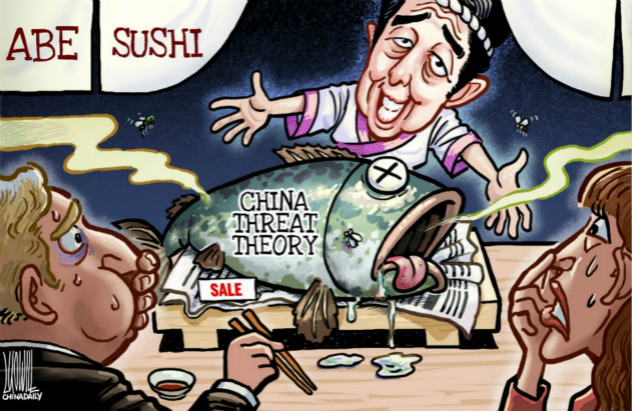
The Abe administration has adopted an accelerated free trade agreement strategy in a bid to revitalize Japan's moribund export-reliant economy and strengthen its position in the face of China's growing political and economic influence in Asia and rest of the world.
Japan is aggressively pursuing free trade agreements with the United States-dominated Asia-Pacific region and the European Union, as well as a trilateral agreement with China and the Republic of Korea.
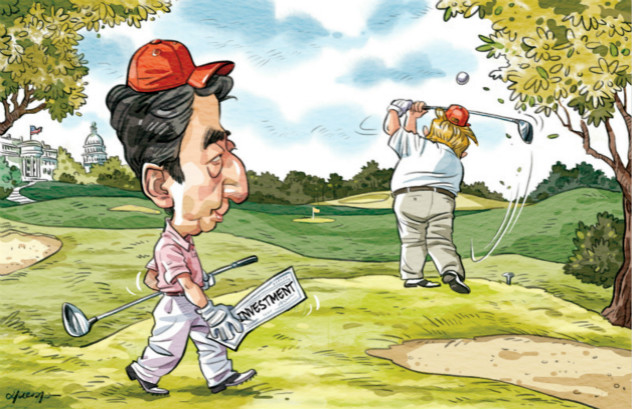
Japanese Prime Minister Shinzo Abe committed Japan to joining the Trans-Pacific Partnership negotiations on March 15, as he feared Japan would be left behind if talks went ahead without it, and he wants to strengthen Japan's security relations with the US and its partners.
On March 25, in a telephone summit between Abe, European Council President Herman Van Rompuy and European Commission President Jose Manuel Barroso, Japan and the European Union formally agreed to open talks on an FTA next month. Japan is keen to begin talks with the EU aimed at both an economic partnership and a political accord that includes security. One of Japan's concerns is that the increasingly friendly ties between the EU and China will prompt the EU to end its ban on the export of weapons to China.
Meanwhile, strengthening cooperative ties with China and the ROK - which as well as being close to Japan geographically, historically and culturally, also possess large growth potential - is an important policy task for Japan.
Growing economic interdependence and shared economic interests have moved the China-Japan-South Korea relationship to expand over the past two decades, and the three countries completed their first round of trilateral talks on a free trade agreement on March 28.
Although the three countries started to promote tripartite cooperation in the context of the Association of Southeast Asian Nations +3 in the 1990s and launched an annual summit in 2008, geopolitical and historical rivalries have long stunted cooperation and strategic issues continue to cast a shadow over the FTA process.
Japan's territorial disputes with China and the ROK mean there is still a long and difficult path ahead, especially as Japan continues to aggravate the disputes. Japan's Ministry of Education announced that two new geography textbooks and six of seven new textbooks on politics and economics approved for use in Japanese high schools starting in April 2014 describe the territories involved in the disputes with China and the ROK as Japanese territory. The Japanese government's approval of these textbooks poses a serious problem for the future of Japan's relationships with the two countries.
Trade relations between China and Japan have already been seriously damaged by Japan's unilateral "nationalizing" of China's Diaoyu Islands last year. So if a free trade agreement between China, Japan and the ROK can be negotiated despite Japan's provocations, it will have broader implications for relations between the three countries.
When China, Japan and the ROK heralded their first round of the tripartite free trade negotiations, the Japanese media praised China and the ROK for separating politics and economics. But Japan should not make the mistake of thinking this stance means China will make concessions on its territorial claims.
The author is Tokyo bureau chief of China Daily. E-mail: caihong@chinadaily.com.cn