Paying for public services
Reform of tax system urgently needed so local governments have the revenue needed to meet their responsibilities
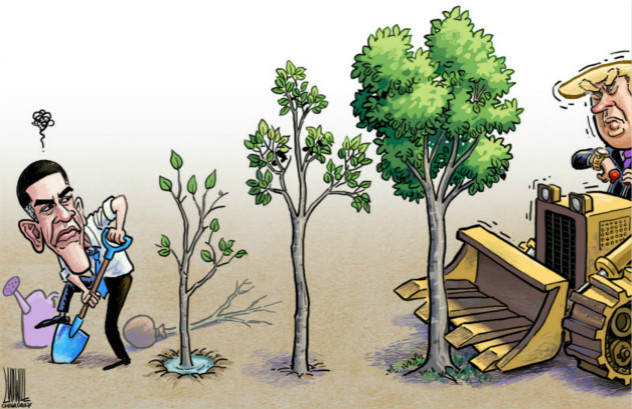
Transferring power to the lower level is the main direction and axis of the new round of reforms that has begun with the institutional reform and transformation of government functions announced on Sunday. Untangling the relations between the central and local governments, decentralizing more power to local governments, matching financial power with responsibilities, and pushing forward reform of the tax distribution system are undoubtedly some of the priorities for this round of reforms.
In recent years, the insufficient financial power of local governments has forced them to squeeze money out of land, and they have developed a strong reliance on the revenue from land transfers. Meanwhile, local governments' preference for long-term investments and short-term debts has aggravated the potential risks arising from these debts. The root cause of these problems is local governments are not granted enough financial power to meet the responsibilities assigned them by the central authority.
Reform of the tax distribution system in 1994 established the basic institutional framework for the relations between the central and local governments, which was an important step forward for China's economic reforms. This reform changed the tax-sharing rules in favor of the central government and drove the various levels of local governments to attempt to balance their budgets at the cost of lower jurisdictions.
The downward movement of government responsibilities and the upward movement of financial power has caused financial difficulties for grassroots governments that have no subordinate governments to contribute to their coffers or absorb their losses.
With the reform favoring the central government, it receives just under half of the overall national revenues. However, its financial outlays only account for about 20 percent of the national total. Local government revenues on the other hand have shrunk from 78 percent of the overall government revenues in 1993 to 52.1 percent in 2011. But during the same period their expenditures have risen from 72 percent in 1993 to 84.8 percent in 2011. This mismatch between the financial power and responsibilities of the central and local governments has become a serious problem.
In most developed countries, the share of local revenues in the national revenues is equal to or slightly higher than the share of their expenditures, which reflects the income-and-expenses reciprocity principle. In China local governments do not have enough tax categories to feed their revenues, and the mismatch between their income and expenditure has forced them to seek more non-tax revenues. Debt and land sales have become the means for local governments to try and make ends meet.
China has 28 tax categories now. Although 18 are earmarked for local governments, these tax categories are mostly small ones that either provide meager revenues or are difficult to collect. Even if the business tax, enterprise income tax and individual income tax are stable revenue sources, the latter two are shared by both central and local governments and do not serve as exclusive and reliable tax categories for local governments. If they lack enough revenue, local governments' ability to pay for public services is not sustainable.
Although China's Budget Law strictly prohibits local financial deficits and local governments seeking debt financing, governments of different levels are, to varying degrees, trying to borrow money to fund their growing financial deficits. Most of the debt exists in a covert state.
Meanwhile, local government's heavy reliance on land transfers is the strongest resistance against the central government's regulatory and control policies for the housing market.
In 2010 the fee for land transfers increased by 70.4 percent year-on-year, and the fee accounted for 76.6 percent of local government revenues that year. Yet in 2012 the fee of 300 cities declined by 13 percent year-on-year. The debt risk of local governments is evident. This will not only put pressure on the banks, it will also put pressure on China's macroregulation measures.
The fundamental solution to the financial risks of local governments is to increase their tax revenues by granting them more reliable and sizable tax categories so they have revenues corresponding to their needs.
In the long run, China should adhere to classifications based on a rational tax distribution system and construct a healthy local taxation system according to its practical national conditions.
To begin with, China has started reforming its resource tax to save resources and protect the environment. The central government can draw lessons from the experience of other countries and let local governments share the resource tax with it in settled proportions.
Second, China should start environmental tax reform in the 12th Five-Year Plan period (2011-15) and make the tax a reliable source of income for local governments, which are the main parties responsible for managing local environmental protection affairs.
Third, the central government should share the revenues from land transfers with local governments in order to contain local government's excessive reliance on land sales. The central government should reconstruct the taxation system on the real estate market to integrate the existing property tax, urban property tax, land use tax, land value increment tax and the other taxes and fees based on land-transfer fees into a unified property tax.
Last but not least, China should reform the existing taxation system and add new local tax categories. The local government system should be a comparatively independent taxation system integrating turnover tax, income tax, property tax and resource tax.
If the central government can decentralize some power and concede some revenues to local governments through reform of the tax distribution system, China will have real public finance to improve the quality of people's lives, and China's economic system will radiate new vitality in the structural transformation period.
The author is a researcher with the State Information Center.
(China Daily 03/13/2013 page9)