Western models not panacea
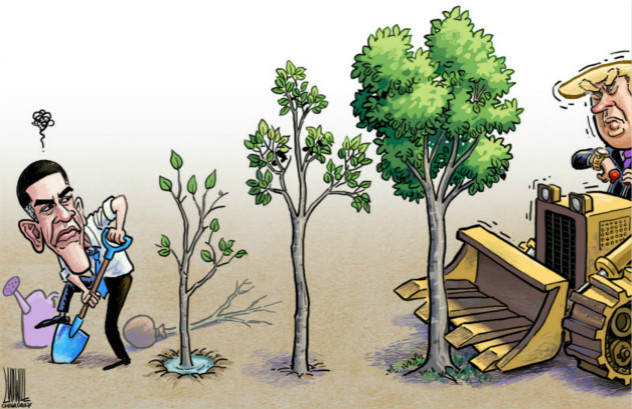
Each human being is different from any other, having a mix of strengths and weaknesses that are unique. In the same way, societies differ from each other, having evolved out of different historical circumstances.
For example, in the 19th century, the British Empire was a source of pride in the United Kingdom, being a small island that took control of more than half the planet and converted its resources to its advantage. India's view on the same empire is different, for it saw its share in the global economy fall from 24 percent to less than 1 percent from 1820, when the British began to establish themselves in India, to 1947, the year they left.
Similarly, the Opium Wars were a source of immense profit for UK merchants, helping huge conglomerates dominate business in Asia and elsewhere. However, for the Chinese people, the Opium Wars were a source of immense pain and the cause of social disintegration that was only reversed in 1949, when the Communist Party of China founded New China.
The reality is that the European experience of colonialism has almost always been a zero-sum game, in which the other side lost heavily in order to ensure gains for the colonizing power. Which is why it is not reasonable for the West to demand that the rest of the world accept its version of history and economic and political doctrines. The circumstances in each non-Western country are very different from those in the West, which is why imposing a Western model would result in a less than optimal outcome.
If China has made such great progress, especially since the 1980s, it is because the CPC rejected copying Western commercial institutions, creating instead a model that had a natural fit with Chinese experience and needs. Strangely, while admitting that the Chinese economic model has worked in China, where a purely Western version may have failed, some Western powers constantly criticize China for not adopting a fully Western model of democracy.
Western powers ensured their dominance in the two previous centuries by control of territory. These days, they seek the same outcome by seeking to make other societies believe that following the advice given by them is the best course.
In South America in the 1970s, much misery was caused precisely because governments there strictly followed the orders of the World Bank and the International Monetary Fund, both of which were, and still are, dominated by the West, with only a United States or an European Union national heading these so-called international organizations.
Indeed, to the West, international means the West. The so-called international relations programs taught in the West, which are unfortunately so popular with affluent students in China and India, teach subjects solely through the prism of Western interests. Those passing out of such programs subconsciously begin to act and think in ways that promote Western interests, rather than that of their own countries. This is hardly surprising.
When the West refers to the international community, it refers only to itself. The views of people in China, India and other large non-Western countries are regarded as not having any worth. In the same way, "international media" refers only to the Western media and to their West-centric viewpoint, ignoring the views of the rest of the world.
Even globalization is taken to mean easier access to Western products, services and people in other markets rather than a genuinely international free flow across borders. The European Union in particular has made entry into its own markets as difficult as possible for companies based in Asia, while constantly putting pressure on this continent to open up markets to the EU. Rather than a Western zero- sum approach, what the world needs is an Asian win-win approach, which is why the rest of the world needs to avoid falling into the trap of judging their own interests solely in the terms set for them by the West. Each country has the right to its own perspective and the right to craft its own path to progress.
India provides an example of a country whose leadership uncritically accepted Western systems when more local solutions were required. Although a democracy, the legal and administrative system in India is largely what it was during British rule. The Indian Penal Code and the Indian Police Act, for example, have not changed for more than a century. Democracy is good for making decisions taking different groups' interests into consideration, but India has developed at a slow pace. In 1949, the Indian economy was twice as big as China's. Today, it is less than a third the size.
It costs millions of dollars to fight a parliamentary election in India and in the US, thereby ensuring that only those with access to money will be elected, the poor are effectively excluded.
While Western-style democracy may suit Western countries, other countries need to ensure that systems are created that meet local needs. A one-size-fits-all approach makes no sense, except for the West, because if other countries slavishly follow the Western model they will be handicapped from competing with the West.
During the 1997 financial crisis in Asia, which was caused by Western currency speculators, India and China both escaped as both refused to adopt the measures that Western governments were urging them to do. In contrast, countries such as Thailand, which faithfully implemented Western prescriptions, suffered badly. Western prescriptions are good - but only for the West.
Non-Western countries should take care to ensure that their national policies do not get framed in a way that helps outside powers at the expense of their national interests. Democracy implies diversity, not the total adherence to the concepts and models that Western countries promote as universal, but which are really to their advantage. Each country has not only the right but the duty to ensure that diversity is protected and that models suited to their own people and their own history get adopted.
Confidence in one's own people is essential to make the sort of immense progress that China has achieved over the past three decades. Such confidence cannot be transplanted from the outside. It has to develop from within a country and its unique people.
The author is vice-chair of Manipal Advanced Research Group and UNESCO peace chair, and professor of geopolitics at Manipal University, India.
(China Daily 03/13/2013 page10)