Better pension scheme needed
One of the great successes of the Chinese government's social security policies in the past decade has been its expansion into the hitherto untouched area of the nation's countryside.
The introduction of nationwide rural pension scheme in 2009 was a landmark move. By the end of 2011, it had covered 326.43 million people, a number larger than that of the entire US social security system. The pension recognizes that farmers never strictly retire from work and instead become increasingly unable to maintain their income as they start getting old and weaker.
That, of course, is even truer in 21st century China, because the impact of the strict family planning policy and mass rural-to-urban migration has left many farming families with no one to depend on in old age. In this sense, the rural pension scheme fulfills the original purpose of a pension as a form of income replacement, rather than a reward for past employment as urban workers worldwide generally see it.
The current national rural scheme is simple and modeled on the urban scheme. If a farmer reaches 60 and has no dependents, he/she will be entitled to social pension even without any prior contribution. Those who are close to the "retirement" age can make modest contributions - 100 yuan ($16) to 500 yuan a year for 15 years commutable to a single sum - and claim social pension after reaching 60.
Younger farmers, under 45 years of age, are expected to maintain their annual contributions to an individual account scheme as well as the social pension, from which they can get a fixed pot of money.
The scheme is hardly generous. The central government contributes a standard of 55 yuan a month to an individual's pension fund and the average rural pension across the country is about 100 yuan. This of course is a very small amount for an urban dweller. But as a regular supplement to rural income, it is useful and contributes significantly to a sense of well-being among pensioners.
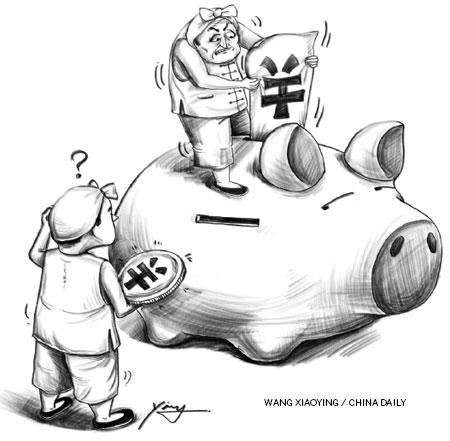
The value of the scheme, however, risks being undermined by the dual purpose for which it has been introduced - both to provide for people currently or soon to reach retirement age and at the same time to provide a savings instrument for younger farmers to help them build their retirement funds. For those who receive a pension, the scheme is a tax-financed social-assistance program and works well enough on that level, although pension levels need to increase. For younger people, however, the scheme is not attractive, which is reflected in the low participation rate of people aged below 30 years.
Given the vast changes that have occurred over the past six decades in Chinese economy and society, it is understandable why young farmers have shown little interest in handing over a significant part of their income. For example, in 2012, an aged farmer surnamed Wang in Taizhou, Zhejiang province, who had joined a pilot rural pension scheme in 1996, was reported to receive just 2 yuan a month as pension. The experience of other farmers such as those in Dengzhou, Henan province, has been similar. Therefore, the government should act to restore young farmers' confidence in the new rural pension scheme.
Local county governments, which administer the scheme, should raise their financial transparency. In most areas, the funds are invested by the county governments in one-year bank deposits - and since the investment funds are small, even the modestly better returns that larger urban or provincial governments earn from large-scale pooling are not available. Most importantly, there are no incentives for those who contribute more than the bare minimum to secure their parents' social pension entitlement. No wonder, younger workers prefer to keep money in their own accounts.
The scheme needs a thorough redesign if it is to attract younger workers. Farmers need to be given incentives to contribute more through matching contributions, possibly in a 2:1 government-to-individual ratio. The individual part of the pension could be made fully portable by having it managed by approved insurance company providers that would be empowered to invest in a wider range of asset classes but under a simplified range of alternative investment (aggressive, modest risk and low risk).
Moreover, the insurance companies should be required to provide these pensions at very modest fixed management fees, and to attract high participation and large amounts if they want to earn sufficient profit. This would also offer enough incentives to the companies and the government to sell the benefits of the scheme to rural workers.
These changes need to be combined with others to give the scheme greater flexibility, such as ensuring that transfers from rural to urban schemes are simple, transparent and generous.
With regard to the current levels of pension, the central government needs to progressively raise and equalize the level of benefits. The current practice of no central funding for counties in the eastern part of the country on the grounds that they are much better off than those in western and central provinces also needs to be re-examined, because there are large income and therefore pension disparities in different counties within the same cities in the coastal region. Also, stricter local auditing could weed out a large number of false claims, allowing genuine claimants to receive significantly more.
The government should not be reluctant to change the basic design to meet the rapidly changing realities. The biggest realities today are the ever-growing rural-urban gap - which has to be narrowed - and recognizing that most of the farmers today will not be farmers after two decades. Improving the scheme will undoubtedly cost more money now, but it will lay the foundation of a more genuine self-sufficient pension scheme for the future.
The author, based in Kuala Lumpur, is an international financial consultant and former fund management expert on the EU-China Social Security Project.
(China Daily 03/12/2013 page10)