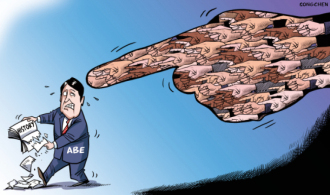
Last week at the Democratic National Convention, held in Charlotte, North Carolina, a woman peddling bumper stickers outside the event's venue shouted to passers-by: "Not Made in China".
I turned back and gave her a questioning look. I asked myself: Should I try to debate her?
At the convention itself, various speakers talked of "stopping the outsourcing of jobs to China". US President Barack Obama, in his speech, proposed giving tax breaks to US companies that bring jobs back to the country.
At a time when the US unemployment rate hovers above 8 percent, "outsourcing" has become even more of a dirty word in the United States than in other industrialized nations.
These days, one gets an extremely strong sense that Americans are desperate to keep all of the jobs they can. What's more, they want to take back jobs lost in the past, not only from China, but also from India and Mexico. Americans are willing to do almost anything - assemble cars, stitch together clothing, even make toys.
In China, meanwhile, increases in production costs are causing certain labor-intensive jobs to leave Shanghai and other big Chinese cities and go to countries where labor costs are lower.
One important thing to keep in mind here is that if the US citizens who want these jobs insist on being paid their country's minimum wage, which amounts to about $7.25 an hour, their employers won't be able to compete successfully in the global market. They'll just go bust, causing more US jobs to be lost.
The technology company Apple Inc could see such a fate befall it. With a market capitalization of more than $600 billion, it has become the largest US business in history. Yet, if it did not have more than 1 million Chinese workers inexpensively producing components for it at Foxconn, Apple's partner in China, Americans would probably have to pay twice or three times as much for the iPhones and iPads they buy. Without the help of those workers, the iPhone 5, which will hit the market on Sept 21, would probably be priced at $499 for the 16 gigabyte version, instead of the planned $199, and $899 for the 64 gigabyte version, instead of $399.
And that's not all. The US firm would also find itself losing market share to its rivals, Nokia and Samsung, a development that would result in even further job losses in the US.
Ironically, Apple Inc, like many big US companies that have turned to outsourcing, has said it has brought many job opportunities to its home country. A report released in March this year shows that Apple products have led to the addition and support of more than half a million jobs in the US, including 47,000 for direct employees of Apple, 257,000 at companies that support Apple devices and another 210,000 in companies that are in the business of making applications for those devices.
While Apple dazzles the business world and its products shine in stores, low-waged Chinese workers' great contributions and sacrifices have often been overlooked or denigrated. And the environmental damage that Apple's supply chain causes in China is not often taken into consideration.
That's why people become angry when they see that a victim is receiving blame, rather than sympathy, from those who are reaping huge profits. To them, it seems as if the biggest beneficiaries are simply ungrateful.
What makes me even angrier is seeing droves of Chinese people "shop 'til they drop" for luxury goods in the US and Europe. A recent report from the financial services company HSBC shows that Chinese customers are the source of a substantial portion of these companies' revenues. Yet the Chinese workers who make some of these luxury goods are still paid minimum wages.
Benoit Cezard, a French amateur photographer, has produced a fun little series of photos named China 2050, which are meant to portray what the future might look like if foreigners found they had to start taking the hard jobs now performed by migrant workers.
When that day comes and China begins outsourcing labor-intensive and polluting industries to the US or Europe, can we blame the outsourcers in the same way some US people do now?
The author, based in New York, is deputy editor of China Daily USA. E-mail: chenweihua@chinadaily.com.cn
(China Daily 09/14/2012 page8)


Copyright 1995 - . All rights reserved. The content (including but not limited to text, photo, multimedia information, etc) published in this site belongs to China Daily Information Co (CDIC). Without written authorization from CDIC, such content shall not be republished or used in any form. Note: Browsers with 1024*768 or higher resolution are suggested for this site.
License for publishing multimedia online 0108263 Registration Number: 130349