Comments()
  Print
Print  Mail
Mail  Large Medium Small

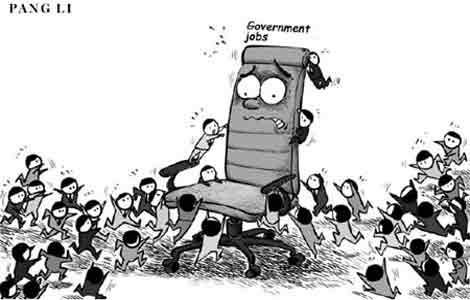
The tragedy of the commons is how Francis Fukuyama describes the infeasibility of Utopia in his new book, The Origins of Political Order. When Garrett Hardin used the phrase as a title for his article in 1968, he actually talked about the dilemma: When everybody owns something, nobody owns it.
We Chinese have a similar saying to describe almost the same thing: A monk fetches water in buckets hanging from a bamboo pole on his shoulder; when he is joined by another monk, he shares the burden with him, but when a third monk joins them, they try to shift the responsibility to each other and as a result, they don't have any water to drink. Simply put, when something is everyone's responsibility, it is nobody's responsibility.
This logic has been used to justify private ownership of property or distinction of property rights or individual responsibility since every human being is assumed to be selfish. But when everyone is busy fulfilling his or her own self-interest, the limited common resources will ultimately be depleted.
This reminds me of how self-interest and common or collective interest were compared in China in the decades before the 1970s. Collective interest was compared to a river and self-interest to a brook. The brook would die a natural death if there was no water in the river. So every individual was supposed to make contributions to the collective interest to fulfill their self-interest.
People were taught to forget their self-interests and instead concentrate on enhancing their awareness of collectivism. The rationale was that once the majority of people became altruistic, they would join hands to increase the common wealth, which would ultimately meet the needs of all individuals to lead a better life.
Rather than confining selfishness of individuals to a reasonable sphere through reasonable rules and competitions, the idealists of the times pinned hopes on turning all individuals into altruists, who would enthusiastically contribute to the building of a society of common good.
But such a society was too good to become reality.
The reform and opening-up China initiated in the late 1970s and what it has achieved in the past 30-odd years seem to justify the tragedy of the commons. But that is definitely not the end of the dilemma.
The ever-widening income gap between the haves and have-nots over the past decades, not just in China but also worldwide, reflects the tragedy of polarization of wealth. Privatization seems to have unraveled the dilemma. But selfishness is part of human nature and people's greed increases with their capacity to amass wealth. The tragedy of polarization of wealth is the downside of capitalism.
The Wall Street turmoil and the global financial crisis have proved the trend of such polarization.
In an article, financial expert Chen Zhiwu attributes the widening income gap to the changed mode of economic development. When it comes to Wall Street, Chen says it is baseless to accuse the financial CEOs of being greedy because the financial services they provide are different from what their predecessors offered. If they are paid less, they will lose the incentive for innovation.
I agree with him, but only partly, that information technology and the development of knowledge-based economy have changed the way we look at development. Innovation is necessary for financial services.
Yet when innovative financial services turn out to be ways that financial companies use to maximize their profits at the cost of their clients or the entire economy, it would be naive to believe they are helping develop the world economy with their innovations.
The tragedy of the commons only points to the necessity and importance of property rights. It does not mean that privatization of the commons will necessarily solve all the problems created by individuals' selfishness.
The question of the greedy 1 percent versus the hard-up 99 percent that the Occupy Wall Street protest has raised is not just a clich. It is a serious issue that calls for serious consideration on the part of scholars and politicians because the world cannot wait until the dissatisfied 99 percent cannot put up with the greedy 1 percent any more.
The author is a senior writer of China Daily. E-mail: zhuyuan@chinadaily.com.cn
(China Daily 08/09/2012 page8)
Copyright 1995 - 2010 . All rights reserved. The content (including but not limited to text, photo, multimedia information, etc) published in this site belongs to China Daily Information Co (CDIC). Without written authorization from CDIC, such content shall not be republished or used in any form. Note: Browsers with 1024*768 or higher resolution are suggested for this site.
License for publishing multimedia online 0108263 Registration Number: 20100000002731