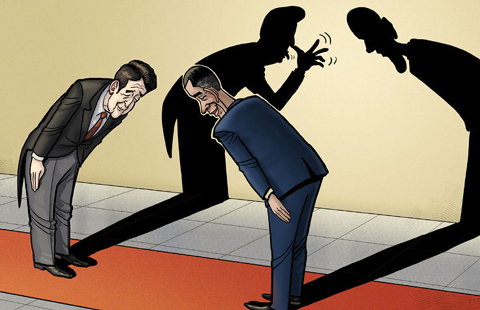
Countries like the United States, the United Kingdom and Japan have criticized China for the rapid rise in its defense budget, which has maintained a double-digit growth rate for almost two decades. But as usual their scaremongering focuses on the size of the figures while ignoring the reasons behind them.
China's military spending is not a threat to neighboring countries. In fact, there are three reasons for the rise in China's military spending:
First, technological progress inevitably leads to periods when there is a rapid growth in a country's military spending. Advances in military technology bring about intensive upgrading of weaponry, which increases the cost of weaponry and directly leads to a rise in military spending. China is currently updating its second and third generation weapons. However, its level of weaponry still lags behind the most advanced international levels by two or three decades.
Second, China has to increase its military input to enhance its national defense strength and safeguard its interests. This too necessitates a rise in military spending. China's national defense task is extremely complicated and arduous compared with other major military states in the world.
Aside from maintaining its border defenses and air defenses, China also has to strengthen its coastal defenses and protect China's maritime rights and interests. Moreover, it has to meet the new challenges of protecting its national interests in space and cyberspace, all of which require increased input and a higher level of professionalism. In addition, increased military expenditures are needed to combat various separatist forces.
Third, China adheres to the principle of peaceful coexistence, friendly communication and collaborative development with other countries in the region. But the US' Asia-Pacific strategy is to "squeeze" China by fueling disputes between China and some of its neighbors. This has made the disputes more complicated and acute, and forced China to increase its military spending to safeguard its interests.
China's military expenditure is based on its own strategic evaluations and decisions. Moreover, it is compatible with its economic growth. It accounts for only a small proportion of its GDP and fiscal expenditure and its per capita military expenditure is comparatively low, which means it has room to grow without adding to the national economic burden.
From 1989 to 2011, China's military expenditure accounted for less than 1.3 percent of China's GDP on average. In 2010, its military expenditure per capita was only $68, well below the $2,327 of the US, $970 of the UK and $336 of Japan.
Fourth, the country's improved social and economic conditions mean that the country is now in a position to release more money for military modernization. In the last two decades of the 20th Century, China's military spending remained almost stagnant, because of the country's efforts to develop the economy and lift the population out of poverty.
During this period China had no money to spare to keep pace with its military upgrading needs as it increased agricultural subsidies to increase crop production and stabilize supply, increased its spending on education and improved the social security level in terms of medical treatment, housing and providing for the aged. Therefore it has to rapidly increase its military spending to meet the modernization needs that were created by the lack of spending during this period.
Unlike the developed military powers, which benefit from the cooperation of defense industries, China has to develop its military equipment through its own research and development. The major military powers have imposed restrictions on exports of advanced military technology to China, which means China can only purchase domestic equipment. Lacking the necessary resources, economies of scale and effective competition, its research and development costs are high.
Meanwhile, its efficiency and performance to price ratio are low. Generally speaking, given the same amount of military expenditure, the higher a country's development level is, the stronger its military efficiency. Compared with developed countries such as the US, the UK and Japan, China's military efficiency is comparatively low.
Hence it is high time for China to improve the efficiency of its military spending, as this will enable it to slow the growth in its military spending and ease the concerns of other countries while still strengthening its military power.
The author is an associate professor at the Economic Security and National Defense Economy Institute, School of Economics, Renmin University of China.
(China Daily 05/16/2012 page9)


Copyright 1995 - . All rights reserved. The content (including but not limited to text, photo, multimedia information, etc) published in this site belongs to China Daily Information Co (CDIC). Without written authorization from CDIC, such content shall not be republished or used in any form. Note: Browsers with 1024*768 or higher resolution are suggested for this site.
License for publishing multimedia online 0108263 Registration Number: 130349