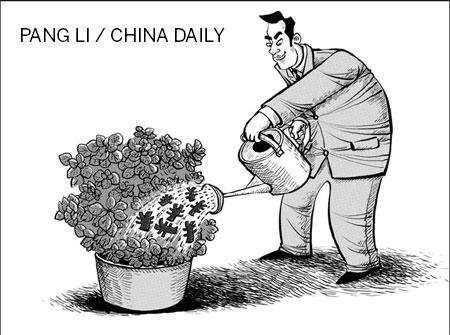
China is moving toward a historical turning point. For three decades, foreign investment has accumulated in the mainland, playing a vital role in rapid growth. Now investment flows are soaring outward from China as well.
Over the past decade, Chinese investment abroad has increased dramatically. In 2010, it amounted to $68 billion. In the next decade, it is projected that more than $1 trillion of foreign direct investment will flow from China into the global economy.
This investment has the potential to spark modern growth in developing and emerging nations. It can also alleviate the adverse impact of the debt crises in advanced economies.
Until recently, most of Chinese investment abroad was focused on developing countries and a slate of resource-rich economies. In the future, much of this investment abroad will move toward developed countries where it will focus on advanced manufacturing, technology and science-based industries.
During the past century, the world has seen several waves of multinationals. The British multinationals were at the peak of their power in 1914, when they controlled half of the world's stock of outward foreign investment. After World War II, US multinationals were positioned to take advantage of the post-war reconstruction, the transfer of new technologies and the leverage of management capabilities. Their power peaked in the late 1960s, when they dominated half of the world's FDI.
Coming from a large and integrated economy, the rise of the US multinationals - from General Electric and Procter & Gamble to Intel - was often driven by internationalization, based on technological and managerial innovations.
After a decade or two of reconstruction, European multinationals resurfaced. Coming from a continent of diverse economies, their expansion was driven by responsive national strategies, from Unilever to Philips and Ericsson.
Also in the mid-1960s, Japanese challengers began to capture increasing market share across industries from cars to consumer electronics. They benefited from falling trade barriers, improved transport links and communications, and increasingly homogeneous markets.
Coming from a unified island-nation, Japanese multinationals - from Matsushita and Toyota to Sony - excelled in global scale efficiencies. The peak of their power occurred in 1990, when they controlled about one-tenth of the stock of foreign investment worldwide.
Starting in the 1980s, globalization has contributed to the rise of large emerging economies. In the next decade, the rise of multinational companies from emerging nations will be spearheaded by China.
Unlike multinationals from Europe, the United States, and Japan, aspiring Chinese multinational companies have to cope with competition that is increasingly global, capital-intensive and innovative. At present, many Chinese multinationals have domestic origins, are not very capital-intensive and are in the process of building up their innovation capabilities.
In a decade, this global landscape will change dramatically. Coming from a massive home base, whose potential exceeds all current market economies, Chinese companies have unique strengths.
China's economic growth has been boosted by foreign multinationals, which, through spillovers and learning, have given rise to Chinese partners, rivals, and innovators.
Today, Chinese challengers represent a broad array of industries, including steel (Anshan Iron and Streel Group, Baosteel), construction (China State Construction Engineering, Sinohydro, Zoomlion), solar energy (Suntech Power, Chint Group, LDK Solar), cars (Geely, Chery, BYD), electrics (Shanghai Electric Group), coal (Yanzhou Coal Mining), IT and telecommunications (Huawei, ZTE, Lenovo), consumer electronics (Haier), shipping and ship building (China Shipping, China Shipbuilding Industry) and many other industries.
These pioneering Chinese multinationals often benefit from cost advantages that are beyond the reach of their rivals. Being familiar with severe pricing pressures in their home base, Chinese companies are well positioned to thrive in merciless cost environments.
More than 30 years ago, Japanese investment in the US also began in an era characterized by friction over trade and currency. Nonetheless, as a percentage of total stock, Japanese investment in the US more than tripled from 6 percent in 1980 to 21 percent in 1990.
But despite some similarities with Japanese experiences, the story of Chinese capital abroad, especially in the US, will also be different. Over time, Chinese multinationals will also play a more important role in foreign investment worldwide than the Japanese two decades ago.
When Japanese firms arrived in the US, they represented a relatively focused array of industries, especially in consumer electronics. Chinese firms operate in a wide array of industries, from low-tech to high-tech.
Japan also remains a vital ally to US in Asia, whereas China's strategic interests are more independent. Consequently, Chinese firms will be under greater scrutiny in the US, especially at the federal level. However, increasing economic problems at the local level are likely to ease Chinese entry into the US marketplace.
Like the postwar European companies and the Japanese firms in the 1980s, Chinese firms, too, will need to integrate fully into US communities to defuse political opposition in Washington.
But in overcoming barriers and investing capital abroad Chinese companies will create jobs, which will enable them to overcome obsolete prejudices and win the hearts and minds of people overseas.
In turn, Chinese companies have the potential to bring more advanced technology, talent and capital to the mainland, which will drive its future development and improve the lives of its people.
The author is research director of international business at the India, China and America Institute, an independent think tank in the US and visiting fellow at Shanghai Institutes for International Studies (China).
(China Daily 03/14/2012 page10)
 New type of urbanization is in the details

Copyright 1995 - . All rights reserved. The content (including but not limited to text, photo, multimedia information, etc) published in this site belongs to China Daily Information Co (CDIC). Without written authorization from CDIC, such content shall not be republished or used in any form. Note: Browsers with 1024*768 or higher resolution are suggested for this site.
License for publishing multimedia online 0108263 Registration Number: 130349