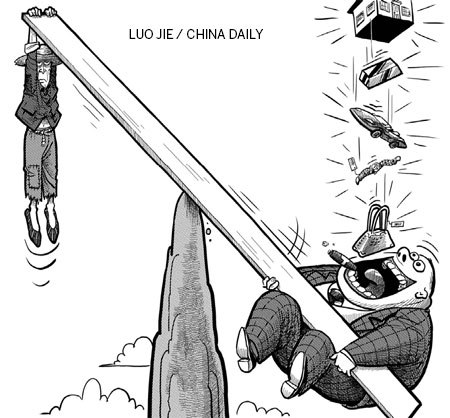
Rich Chinese spent $7.2 billion abroad on luxury goods during the weeklong Spring Festival holiday, becoming the most powerful purchasing group in the process. Contrast this with migrant workers struggling to travel home for that all-important annual family reunion and then return to cities, with many even riding pillion on motorcycles to save money.
Over the last few years, it has become a trend among the rich to travel abroad during the Lunar New Year, which is not surprising given the rising affluence in China.
In high-income Western countries, conspicuous consumption reflecting financial success starts with a nice home and furnishings and then moves on to a desirable automobile. The third consumable is a "status vacation". If one cannot get a "winter tan" on a sun-baked beach in a tropical country, there is always a ski resort as an exhilarating alternative. A cruise vacation is another dream many Westerners aspire to realize.
But given the economic crisis gripping the developed world, many Westerners are tightening their belts. In contrast, an increasing number of Chinese are adopting this foreign travel habit as a welcome escape from the pressures of traveling in China during Spring Festival. And quite a large number of those taking foreign trips really loosen their purse strings.
Many Chinese attribute the frenzy to buy luxury goods abroad to the high tax in the domestic market. Irrespective of what the reason is, there is a side-effect to it: Though China with its per capita income of $4,500 is still a middle-income developing country, Chinese people's spending spree abroad could distort the image of the country's wealth in the eyes of foreigners.
While Westerners are astonished by rich Chinese consumers' appetite for luxury goods, people in rural China on average earn less than 7,000 yuan ($1,100) a year. Besides, more than 120 million Chinese people still live in poverty, making only about 6 yuan a day.
Just a few days ago, media reports said Pan Qihou, a farmer in his 60s in Xianfeng county of Hubei province, committed suicide after being ill for three year because he wanted to save money for his two grandchildren's tuition. Such tragedies are reminders of the widening wealth gap in China, and show the mental poverty of Chinese nouveaux riches who splurge on luxury goods abroad.
Of course, China is not the only country where the wealth gap is widening. Many Western countries face a difficult 2012, and economic inequality and austerity measures threaten to make life more difficult for low-income people.
Everyone has to be in the same boat. Excesses are no longer politically acceptable, including 1 million bonuses for British bankers, which they were forced to give up this month. US President Barack Obama has made economic inequality in the country his campaign platform for the presidential election. He has described battling income equality and maintaining the American dream as "the defining issue of our time".
In South Korea, President Lee Myung-bak is being criticized for his grandchildren's expensive outfits. The white winter jacket Lee's granddaughter wore is thought to be a Moncler, which could cost as much as $1,700.
Even though economic inequality exists everywhere, it's not wise for Chinese society to be blind to the mad pursuit of luxury goods, for it will help consumerism boom and lead to over-consumption, which has dragged Western countries into a debt crisis.
Urban residents in China have now outnumbered their rural counterparts, but the average annual urban-rural personal income gap is as big as 17,000 yuan. Looking ahead, the pace of shift from a rural to urban China should be slowed down and the inequality between rural and urban incomes reduced. In a difficult year for the global economy, if China really wants to boost consumption, it should take measures to improve incomes of lower earners and invest more in rural areas to narrow the income gap and bridge the urban-rural divide.
The author is director of China programs at CAPA International education, an UK-US based organization that cooperates with Capital Normal University and Shanghai International Studies University.
(China Daily 02/09/2012 page9)
 New type of urbanization is in the details

Copyright 1995 - . All rights reserved. The content (including but not limited to text, photo, multimedia information, etc) published in this site belongs to China Daily Information Co (CDIC). Without written authorization from CDIC, such content shall not be republished or used in any form. Note: Browsers with 1024*768 or higher resolution are suggested for this site.
License for publishing multimedia online 0108263 Registration Number: 130349