|
Wang Xiaoying / China Daily |
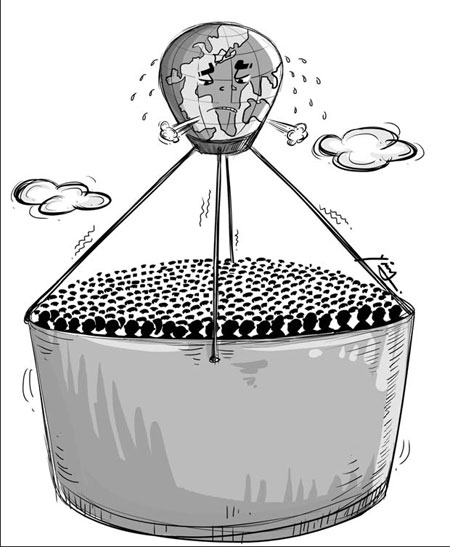
At some point this month, a child will be born and the world's population will reach 7 billion. There is a good chance this child will be born in the Asia-Pacific region, home to 61 percent of the world's population.
If the child is born in Asia Pacific, it will most likely be a boy, for last year, among the children below the age of 5, there were 110 boys for every 100 girls in the region. This is much higher than the natural sex ratio, and higher than in any other region in the world.
This shift away from the natural sex ratio indicates that prevailing family structures, cultures, policy incentives and the available technologies combine to make parents in some countries opt for boys. The trend is alarming, and reflects existing social practices of gender discrimination, neglect and under-valuing of girls.
The newly released Statistical Yearbook for Asia and the Pacific tells the story of the region quite succinctly.
The 7 billionth child has a better chance of living past the age of 5 than children born a decade ago. It is also likely to enjoy a much longer life than his or her parents and grandparents, for the life expectancy both for women and men has increased in every country in Asia Pacific during the past decade.
The 7 billionth child is also likely to have fewer siblings than his or her parents: Declining fertility rates in the Asia-Pacific region during the past decades made the regional fertility rate equal to the "replacement level", - 2.1 children per woman. According to the recorded history of the region, the rate has never been this low.
The falling fertility rate combined with increased life expectancy point to another demographic trend that has implications reaching far into the future, namely an aging population. The proportion of the elderly is increasing in all sub-regions of Asia Pacific - today, almost 300 million people in the region are 65 years or older.
Policymakers have to note another trend, too. In the wake of a devastating financial crisis, the Asia Pacific statistical yearbook confirms a remarkably positive message: The Asia-Pacific region and Africa were the only regions in the world to experience positive GDP growth in 2009. Also, Asia Pacific was the only region in the world to return to pre-financial crisis levels of trade in 2010. All the while, the unemployment level in the region was relatively low at about 5 percent on average.
We have the possibility to fully open the door to the "Asia-Pacific Century". Economic growth, however, is not bringing equal benefits to all. Least developed countries were hit especially hard by a massive decline in overseas development assistance (ODA). In one year alone, from 2008 to 2009, the drop in the ODA level was 70 percent.
People in low-income countries fall victims to severe natural disasters, too. More than 30 in every 1,000 people living in Asia Pacific countries were affected by a disaster every year during the last decade. In contrast, only 1 in every 1,000 people living in high-income economies was affected by a natural disaster. More than 26 million children in the Asia-Pacific region did not attend primary school in 2008. And women still make up 65 percent of the illiterate population in the region - a figure that has barely improved during the past 20 years.
We need to work harder to ensure that all people in the region are given the best possible opportunities for a productive and healthy life.
The rapid economic expansion and large population have also had environmental impacts on the region. From 2000 to 2010, the proportion of primary forests in the region declined by more than 10 percent. In 2008, Asian Pacific countries accounted for almost half the world's carbon dioxide emissions, when that figure was only 38 percent in 1990.
There is room and need for the region's leaders to push for a more environment friendly growth model, such as the green growth model promoted by the United Nations Economic and Social Commission for Asia and the Pacific (ESCAP).
The Statistical Yearbook for Asia and the Pacific 2011 gives the picture of a region that is developing economically at impressive speed even in the midst of a financial crisis that has crippled the more developed economies. The yearbook figures tell the story of a region that provides different and unequal opportunities to its girls and boys; where some countries and areas lag behind in socio-economic development; where a number of the UN Millennium Development Goals are far from being achieved; and where the environmental toll of the rapid economic development is cause for concern.
It is the job of experts, opinion leaders and decision-makers to look carefully at the facts and ensure that the debate leading toward policies is fully informed by them. It is also our job to ensure that the statistical systems of the region are supported to meet the enormous demand for more evidence to guide policy dialogue and steer the region toward inclusive, sustainable and resilient societies through well-designed policies.
Let us work together to ensure that the 7 billionth child and the children of all the children today enjoy the rights and opportunities they deserve.
The author is under-secretary-general of the United Nations and executive secretary of ESCAP.
(China Daily 10/19/2011 page9)
 New type of urbanization is in the details

Copyright 1995 - . All rights reserved. The content (including but not limited to text, photo, multimedia information, etc) published in this site belongs to China Daily Information Co (CDIC). Without written authorization from CDIC, such content shall not be republished or used in any form. Note: Browsers with 1024*768 or higher resolution are suggested for this site.
License for publishing multimedia online 0108263 Registration Number: 130349