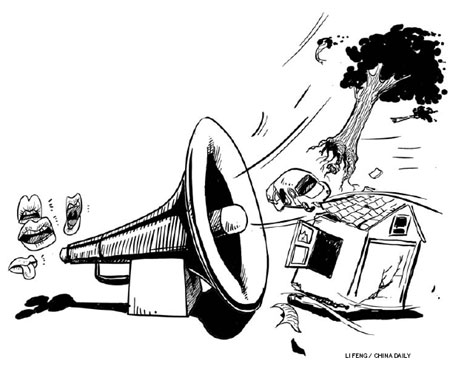
It's one thing to trumpet color revolutions far from home, quite another to confront violence at your own front door. It's one thing to trumpet the revolutionary potential of social networking devices at posh conventions and in advertorials, quite another to bear the brunt of rumors and hate mongering spread anonymously at the speed of light.
When London and other English cities were shaken by street riots between Aug 6 and 10, British Prime Minister David Cameron and officials in high places were quick to point the finger at Blackberry and considered closing it down. This begs the question: Was Britain hit by a Blackberry revolution?
Low social mobility combined with high degree of social networking is a recipe for a revolution of rising expectations, as can be seen in Britain where the rich-poor gap is wide and social networks are all the rage.
The normally feisty and combative British press got a taste of its own medicine, going from gleeful cheerleader of Internet-enhanced unrest on foreign shores to drop-jawed skeptics as BBC television crews on British soil had to scurry away to safety and tabloid photographers were under attack.
Free speech is not absolute, not anywhere. It is not a protected right to yell "fire" in a movie theatre just for the fun of it, and hate speech, though sometimes difficult to define, is generally taboo even in countries with a high degree of free expression. Clearly, some societies are more comfortable with freewheeling expression than others, but every society has its sacred cows and shibboleths. Everywhere in the world there are historical events too hot to handle. Ironically, even in some of the freer countries, disputing the received wisdom of a well-documented historical narrative can result in a jail sentence.
Texting and micro-blogging are the latest message delivery systems in a long, distinguished tradition that emerged from the prehistoric forest mists with drumbeats and smoke signals. Along the way man has found myriad ways to sign, seal and deliver long-distance messages, everything from the impatiently speedy, such as the pony express or Federal Express, to the impossibly slow, such as note in a bottle or the US postal service.
With the advent of electricity, messages could be transmitted almost instantaneously. There's the telegraph, telephone and the television, of course, followed by fax machines, and keyboards connected to the Internet, Apples and Blackberries.
Many of the new mobile technologies are brilliant, inspired even beautiful, but they are only tools which can be used for ill or good depending on the innately fallible human hands they fall in to. While science has progressed in leaps and bounds, human behavior has evolved much less slowly, which is why the insights of Shakespeare into notions of hubris, power and injustice can be read with such relevance today.
Information exchange begins and ends with people. Social networks speed it up and spread it out, connecting sparks to make a prairie fire. It's no accident that the technology is billed as "revolutionary", for it is at once innovative and insolent, impersonal and insurrectionary.
Boosters for the big companies behind social networks tend to accentuate the positive while playing down the downside. What better publicity than to spread the word that US President Barack Obama was so addicted to his Blackberry that he refused to give it up despite warnings from his security people? Less trumpeted is the discovery that drug dealers have also found the device efficacious and compelling, and it is jokingly called the "crackberry".
Indeed, a notable portion of the looting that took place in the shadow of the English street turmoil targeted stores selling trendy communication devices.
Britain is already one of the most heavily monitored countries in the world, with more surveillance cameras per person than anywhere else. BBC, perhaps the world's leading critic of autocrats, is infamous for banning speech of Irish nationalists and cooperates closely with the government. It is at once free and unfree.
Fleet Street, despite its freewheeling ways (including telephone intercepts) has shown a degree of stiff upper-lip restraint in its coverage of the riots for fear of inflaming already-simmering ethnic tensions.
Yet when China or other nations try to play down news of ethnic strife, sometimes for the eminently reasonable purpose of halting the violence, such as in the race riots in Lhasa in 2008, BBC and other Western media can be depended on to cry "censorship"!
Now UK politicians are calling for more aggressive policing and more vigorous Internet monitoring as part of a campaign of zero tolerance for unrest. Expect more arrests based on text messages and signal intercepts (Blackberry, now cooperating with police, has been hacked in protest) and intelligence collecting of the sort that is routinely carried out by MI5 and the Britain's Government Communications Headquarters.
Texts and tweets can give life to lies with the same efficacy as they can speak truth to power; technology is neutral and knows not what it says, but it leaves a hard to erase electronic trail.
Already the likes of Google and Facebook data-mine intensely private communications and preferences to rake in billions of dollars in advertisement profits, driving home the point that nearly everything said and glanced at online leaves incriminating clues. The same technology that invites revolution and possibly even incites revolution also invites unparalleled opportunities for surveillance in the service of counter-revolution.
The author is a visiting fellow in the East Asia Program, Cornell University, New York.
(China Daily 08/23/2011 page9)
 New type of urbanization is in the details

Copyright 1995 - . All rights reserved. The content (including but not limited to text, photo, multimedia information, etc) published in this site belongs to China Daily Information Co (CDIC). Without written authorization from CDIC, such content shall not be republished or used in any form. Note: Browsers with 1024*768 or higher resolution are suggested for this site.
License for publishing multimedia online 0108263 Registration Number: 130349