The Chinese Academy of Social Sciences issued a report last year, which said China's pension system was short by about 1.3 trillion yuan. In 2005, the World Bank said that the total pension gap between 2001 and 2075 would be 9.15 trillion yuan - without any depreciation in currency.
To cover this gap, Du suggests that the government make serious efforts such as raising more funds from State-owned enterprises, increasing the pension insurance premium, and adding more value to social security funds.
Apart from the establishment of proper pension and medical insurance systems, long-term nursing service will also be crucial for elderly people's quality of life. According to the census data, China's average family size has decreased to 3.1 people, which means families today are becoming increasingly incapable of taking care of the elderly. Therefore, there is a great need for long-term social nursing service. The country already has about 16 million aged people who cannot take care of themselves - and their number is estimated to grow to 56 million by 2050.
Also, the country's migrating population is about 220 million. Since most of these migrant workers are young, their prolonged stay in cities may cause and/or intensify the unbalanced pace of aging population growth in rural areas and cities.
In fact, this problem first came to light in 1982. That year's census showed that the rural population was aging faster because of the outflow of young people from rural to urban areas. This gap between urban and rural areas in the pace of the aging population growth still exists.
Du says the gap would have a dual influence. On one hand, the flow of rural laborers into cities will help relieve the urgent need for labor and old-age nursing services in urban areas, and therefore slow the pace of aging population growth and promote socio-economic development. In Beijing, for example, the proportion of senior citizens would have been several percentage points higher than the current 12.5 percent without the 7.04 million migrants.
On the other hand, the rapid proportional rise of senior citizens in rural areas means the problem of aging population is more serious in the countryside. This shows that the need to improve the social security system and nursing resources for elders is more urgent in rural than urban areas.
Since the impact of the aging population will last long, the government should pay more attention to drafting and implementing long-term policies and regulations. Such efforts should include amendment of laws to better protect senior citizens rights and interests, and legislation covering elders' welfare, healthcare and medical insurance.
The social security system, however, should cover urban and rural areas both as soon as possible and focus on old-age and medical insurance. The Social Insurance Law, which takes effect in July, is a product of such efforts. But Du says the establishment of such a social security system would only be the start, not the end, of the government's efforts.
Besides legislation, Du believes there are many other factors that can help establish such a system. Taxation is one of them. That's why he suggests tax preference measures be put into practice. Such measures include exempting old-age homes from paying business tax for the service they render, abolishing property and land taxes on such homes, and encouraging individuals and organizations to donate for senior citizens' welfare by making such donations tax free.
The protection offered to old-age pension and medical insurance in the countryside is still very low compared with urban areas. The average national old-age security pension is about 1,350 yuan a year. But most elders in rural areas get as small an amount as 200-400 yuan a year.
Moreover, the amount that retired employees of enterprises and superannuated government staff members get as pension is quite different - the latter get much larger amounts, Du says. This is something that the government has to attend to and rectify sooner rather than later. 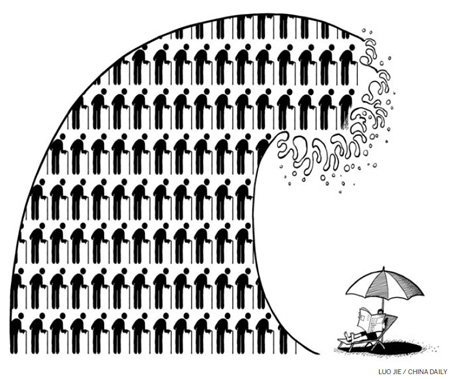
 New type of urbanization is in the details

Copyright 1995 - . All rights reserved. The content (including but not limited to text, photo, multimedia information, etc) published in this site belongs to China Daily Information Co (CDIC). Without written authorization from CDIC, such content shall not be republished or used in any form. Note: Browsers with 1024*768 or higher resolution are suggested for this site.
License for publishing multimedia online 0108263 Registration Number: 130349