OPINION> OP-ED CONTRIBUTORS

|
OPINION> OP-ED CONTRIBUTORS
|
|
Govt stimulus is like planting grass on a desert plot
By Ma Chao (China Daily)
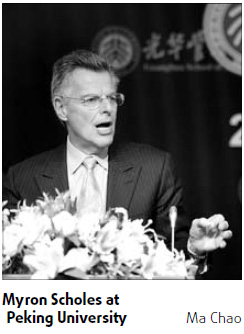
Updated: 2009-10-28 08:04 In times of the global economic crisis when free market has received a battering and the competence of economists has been challenged, an Economics Nobel laureate has jumped to the defense of both. Myron Scholes, professor of finance at US' Stanford University and 1997 Economics Nobel winner, delivered a speech at Peking University's Guanghua School of Management on Oct 7, enumerating the causes behind the global financial crisis and how the market can facilitate a true recovery. Addressing a packed auditorium, he said "green shoots" has become a trendy phrase this year, and people are talking about signs of economic recovery. But government-funded economic recovery is like planting a plot with grass in a desert and watering it. Surely, the grass will grow, but what about the rest of the desert?
Since the advent of the global financial crisis, many have criticized the unfettered financial market and called for more government regulations. Opposing the trend, Scholes emphasized the value of the market and warned against the flaws of state intervention. Though he did not oppose government regulations in general, and acknowledged the merits of reasonable ones, he cautioned that it might be risky to enact stricter regulations under political pressure, without sufficient discussion and understanding. It's true that many financial innovations turned out to be failures and swept away huge amounts of wealth. It is not wise, however, to throw all the innovations out of the window, he said, and urged that the world be wary of a trade-off between government regulations and the innovation drive. We should ensure that the benefits of regulations offset the costs of stifling innovation and creativity. "We should not go from one extreme to another." Defending the free market, Scholes contended that governments should not reduce the natural volatility of the market because that might elicit "the wrong responses in the markets and consequently a huge non-linear feedback". Volatility is necessary to scare people, he said, using a metaphor to illustrate his point. In the US, firefighters usually succeed in putting out small fires in forests. But when smaller fires are doused, the grass grows wildly. And then when lightning strikes, it causes much bigger fires that bring even bigger losses. We have seen the great losses of conflagration. The financial crisis occurred when the market was hit by panic selling of assets to pay off debts, which Scholes calls a "cascade of de-leveraging". When everyone sought to sell their assets, prices inevitably plummeted, worsening the balance sheets of corporations and forcing them to sell even more assets. The vicious downward spiral pushed the financial sector and even the entire economy to the edge of collapse. Scholes used another metaphor to illustrate the aggregated effect of de-leveraging. When a family wants to sell its house in a town during good times, it can seal a deal in three to four weeks. But if everyone in an area wants to sell his house at the same time, one may need a year or even longer to actually do that. Hence, the aggregate of everyone's action makes an individual's choice, which looks rational during good times, absurd on rainy days. The aggregation of human actions poses a real challenge to economists. Scholes concedes that there is a problem with macro-economics when it comes to aggregation of individuals' desires in a very "diffused and complicated" world. It is very hard to aggregate all the actions and forecast something. To avoid being trapped in a vast jungle of data, macro-economists have to rely on their own sets of information and views, which may be wrong. The global financial crisis, however, has made the economics profession more important, he said. People need the brains of economists to provide answers and solve problems. Now corporations have to change the way they had been looking at things, and that has opened new vistas of research, though they are still at an embryonic stage. "Shocks create changes", he said. Chinese have a special interest in the country's exchange rate policy. And when the audience asked Scholes how he saw the call for China to revaluate its currency, he took a jibe at the term "rebalancing", which Western politicians use to persuade Beijing to raise the value of the yuan. "Rebalancing" sounds as if everyone would benefit from the revaluation of the yuan, but reality may be different. Revaluation of the yuan is a double-edge sword for China. A stronger yuan would make the Chinese relatively richer in terms of international prices because imports would become cheaper. But since China's economy is still largely export-based it is likely to suffer a huge loss and lose its competitive edge in the international market. The flip side of the coin is that China maintains the value of the yuan to encourage exports and it has to accumulate even more foreign exchange reserves to prevent domestic inflation. Scholes advised China to evaluate the positive and negative effects of a currency revaluation scientifically, rather than giving undue consideration to only "harmonization of the world" and footing the bill for the global financial crisis. (China Daily 10/28/2009 page9) |