In a conference room at a
Holiday Inn last week in Connecticut, 167 young women from 22 countries received
a tutorial in catering to the needs of the affluent American child. (Lesson 1:
Turn off the television set.)
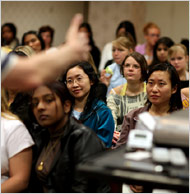
Kunyi Li, wearing glasses, and Man Zhang, next
to her, at a tutorial last week in a motel in Connecticut for au pairs
from 22 countries. [The New York Times] |
Many of
the women were German. But two drew particular attention, Kunyi Li, 23, and Man
Zhang, 24, among the first au pairs from China.
Their services are in great demand, in part because so many Americans have
adopted baby girls from China. Driving the need more aggressively is the desire
among ambitious parents to ensure their children¡¯s worldliness, as such parents
assume that China¡¯s expanding influence will make Mandarin the sophisticates¡¯
language decades hence.
¡°Our clientele is middle and upper middle class,¡± said William L. Gertz,
chairman of the American Institute for Foreign Study, which oversees Au Pair in
America. ¡°They see something really happening, and they don¡¯t want to be left
behind.¡±
The last two years have seen an astonishing increase in the number of
American parents wishing to employ Mandarin-speaking nannies, difficult to find
here and even harder to obtain from China.
Au Pair in America, the 20-year-old agency that sponsored the two young women
in Connecticut, had received no requests for Chinese au pairs until 2004, said
Ruth Ferry, the program director.
Since then, it has had 1,400.
The agency said it expected to bring 200 more au pairs to this country before
the end of 2007, and other companies in the business are beginning to recruit in
China, all taking advantage of relaxed standards for cultural-exchange visas for
Chinese.
Hongbin Yu, 23, of Harbin, north of Beijing, who like many other Chinese
college students studying English gave herself an Anglophone name, Cecilia, was
the first Chinese au pair to land in the United States.
She arrived in March through Go Au Pair, one of the 11 such agencies
sanctioned by the Office of Exchange Coordination and Designation at the State
Department.
Her employer is Joan Friend, a former president of a technology company in
northern California who had been having her two children, Jim, 5, and Paris, 6,
tutored in Mandarin for several years.
¡°The tutors just played with them,¡± Ms. Friend said from her house in Carmel
Valley, Calif. ¡°They thought I was crazy because the children were so young.¡±
After her son and daughter began to learn the sounds of Mandarin, Ms. Friend
sought more intensive training and repeatedly asked Go Au Pair for a Mandarin
speaker to live with the family. But visa problems and a lack of contacts in
China left the agency unable to place anyone with her.
Ultimately, Ms. Friend found Ms. Yu on her own, through an acquaintance in
China, and Go Au Pair handled the paperwork.
¡°I¡¯ve never been to China,¡± said Ms. Friend, a single mother who is retired.
She added that she considered China central to the future of global
economics, saying, ¡°I think China will rule the banking world in my children¡¯s
lifetime, and I want them to be able to participate in that if they want to.¡±
Like Ms. Friend, Jean Lucas, who lives outside Tampa, Fla., had been
frustrated in finding a Chinese au pair for her four children. She is now
obtaining one through Au Pair in America who will arrive in a few weeks.
Ms. Lucas said her husband, Sky, a manager of a hedge fund, initiated the
search because he did not want to raise culturally narcissistic, monolingual
children.
¡°My husband had been following China for some time,¡¯¡¯ Ms. Lucas said, ¡°and he
simply believes that it would be better for international relations if we all
put some time and effort into learning Chinese. I¡¯m not expecting this girl to
come in and lecture. My children wouldn¡¯t put up with that. But I want them to
have an introduction, and I want it to be fun.¡±
Since she has been with the Friends, Ms. Yu, who studied English and tourism
in college in China, has been reading to the children in Mandarin and teaching
them to count. In turn, Ms. Friend, in addition to paying her expenses and a
monthly stipend, has taken her on trips to Arizona, San Francisco and farther
down the coast to Newport Beach.
Begun in 1986, the State Department Au Pair program requires that young
nannies work no more than 45 hours a week and return to their home countries
after one year. Host families have to provide their charges with a window into
the American experience. It is only in the last few years that au pairs have
been actively recruited outside Western Europe.
Among Chinese-Americans, it is difficult to come upon young women interested
in child-care careers, nanny agency representatives say.
¡°This is not a field they evolve into,¡± Amy Hardison, founder of Nanny on the
Net, said. ¡°We just have a very hard time finding Chinese nannies.¡±
In China¡¯s new culturally progressive climate, biases against such domestic
work prevail. Ms. Zhang, one of the au pairs who arrived last week and moved in
with a family in New Hampshire, said her parents had initially disapproved of
her decision, especially because she was then working in customer service for
Continental Airlines in Beijing.
¡°There are prejudices about being a baby sitter,¡± she remarked. ¡°They said:
¡®You have a great job coming out of college. Why would you want to go to America
to take care of children?¡¯ ¡±
It is Ms. Zhang¡¯s hope to open a nursery school in China. And she would like
to immerse herself more deeply in American culture, she said, beyond the
knowledge she has acquired of it from watching ¡°Friends.¡±
As for American cooking, she foresees it as a challenge.
¡°I don¡¯t hate it but I don¡¯t like it,¡± she offered. ¡°I had pizza yesterday.
It¡¯s better at home.¡±

