http://www.nytimes.com/2006/06/20/science/20hawk.html?pagewanted=1&ei=5094&en=6df9ff632bdeba92&hp&ex=1150776000&partner=homepage
BEIJING,
June 19 ¡ª Like an otherworldly emperor, Stephen Hawking rolled his wheelchair
onto the stage of the Great Hall of the People on Monday, bringing with him the
royalty of science and making China, for this week at least, the center of the
cosmos.
Slouching in profile, draped in black and moving no more than an eyelid to
send his words to a mesmerized audience of 6,000, Dr. Hawking ruminated on the
origin of the universe as the headliner of an international physics conference.
"We are close to answering an age-old question," he concluded. "Why are we
here? Where did we come from?"
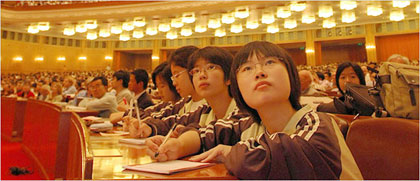
Participants listen
attentively to Stephen Hawking in the Great Hall of the People in Beijing
June 19, 2006. [NYtimes] |
But as weighty as
his speech was, his mere presence was a powerful symbol of what China is and
would like to be.
China wants to stand up scientifically, as it is beginning to economically,
and it is pouring money and talent into the sciences, particularly physics. Jie
Zhang, director general of basic sciences for the Chinese academy, said his
budget had been increasing 17 percent a year for the last few years as China
tried to ramp up research spending to about 2.5 percent of its gross domestic
product. By comparison, the United States spends slightly less than 2 percent,
according to the National Science Foundation.
Among the big-budget items on the table, Dr. Zhang said, are a giant
500-meter-diameter radio telescope in China's outback to study microwaves from
the Big Bang and a multinational particle-physics project, known as the Daya Bay
Reactor Neutrino Experiment to study the ghostly elementary particles known as
neutrinos.
To keep track of all this activity, the United States National Science
Foundation opened an office in Beijing last month. The foundation noted that
China had gone from fourth in the world to third in research and development
expenditures from 2000 to 2006.
While some scientists express doubts that China is open enough to foster
top-tier science, others are enthusiastic.
"China is changing at a rate that is truly amazing," said David J. Gross, the
director of the Kavli Institute for Theoretical Physics in Santa Barbara,
Calif., and a recent Nobel Prize winner, who has been visiting to help
reorganize the Beijing theoretical institute into a model that can be used for
future research institutes.
Dr. Hawking's talk was part of the very public kickoff of Strings 2006, which
has drawn 800 of the world's brightest and most ambitious physicists here for a
week to take stock of string theory, their vaunted "theory of everything" that
says the elementary constituents of nature are submicroscopic vibrating strings.
Imagine, several string theorists in the audience mused, if a physics
conference in the United States started in the House of Representatives.
As he opened the conference, Chun-Li Bai, the executive vice president of the
Chinese Academy of Sciences, stressed that basic scientific research had a "high
visibility" in the most recent of China's five-year plans. "The next 50 years
will be of beauty for the development of Chinese science and technology, as well
as economic development," he said.
Calling string theory the cutting edge of curiosity, Shing-Tung Yau, a
Harvard mathematics professor and the meeting's chief organizer, said he hoped
to make China more involved in the field. "I want to put on a good show," he
said.
Dr. Hawking, 64, is always a good show, and his arrival set off a stellar
burst of camera flashes worthy of any rock star. A cosmologist at the University
of Cambridge, he has been in a wheelchair for most of his life because of
amytrophic lateral sclerosis, or Lou Gehrig's disease. But he has nevertheless
become one of the leading gravitational theorists, an avatar of mysteries of
black holes and the origin of spacetime, as well as a best-selling author, a
father of three, an indefatigable world traveler and a guest star on "The
Simpsons" and "Star Trek: The Next Generation."
He speaks with the aid of a computer-driven voice synthesizer. He used to
operate it with his thumb but is now so weak that he has to use an infrared
device that tracks his eye movements. So the camera flashes were potentially
catastrophic, and Dr. Yau ordered the photographers away.
Dr. Hawking's star turn, across the street from the large portrait of Mao
Zedong, also had historic resonance. In the Cultural Revolution, Mao denounced
Einstein and his work as reactionary and bourgeois. Groups of scientists and
scholars were set up to criticize relativity because it appeared to collide with
Marxist dogma that the universe was infinite and endless, eternally embroiled in
a sort of cosmic class struggle.
History has buried those aspects of Marxist thought. Chinese leaders now are
technocrats, not "cosmocrats," as Yinghong Cheng, a historian at Delaware State
University who has studied the cultural revolution, put it. Prime Minister Wen
Jiabao wished good health to Dr. Hawking.
Hardly a week goes by without an announcement of another research initiative
or new investment in a building or an institute. It is hard to find an American
physicist who is not on his way to China to consult or collaborate, or has just
come from China, glowing about the experience.
"The Chinese are so smart they knock your socks off," said Andrew Strominger,
a Harvard string theorist who visits here often. "The impression you get when
you go over there is that China is going to take over the world
soon."
This week, Fred Kavli, the inventor and philanthropist whose
foundation has endowed 10 research institutes in the West, announced that he
would endow two new Kavli institutes in Beijing ¡ª at the Institute for
Theoretical Physics at the Chinese Academy of Sciences and at Beijing
University's Institute for Astronomy and Astrophysics ¡ª for several million
dollars each. Both will be linked in a network with the others. Every summer,
hundreds of Chinese-American scientists, so-called overseas Chinese, leave their
posts in the United States and elsewhere to return to help out, lured by
lucrative salaries, prestige and the chance to "help China."
Marvin I. Cohen, a professor at the University of California, Berkeley, who
is president of the American Physical Society, said physics had come in for
special attention in this effort, for its centrality to science and what he
calls its rigorous approach.
Dr. Cohen was impressed by an up-to-date physics building that he saw in
Beijing. "Someone writes a $10 million check, and they build the building in
Beijing that we wanted in Berkeley," he said.
Putting up buildings is easy compared with filling them with the right
people. Despite all the hype, most researchers say, their best students are so
far staying in the United States. The system, everyone seems to agree, is rife
with politics, and the sudden influx of money has created opportunities for
corruption and fraud.
Last month, a star chip designer, Jin Chen, was fired by Shanghai Jiaotong
University after a Web site run by a biochemist in San Diego, Shi-min Fang,
disclosed that his design for a ballyhooed new signal-processing chip had been
stolen.
That and similar incidents led 120 biologists to sign a letter written by a
researcher at Indiana University, Xin-Yuan Fu, calling for a government office
to investigate science misconduct. The Education Ministry has since set up a
special commission to study misconduct. Dr. Yau said he was pleased to see China
take the problem seriously, adding that there were many more incidents of fraud.
"They want to catch up too fast," Dr. Yau said. "They want to
leapfrog."

