 Admiring tea sets adds to the joy of savoring tea. File photo
 |
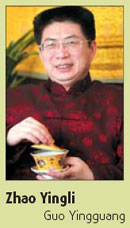
Beijinger Zhao Yingli's daily routine starts with tea and ends with tea. Whenever his friends call him, he is most likely to be in a teahouse. He does not own one but is greeted with genuine welcome and warmth at many of Beijing's finest. And he doesn't need to pay for his stay.
Officially, 51-year-old Zhao is a "professor of the tea ceremony" at a Beijing vocational school. He also acts as cultural advisor for several major teahouses in the capital and is a licensed trainer of tea ceremony performers. You would be hard pressed not to fall in love with tea after drinking with him. Most people return for more, and bring their friends with them.
Zhao's charm lies in the small paper bag he always carries with him. Inside, there are always at least 10 small sachets of good tea, which he is ready to share. Many teahouse owners rely on Zhao to distinguish the teas they should stock and many of the waitresses are his students. For them, it is an ideal opportunity to perform the tea ceremony with Zhao's good teas and get his personal tuition at the same time.
Zhao majored in Chinese literature in university but his interest in tea led him into the field more than 10 years ago. "My teachers are tea sellers and tea farmers," he says. He served as a shop assistant at "tea cities" - shopping areas specializing in tea - and visited China's major tea-producing regions to meet and talk with tea farmers.
It has become routine for Zhao to take his wife and some of his students to spend three weeks visiting tea-producing regions in eastern and southern China in late March and early April, when the first batch of spring green tea is ready to come onto the market.
China has 19 provinces in four major tea-producing regions: north and south of Yangtze River, Southwest and South China. There are thousands of varieties of tea farmed and harvested in all four seasons, unfermented or fermented to different degrees.
China not only produces the world's largest amount of green tea, but also the best oolong in southern China, as well as black, white, yellow and dark black tea.
Zhao buys his tea from tea farmers and tea sellers in Beijing's tea cities like Ma Lian Dao and Fu Li Te. At each tea store, the dealer will make you a pot of tea to sample so you can buy the ones you like. Zhao's expertise has won him quite a few friends among the dealers, and good bargains when it comes to the price.
Each year's new green tea comes to the market at the end of March and should be consumed within a few months. New oolong teas can be seen at the end of April and early May. New rock tea (north Fujian oolong) doesn't appear until May-June and some until August. Jasmine tea arrives in August, when the jasmine flowers bloom.
Most Beijingers are familiar with just the most ordinary or famous teas, such as jasmine tea, which Beijingers drink a lot, and famous green teas such as longjing (dragon well). Chrysanthemum "tea", provided in many Chinese restaurants, is made from chrysanthemum flowers, and is, strictly speaking, not even tea.
At a tea party for a specialist like Zhao, teas are served course by course. They usually start with something light, like biluochun, (jade-green spiral spring), a green tea from Suzhou of Jiangsu province, or a tieguanyin (iron Kwanyin), a south Fujian oolong, and then progress to some stronger tasting teas, such as fenghuang dancong (phoenix single tree), a sweetly fragrant Cantonese oolong, before finishing with yancha (rock tea), north Fujian oolong, or probably a qihong (Qimen black tea), a black tea produced in Anhui province. It is not uncommon for specialists to try five to six of China's best teas in one evening.
The water used to make tea is spring water from Qiandaohu Lake of Zhejiang province. The makers use all the utensils of a tea ceremony and create different teas according to a precise temperature and length of soaking time. They sip the tea using a cup the size of a mouthful. Zhao is a believer in Zen and says the best tea maker can communicate with the tea and reach a near-meditation state of mind. He has written more than 100 poems about the subject.
Although all teas have health benefits, Zhao recommends raw pu'er (dark green colored) and rock tea to help lose weight. He is happy that the Beijing Olympics had tea reflected in the opening ceremony. As a "man of tea", he hopes that the Olympics will prove to be a good chance for China to promote its great teas.
"Among the thousands of teas in China, there's surely one that suits you," he says. "I hope everybody can find his own tea and be able to drink it to acquire a peaceful state of mind."
