Beijing Hut
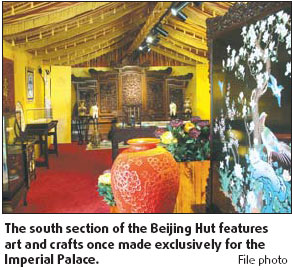
The Beijing Hut offers a mix of folk and royal crafts.
Chief Beijing hut designer Liu Xiaoning admits it was a bit of challenge finding a balance between the two art forms.
"As the capital, which gathers thousands of artisans in Chinese history, Beijing boasts a veritable laboratory of craftsmanship, from arts and crafts once made exclusively for the Imperial Palace to fascinating folk handicrafts made for ordinary people," says Liu. "I have to present both for visitors."
Entering the south section of the hut is like stepping into a king's study. A huge redwood antique table lies in the upper east area with a golden throne and delicately carved wooden screen in the backdrop. Amid the display are two inlaid gold lacquer wares in the shape of white cranes, which symbolize immortals in Chinese mythology.
Atop the large wooden table is a cloisonn enamel (a squiggly-shaped ornament), carved with patterns and inlaid with precious gems.
The object was once a common Chinese household item. But, in the Qing Dynasty, it became a pure ornamental called ruyi (as you wish), which was often bestowed by the emperor upon his ministers or subjects.
Visitors can write down on paper their wishes for the Olympic Games in Chinese calligraphy-style by using the brushes and ink slabs left on the table.
Two magnificent dragon robes also hang on the wall, reflecting the unique embroidery skill of the Qing Dynasty. Other exquisite pieces made by art masters adorn the area including a palace carpet, filigree and inlay ornaments and jade-carved sculptures.
Lacquer carving vase made by Wen Qingang, silk figurines made by Hua Shulin and cloisonn lions made by Zhang Tonglu, all feasted the visitors' eyes.
The western area of the hut allows visitors to watch how the widely popular kongzhu, a spool-shaped toy, is made. The popular folk game is often played by Beijing residents in the mornings.
"I am so honored to show the process of making this spool-shaped toy and how the buzzing sound is made when it maneuvers," says Zhang Guoliang, a master renowned for making delicate kongzhuespecially double-domed versions.
The hut also has a station that showcases watercolor block printing, a unique technique, used for reproducing famous Chinese paintings and calligraphy.
Sichuan Hut
Chinese music fills the air with lovely melodies as Li Quyang plays the qiang flute, blowing into the instrument for more than five minutes without exhaling.
The student from quake-hit Beichuan Middle School demonstrates the unique respiration skills needed to play the ancient Qiang minority folk instrument inside the Sichuan Hut.
The 20-year-old Qiang minority Olympic volunteer came to the Chinese capital from his home in Sichuan province to promote his home and culture at the Games.
The ancient reed flute is widely used by Qiang musicians to convey messages of love and nostalgia.
"Only few masters can blow into the flute incessantly for over 30 minutes nowadays, which impels me to inherit it," says Li.
The Qiang ethnic group is one of the earliest members of the great multi-ethnic family of China. As China's only ethnic Qiang autonomous county, Beichuan is home to a large number of ancient cultural relics. But sadly, Qiang's cultural heritage suffered incalculable losses when the May 12 earthquake struck the area.
"The embroidery pieces and stoups you see here are all borrowed from National Culture Palace," says Gao Zeyou, the curator of the Beichuan Folk Culture Museum. "All the 800 pieces of Qiang antiques and folk crafts preserved in our museum are buried under the rubble as the whole building collapsed in the earthquake."
More than 30,000 people of Qiang origin were killed in the devastating quake, including many folk artists.
"Qiang is a group which has language, but no characters. As long as its people exist, its culture can be passed down," says Gao.
Dozens of pictures depicting Qiang's architectures, costume, religious belief, festivals and folk arts plaster the wall. In the corner, middle-aged Yang Dequan sits quietly making shu embroidery (one of the four celebrated Chinese embroideries). The peony pattern under her hand is vivid with precise lines and shining colors.
Sichuan boasts many intangible culture heritages. It is also renowned for its rich folk culture and high passion for preservation its endangered art.