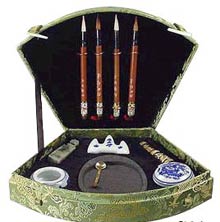
To practise calligraphy requires the basic tools of “four treasures of study” (writing brush, ink stick, paper, and ink slab) as well as much concentration on guiding the soft writing brush charged with fluid ink, and writing on the paper where the ink will diffuse quickly. Once the brush movement hesitates, a black mark is created, so speed, strength and agility is the essence of fine artwork. When writing, many calligraphers will forget all worries and even themselves, combining all thoughts in the beauty of the art. Thus it can be compared with Qigong, which also can mould and improve a person's temper and promote well being.
Calligraphy, like a mirror, is a silent reflection of the soul. It is believed to have verve, of optimism, moderateness, or pessimism. In the West, Picasso and Matisse are two artists who openly declared the influence by Chinese calligraphy on their works.
Today, although various modern ways have been substituted for the original calligraphy, especially which created with a writing brush, people still love the ancient form and practise it untiringly.
Origin of Calligraphy
When did calligraphy originate? No precise date is given in ancient Chinese history. Legend says that during the reign of the Yellow Emperor a man named Cang Jie invented the Chinese characters. Calligraphy came after invention of the characters. Archaeological discoveries since the birth of new China have authenticated that 4,500 years ago language characters came into existence in China. It follows that calligraphy entered an embryonic stage then.
Styles of Calligraphy
Calligraphy has endured for more than 2,000 years, and evolved into five main ways of writing each with different techniques. Even today, these are still followed and practiced often as a hobby.
Just as calligraphy is an art practiced in western cultures so Chinese writing is a leading component in the four traditional arts, namely lute-playing, chess, calligraphy and painting.
With the unification of the Chinese people by the Qin Dynasty (221BC–206BC) the Prime Minister Li Si actively promoted a unified form of writing based on inscriptions on bronze wares of previous states. This was the first example of calligraphy -- known as “seal character” (Zhuan Shu in Chinese). Calligraphers of seal character stress a slender font, even speed and strength, and even thick lines and strokes. When seen as a whole, this calligraphy is quite round and contracted.
In the Eastern Han Dynasty (25-220), people tended to simplify the seal character which had many strokes and created the official script (Li Shu in Chinese). The new calligraphy appeared to be much neater and delicate, turning the round style into a flat one. When beginning to write a horizontal line, one must let the brush go against the direction of point like a silkworm, and concentrate on stretching steadily, then end up with warp like a swallow's tail.