The 2008 Beijing Olympics has put China in the spotlight this summer.
To a young Chinese studying in the United States, especially one with a journalist background, I prefer to discuss China with American friends of different backgrounds. To my delight, most of them hold a friendly and positive attitude toward China, and sometimes criticize the country out of sincerity.

What surprises and worries me, however, is that most other Americans even elites know little about China. Their views are often lagged, biased, and full of contradictions.
One of my American friends was a media officer of former President Ronald Reagan. In his entire life, he had been to China only once in the 1970s. His impression of China still remains the same as 30 years ago: narrow streets, few cars, people all wearing the same style of clothing, and fearing to express their opinions. He even does not know that currently there is a non-stop flight between Washington D.C. and Beijing, and that it only takes 12 hours to fly to China.
Another American friend is a senior journalist and a member of an influential think tank. He is very fond of Chinese food, yet he has never been to China. His impressions of China: a mystical, prosperous, rising country. He said he cannot imagine how China operates with a population of 1.3 billion people and is very confused as to why Chinese people are so excited about the Olympic Games.
I also personally experienced a story in a private kindergarten in Washington D.C. There are only two Chinese children in this kindergarten, one is my son Ying, another is an orphan Ann who was adopted by an American couple at birth. At a music class, the young teacher who also had never been to Asia told the children a story "...all the kids put on a new dress to celebrate the holiday, except for one. Because he is from China like Ann and Ying, they are very poor and have no money for a new dress and delicious food..."
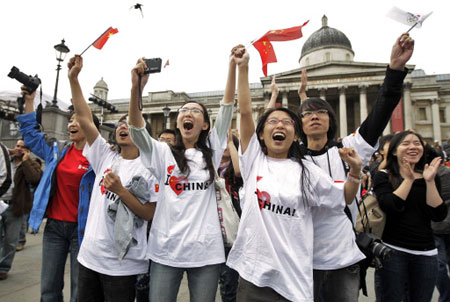
People react as they watch a live broadcast of the opening ceremony of the Bejing Olympic games 2008 on August 8, 2008, in London's Trafalgar Square. [Agencies]
|
In fact, it is not surprising the teacher did not know anything about China. It is also understandable the journalist had so little knowledge of China.
The list of such stories goes on. The American perception of China seems to have been frozen somewhere in China's history. Their knowledge of China is mainly gleaned from the media or study results from think tanks as opposed to their personal experiences.
In the age of information, it seems people more often than not rely on the global media to know the world. But the media is just a carrier of information. It is the people who decide the choice of information they view or read and what they should believe. Naturally, each country's media coverage of the same topic may differ. This bias could be due to the local economy, politics, culture, nationalism and other factors. What is more, the media tend to look for sensational and negative stories. In this sense, most Americans only know a virtual China created by the American media.
In addition, many China experts in the West, including Chinese Americans, usually spend two to three months in China and devote the rest of their time to desk research, which lags real developments in China. And they usually focus on very specialized topics. These experts often create their own perceived picture of China which is far from reality.

In fact, the best way to gain a better understanding of any country is to visit it, experience the culture, and listen to the views of the local people. Mere reliance on the media and think tanks is far from enough to accomplish this objective. Naturally, China and the United States are two totally different countries in terms of history, culture, governments and ideology, and perhaps ways of thinking. If we collectively fail to view matters from the other side's perspective, gaining a consensus will be a daydream.
Of course, to know the real China for the Americans is not as simple as just seeing with their own eyes. But it has been proven to be one of the best approaches to strengthen the trust and understanding between the two countries and peoples.
In April, US media reports on the Tibet riots and the Olympic torch relay led to strong indignation among the general public in China. They felt the reports were biased and contrary to journalistic ethics. On the other hand, some US media and politicians could not understand why the reaction from the Chinese communities could be so strong and viewed it as "radical national protectionism". Such a confrontation was indeed worrying for both countries.
However, the Sichuan earthquake has eased the misunderstanding to some extent. Faced with the disaster, Chinese people and the government moved the world by their courage, unity and unselfishness. At the same time, the Chinese public's resistance and distrust has changed by the US media's all-round coverage of the disaster.
All these changes, however, lie in the fact that many Americans now see the real China with their own eyes and report about it the way they see it.
Some social elites in the US are still criticizing the Beijing Olympics on the pretext of human rights and press freedom. In my view, China needs to adjust itself and welcome all kinds of well-intentioned criticism in a more open, confident, peaceful and true attitude. China's young generation should also learn to tolerate different opinions and respond to them more actively.
As one who was born during the "Cultural Revolution" (1966-76) and grew up during the reform and opening up, I am a witness to the resounding progress China has made and the problems it still faces. For a country of 1.3 billion people and 56 ethnic groups whose history spans 5,000 years, we cannot expect to solve all the problems overnight. China still needs time, needs understanding, needs friends and support from the rest of the world.
To the US elites who are still critical of China, the Olympics is a gold opportunity to cast away their preconceived opinions and lend a listening ear to the voices of the general public in China.
Chairman Mao once said: "If you want to know the taste of pear, you have to eat it yourself?"
The author is a visiting fellow at the Brooklings Institution
