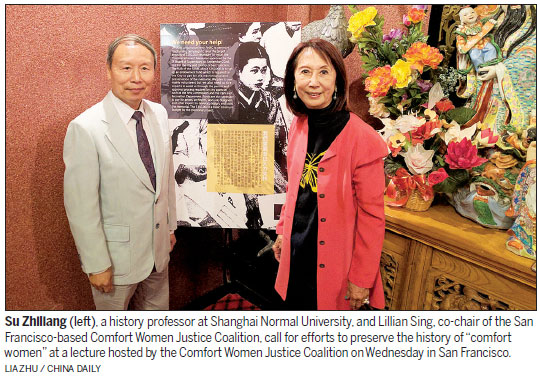
With only dozens of "comfort women" victims alive today, a prominent historian of their plight called for international efforts to preserve the historical documents for future generations.
"A lot of the documents and photos of 'comfort women' were ruined by fire or water as the Japanese military tried to destroy the evidence when they were defeated," said Su Zhiliang, a history professor at Shanghai Normal University, who has spent more than two decades researching the "comfort women" system and campaigning on behalf of the victims.
The Japanese military set up the first "comfort stations" (military brothels) in Shanghai in 1932. By the full-scale invasion in 1937, the stations were all over China, from northernmost Heilongjiang to southernmost Hainan Island, said Su during his visit to San Francisco at the invitation of the Comfort Women Justice Coalition, an activist organization based in the city.
The "comfort women" system was soon expanded to Southeast Asia, until the end of World War II in 1945. An estimated 400,000 girls and women were forced into prostitution by the Japanese military.
Half of them were from China, 140,000 to 160,000 from South Korea and the rest were from Japan and other Asian countries, according to Su.
The "comfort women" documentation was not meant to protest against Japan but to preserve the "shared memory of humankind", said Su, also director of China's Comfort Women History Museum at Shanghai Normal University.
"What the Japanese military did to 'comfort women' is an atrocity against human rights, especially against women's rights, that ever happened in human history. Not only Japan, but the whole world should reflect upon it," he said.
In 2015, Su was prominently involved in the Chinese application to have Nanjing Massacre and "comfort women" documents inscribed on the UNESCO Memory of the World Register, a compendium aimed at preserving documented heritage of universal value.
While the historical documents of the Nanjing Massacre were listed on the program, the application of "comfort women" was rejected by the UNESCO Committee as a result of intensive behind-the-scenes lobbying from Japan.
Last June, the applications were submitted by an international joint committee representing eight countries and regions - Chinese mainland, Taiwan, South Korea, the Philippines, Indonesia, East Timor, the Netherlands and Japan - as well as three war museums in the UK, the US and Australia.
Su showed some of the key evidence filed with the application - including the records of the "comfort stations", photos taken by the Japanese soldiers, and a membership roster of a Korean natives association in Nanjing - at a lecture attended by activists from different communities in the San Francisco Bay Area.
A record dated February 1938 shows that more than 8,000 Japanese soldiers entered the "comfort station" in the small town of Zhenjiang in East China over 10 days. The ratio of "comfort women" to Japanese soldiers was 1 to 178.
Another important record is a roster of a Korean natives association found in Jinhua, Zhejiang province. Among the 210 people with their names, occupations and addresses recorded on the roster, 127 were "comfort women", with the youngest being 19.
"In 1944, there were about 2.5 million Korean people in China. This roster shows 60 percent of them were 'comfort women'. We believe there are much more 'comfort women' than the estimated figure," said Su.
This autumn, the UNESCO committee will discuss the application and make a decision despite the efforts of the Japanese government.
Last October, Japan, the second largest contributor to UNESCO, announced the suspension of its payments to the organization to protest the inclusion of Nanjing Massacre documentation in the Memory of the World Register.
"Japan continues to deny its role even in the face of powerful evidence. But facts are facts, and lies are lies. Even a child understands that. Historical facts cannot be changed by a revisionist government," said Lillian Sing, co-chair of the Comfort Women Justice Coalition.
liazhu@chinadailyusa.com




Copyright 1995 - . All rights reserved. The content (including but not limited to text, photo, multimedia information, etc) published in this site belongs to China Daily Information Co (CDIC). Without written authorization from CDIC, such content shall not be republished or used in any form. Note: Browsers with 1024*768 or higher resolution are suggested for this site.
License for publishing multimedia online 0108263 Registration Number: 130349