Arbitration mechanism needed to settle disputes arising from diverse cultures, legal expert says
This should be the beginning of a busy year for Wang Guiguo. He wants his idea of building a modern legal structure for China's Silk Road initiatives to come to pass.
Wang, who is the president of the Hong Kong-based International Academy of the Belt and Road and a professor of international law in Beijing, Hangzhou and New Orleans in the United States, published a book in October - about the dispute resolution mechanism for the new Silk Road initiatives proposed and led by China.
The new Silk Road project, which comprising the Silk Road Economic Belt and the 21st Century Maritime Silk Road, is called the Belt and Road Initiative.
|
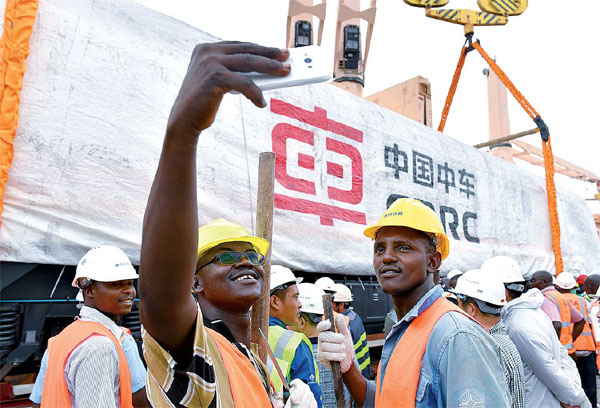
Workers take a selfie at a locomotive delivery ceremony in Mombasa, Kenya. The eight China-made locomotives will be used on the Mombasa-Nairobi railway. Xinhua |
This year, beginning with US President Donald Trump withdrawing the United States from the 12-nation trade deal Trans-Pacific Partnership, the need is becoming more acute, Wang says, for China to work with other countries to structure their own free trade systems and related legal mechanisms.
"In fact, how to build a fair, all-a round and workable dispute-resolution system for international trade and investment is a common task for governments and legal professionals," Wang says.
Whether or not the US or any other country stays in or leaves a free-trade pact won't affect the need, he says.
"Globalization is not going to stop."
That is also why ideas such as international dispute settlement and international dispute tribunals are more often suggested by judicial forums in Europe, he says.
Since 2013, when the Belt and Road Initiative was proposed by President Xi Jinping, China has signed partnership agreements with 40 countries.
Overall, the initiative covers 60 percent of the world population and one-third of global GDP of around $20 trillion (19 trillilon euros; 16 trillion). For the past decade or so, it has shown the fastest growth of all regions.
Owing to diverse legal systems and practices, the implementation of Belt and Road-related agreements will inevitably give rise to many issues in the governance of trade and cross-border investment, Wang says.
Last year, upon the publication of the book that he edited, with contributions from more than 40 legal experts from different countries, Wang's academy held a forum in Hong Kong.
An official from the Supreme People's Court of China spoke there and declared support from the central government for Hong Kong to become a regional dispute-settlement center.
Wang argues that the now defunct TPP, although it did contain some provisions about disputes between investors and their host nations' governments, "was actually less perfect a dispute-resolution model than it was branded".
None of the dispute-resolution mechanisms available in the world today is perfect, he says. Most important, they are incomplete in terms of appeal, compensation or mediation and reconciliation in cross-border investment disputes and rulings.
They lack efficiency and accommodation of digital technology, he adds, "in such things as an online tribunal, for example".
Now, with its new Belt and Road Initiative, China should work with its partners to develop a dispute-resolution mechanism to better incorporate common law and some "Eastern values" - those about dispute mediation and reconciliation in particular, Wang says.
In the meantime, China and its partners in the initiative will be open to adopting useful lessons learned through other dispute resolution designs in the world.
Wang says he hopes to see an effort to build a comprehensive, unified arbitration mechanism that also works well with the civil law system, which most Belt and Road nations are familiar with.
"Unlike trade disputes, which can be settled in the unified mechanism of the World Trade Organization, investment disputes are handled differently by different tribunals, even in similar cases," Wang says.
The International Center for Settlement of Investment Disputes is a product of the Washington Convention on the Settlement of Investment Disputes of 1965. It deals with disputes between states and nationals, especially corporate entities from different states. But it doesn't have an appeal system.
"Developing countries would need a court of appeal to ensure the fairness of the rulings," he says.
wangqiao@chinadaily.com.cn




Copyright 1995 - . All rights reserved. The content (including but not limited to text, photo, multimedia information, etc) published in this site belongs to China Daily Information Co (CDIC). Without written authorization from CDIC, such content shall not be republished or used in any form. Note: Browsers with 1024*768 or higher resolution are suggested for this site.
License for publishing multimedia online 0108263 Registration Number: 130349