A living museum's life support
By Xing Yi ( China Daily Africa )
Updated: 2013-11-15
The capital's first hutong museum preserves history
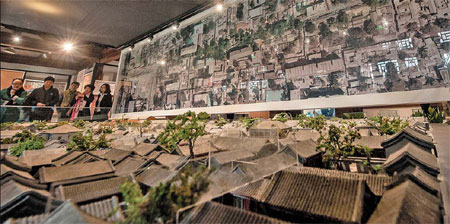
Beijing's new hutong museum not only houses historical relics but also is itself a relic.
Shijia Hutong Museum is an architectural artifact. The structure has dodged the wrecking ball of progress to break new ground in the preservation of, and education about, old Beijing's buildings and the people who've long dwelled in them.
It opened to the public last month.
While advancing historical conservation, the establishment also elaborates on the transformations of these buildings over the generations and the lifestyles of their inhabitants, demonstrating tradition isn't static.
"The museum is a footnote to the beautiful chapters of the story of Shijia Hutong - and Beijing's hutong in general - and traditional lifestyles," Chaoyangmen sub-district's secretary and the museum's founder Chen Dapeng says.
"The best part is that it's embedded in occupied hutong and quadrangular courtyards downtown. So, when visitors leave, they feel like they're stepping into another museum."
A resident of the surrounding hutong, who would only give his surname, Wei, says: "Actually, every hutong has its stories and each should have a museum like this."
Shijia Hutong Museum is housed in the siheyuan (traditional courtyard) that was once home to celebrated Chinese writer Ling Shuhua.
It was renovated with authentic bricks and tiles gathered from hutong and other heritage sites around Beijing, says Chen. It receives about 200 visitors a day.
A visitor from Haidian district, who would only give her surname, Guo, says: "The museum has preserved many items and scenes from daily life in olden times. Some items remind me of my younger years because I owned such things, too."
Some items were donated by Suo Ya at 49 Shijia Hutong. Her grandparents bought the compound in the late Qing Dynasty (1644-1911). The 57-year-old grew up there in the 1960s and later moved into an apartment building in another part of town.
She loaned her student ID, report cards and schoolbooks from Shijia Hutong Primary School.
"Those objects are my treasures," Suo says. "They record history. While they're precious to me, I've lent them to the museum so more people can see them."
She hopes to do whatever she can to support the museum.
"It think its opening is meaningful," she says. "It shows people have started to realize hutong culture's value."
Suo hopes the museum doesn't overemphasize local bigwigs.
"Many famous figures lived in Shijia. But so did many ordinary people," she says. "They created culture together. Diversity is hutong culture's essence. So, the museum should display regular people's relics, too."
Some of Shijia's stories - legacies of both regular and well-known residents - have been lost.
Even its namesake's origin is debated. Many contend it hails from the prominent Ming Dynasty (1368-1644) Shi family. Others believe it derives from Ming chancellor Shi Kefa.
The reincarnation of the hutong accords with its past life as an education center.
In 1908, the US Congress passed an act creating a scholarship program for Chinese students to study in the United States. A bilateral agreement created Tsinghua College, and 100 students were sent Stateside annually.
In 1909, the imperial Ministry of Foreign Affairs opened an administrative office in Shijia to manage these overseas students. Three exams to select the students - noted scholar Hu Shi among them - were held between 1909 and 1911.
Yet this is but a single page in Shijia's sometimes-turbulent chronicle, as the museum reveals.
Ming historian Zhang Jue's Capital City Hutong Collection reveals Beijing's inner city contained more than 900 hutong during the reign of Emperor Jiajing (1507-1566).
When the ethnically Manchurian Qing Dynasty named the city its capital, it didn't alter much of the physical layout but reconceived administrative jurisdictions.
It carved the city center into military-defense divisions called the Eight Banners.
Shijia Hutong came under the Bordered White Banner's management.
This meant the 1901 signing of the Boxer Protocol put some of Shijia's courtyards under Danish and church rule, since the greater Dongjiaominxiang area containing the hutong was designated as a foreign legation quarter.
Demographics and architecture changed again as Beijing experienced a population explosion from 1919 to 1949 that generated a construction boom. Influential officials gravitated toward the Dongcheng district that contains Shijia. But Shijia's essential layout survived the redevelopment, which particularly focused on roads.
The greatest threat to Shijia's essential ancient integrity has come with post-1949 modernization and population increase.
Many ancient courtyards were gutted and replaced with multistory structures. Streets and hutong were reconfigured into new communities.
Shijia today contains 15 multistory buildings and 82 bungalows and courtyards.
The reconstruction came before the Protection of Beijing Traditional Hutong-Siheyuan Architecture was included in the General Plan of Beijing City (2004-2020). The policy's crux is the effective preservation of the original layout and style of hutong.
Courtyards are among the primary considerations for architectural conservation in the country's urban planning since they remain an important cultural vehicle.
They're still evolving and, with well-conceived planning, can continue to develop for generations.
Beijing's downtown hutong were mostly constructed in the 13th century, when the Yuan Dynasty (1271-1368) made it the imperial capital.
Around that period, Italian explorer Marco Polo wrote: "The city's layout is so well-structured that other cities pale in comparison."
Shu Yi, former curator of the National Museum of Modern Chinese Literature and son of legendary Chinese author Lao She, advocates the perpetuation of Beijing's ancient edifices.
"The city would lose its charm as an ancient capital if there are only modern buildings," he says.
"So, it's fortunate we're preserving some precious heritage, such as hutong and siheyuan, however we develop."
Xinhua and Erik Nilsson contributed to this story.??
|
A sand table is displayed at Shijia Hutong Museum, which showcases an overall view of Beijing's hutong and courtyards. Zhang Yu / Xinhua |