Neck and neck
By Wang Ru ( China Daily )
Updated: 2013-01-23
|
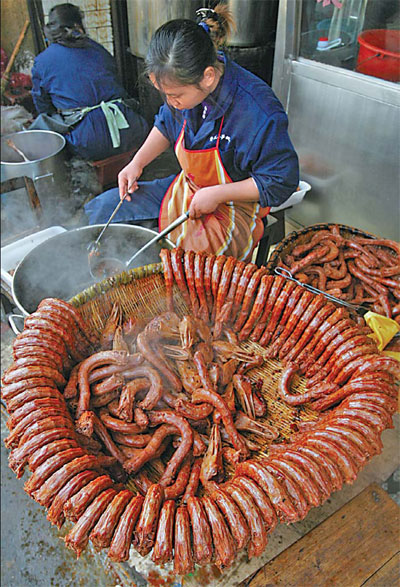
A cook prepares duck necks at a food stand on Wuhan's Jingwu Road, which was demolished for a multifunctional residential community. Provided to China Daily |
|
A long line outside a popular spicy duck neck store in Wuhan, Hubei province. Sun Xinming / For China Daily |

The street is no more, but its name remains on the signature delicacy that became a nationally celebrated dish. And, the competition is still just as fierce. Wang Ru reports in Wuhan.
Wu Jixue has kept the local newspaper from Jan 22, 2011 - the day Jingwu Road in Hubei province's provincial capital Wuhan was demolished, along with its signature rows of spicy duck neck stores. The 50-year-old is among the tycoons who made a fortune on Jingwu. His family-run business has grown from its first shop in 1995 into an empire of 12 chain stores, a factory with about 1,000 employees and 150 million yuan ($24 million) in sales.
But while his business survived the demolition, Wu says he feels like he has lost a child. Jingwu was where his business was born, and he helped the road's spicy duck neck industry develop from a jumble of ramshackle sheds into more organized food stalls.
There are many stories about the dish's origins. The most widespread says a local man named Tang Lajiu created it on Jingwu in 1993.
Vendors usually discarded the duck necks back then.
Tang and his brother took inspiration from Sichuan's spicy cuisine and stewed them with herbs and spices.
The lines in front of Tang's shop grew and started to include celebrities.
|
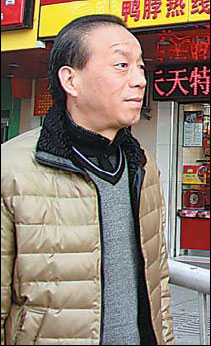
Wuhan tycoon Wu Jixue made his fortune selling duck necks. Wang Ru / China Daily |
Wu, who worked as a taxi driver before opening a grocery shop, noticed the growing popularity and opened a duck neck stall outside his store on Jingwu's southern end.
The location helped his business boom. The stall ran 24 hours a day, and Wu decided to close his grocery and sell the necks full time.
Most customers were passengers and bus drivers from a nearby bus station and late-night patrons of a neighboring nightclub.
Soccer fans started pouring in by the thousands after the local team, whose home stadium was near Jingwu, joined the top tier of the national professional league in 1997.
"Every stall was too busy to feed them all," Wu recalls. "Local officials had to stand in line. I was often too exhausted at night to count the day's earnings."
Wu opened three new stalls in 1997. He turned down an offer to a buy his business in 2000, although he was offered 10 times his investment.
That was a wise move. In 2002, the film Life Show, centered around a Wuhan woman who earns her living selling spicy duck necks, lifted the dish to national acclaim.
Visitors to the city started flocking to Jingwu en masse to try its famous duck necks.
But a year later, SARS disrupted Jingwu's business.
Only about 40 of its 100 stalls survived the epidemic. Wu didn't abandon his business but stocked up on frozen necks.
"The business couldn't fade," he says. "Its reputation was too great."
By 2004, Wu had become one of Jingwu's richest tycoons. That same year, he established his company and upgraded his stalls into eateries where staff wore uniforms and used disposable gloves.
Other entrepreneurs found different market entry points.
Wang Songlin earned bundles selling premixed spice bags to vendors across the country.
Tu Guohua started a company selling vacuum-sealed bags and gift boxes of duck necks in supermarkets nationwide.
But Tang, the purported inventor of spicy duck necks, lost his fortune by gambling away millions in Macao, Wuhan media reported.
Duck neck producers faced a trademark dispute in 2007, when they were sued by a food company that claimed to have registered "Jingwu" as a trademark in 1997.

In the 1920s, Jingwu Road was named after a martial-arts club created by Huo Yuanjia, who had made his name in Tianjin municipality. A town in Tianjin is also named "Jingwu".
"In 1997, nobody realized 'Jingwu' would become a priceless trademark," says Wu, who adds he was among the first to register a trademark containing the name in 2003.
The suit ended in March 2011 - after Jingwu Road's demolition. The court ruled that Wuhan's duck neck companies were allowed to use "Jingwu" in their trademarks. About 30 enterprises currently use the word in their branding.
About 125 million duck necks are sold every year in Hubei - lined up, they'd stretch about halfway around the planet - according to the Jingwu Duck Neck Association, which was founded in 2007.
"Jingwu duck necks are no longer small businesses but are, rather, an important industry for Wuhan that generates about 6 billion yuan in annual revenues," the association's general secretary Liu Shiping says.
Jingwu Road's duck neck shops were relocated to a street about 300 meters away after the demolition.
Many outlets couldn't afford the higher rents, leaving 18 stores to reinvigorate Jingwu's legacy.
Wu opened three new shops on the street.
"I could open more but believe I should leave space for others who helped create this legacy over the past two decades," Wu says.
He spent 150,000 yuan for a large advertisement on the side of a residential building.
But, his business shrank by 30 percent in 2012, he says. "The influence and effect of the relocation is inevitable," he explains.
But, the duck neck tycoon has bought 3.3 hectares of land to expand his factory this year.
"I want to make my company a century-old brand," he says.
The original Jingwu site is slated to become a multifunctional high-end community.
"I think that wherever spicy duck necks are, that's where Jingwu Road is," Wu says. It is after all, a name to remember.
Contact the writer at wangru@chinadaily.com.cn.
|
At Jingwu Road, eager customers wait as their orders of duck necks are chopped into bite-sized portions. Sun Xinming / For China Daily |

(China Daily 01/23/2013 page18)