Trade town turns to tourism
By Zhang Yue ( China Daily )
Updated: 2013-07-11
|
Most local people live in yaodong, or cave houses, one of the most dominant features of the Loess Plateau along the Yellow River. Photos by Kuang Linhua / China Daily |

Qikou is a quaint town along the Yellow River. Zhang Yue explores the once vital trading point that is striving to be a tourism spot.
Unlike many travel destinations, Qikou in Shanxi province has never been a place full of color.
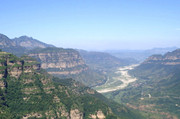
The ancient town sits along the Yellow River, about three hours' drive from Taiyuan, the provincial capital. In spite of its proximity to the river, Qikou experiences drought almost all year round.
Home to a population of about 30,000 people, the place is also known as one of the "ancient towns still in existence".
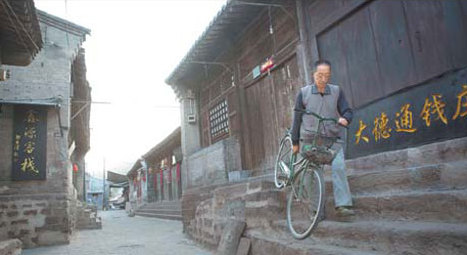
Most local people live in yaodong, or caves, and roads are paved with flagstones.
The history of Qikou dates back to the Neolithic period, and the town was named after its geographic location.
The word "qi" in Chinese literally means rip current of the Yellow River, which is formed by fluctuations in the river. The riverbed can reduce from 400 meters to 80 meters, which causes a sudden rapid currents on the Yellow River and made this stretch of water one of the most challenging places for transportation in ancient times.
The town flourished during the Ming (1368-1644) and Qing (1644-1911) dynasties, as most goods transported using the waterway, had to be transferred onto land, indirectly bringing large numbers of visitors to the town.
It remained a trade center until the 1940s, connecting business from Shanxi, Shaanxi and Inner Mongolia.
Today, the town has lost its former glory, with modern transportation long ago replacing traditional shipping.
Because the town sits along the Yellow River, it is not a good place for plantation.

Since the 1980s, the majority of the young people left Qikou for larger cities to look for work.
Li Xiaobing, a 32-year-old local resident, says many former residents are now migrant workers.
The local government has developed tourism since 1998, aiming to turn the town into a tourist attraction with its long history and the scenic Yellow River. But it was not until 2010 that tourists started visiting.
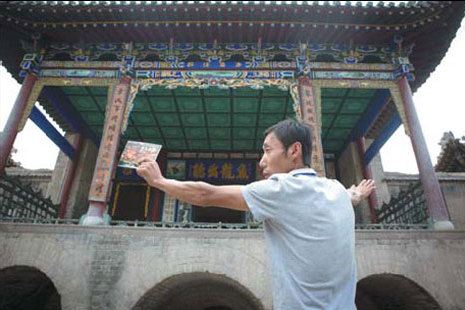
Many young people have returned to Qikou to work as tour guides.
Li returned in 2009 from Zhe-jiang province where he had worked in a factory for five years.
"Business was gloomy at first," he recalls. On most days, he spent one day showing the main streets and attractions to visitors for 30 yuan ($5).
From 1998 to 2004, most visitors to Qikou were photographers and painters who came for art. It was only after 2008 that many self-driving travelers visited the town.
The most popular tourist accommodation is Qikou Lodge, a two-story compound with 66 caves converted into guest rooms.
Before 1940, the venue was used as a granary. It was bought in 2003 by Zhang Qingde, a resident from a nearby county, who turned it into a lodge.
Zhang spent 280,000 yuan ($45,600) buying the whole building. Now it is worth at least 10 million yuan.
"A dwelling cave now is worth at least 10,000. Ten years ago, you could buy one for 500 yuan," Li says.
It also serves one of the most popular local snacks, wantu, a bowl of buckwheat jelly, for 3 yuan.
It was only 8 pm when we finished dinner at the lodge. A terrace is built on the southern side of the villa, overlooking the Yellow River.
We chose our spot and ordered beer, planning to have a relaxing evening. But our plan was cut short because we were attacked by mosquitoes.
We spent our last day in Qikou boating on the Yellow River. Li and his peers used to swim across the river to Shaanxi province on the other side. A 30-minute boat ride on the river costs 100 yuan per person.
What's interesting is the "Yellow River Fresco", which are trails left by the river current on the river bank. These dimensional trails were formed naturally, but some resemble images, such as Buddha and the ancient Chinese scripts.
Li guided us along the river that day and told us that in 2008, a visitor noticed one of the dimensional trails looking like the ship Titanic.
Before we disembarked, we stopped at a towhead and stepped onto it.
It was noon and the sand under our feet was scorching hot. With pride, Li entertained us with a local folk song. He has a good voice. It was one of the best moments of our trip.
Contact the writer at zhangyue@chinadaily.com.cn.
|
Qikou's fledging tourism industry offers new job opportunities for local residents like Li Xiaobing. |
|
The once bustling hub is now a relaxing town, attracting visitors with its long history. |
(China Daily 07/11/2013 page19)