Jazz player melds musical styles of East and West
(China Daily)
Updated: 2016-08-19
A project to meld the musical styles of East and West is creating exciting new music. Matt Hodges tunes in.
Jazz wizard Gene Aitken is creating more magic in the recording studio: This time in Shanghai with a band combining the styles of old Chinese classics with tunes recognizable from United States pop culture.
"If you got caught playing jazz in the US in the 1950s you'd get expelled from college, so we would practice in secret after 10 pm. It was very underground," Aitken says.
He recalls learning his craft by watching black musicians improvise in smoky clubs run by local gangsters.
"Now you have YouTube, or Youku in China, so everyone has access to this world, and you have some very fine Chinese players improvising to almost anything," he says when asked if the Chinese can boast of creative genius or just technical virtuosity.
From Elvis onwards, most modern pop music owes some debt to the legacy that jazz created, so getting a good grounding in this can serve as a stepping-stone to a career in showbiz.
In Shanghai the jazz scene is smaller than it was before World War II, but dedicated clubs like JZ are packed most nights.
A big advocate of computer technology to aid jazz studies, Aitken says China is fast catching up with the West in this area of education. He also helped develop the jazz studies program at Fu-Jen University in Taipei.
In the US, multi-million-dollar government grants gave the industry a boost in the mid-80s, and now China has also begun introducing jazz studies at a collegiate level.
"Jazz can adapt to a culture. It's not like a foreign language," says Aitken.
"I think now China is recognizing the value of music in its own culture, both as a form of communication that can cross borders and as something that engages the right side of your brain and breeds creativity.
"In the US now they're even using jazz as a vehicle for teaching people how to manage large companies, because the organizational structure of a jazz ensemble can be compared to that of a mid-sized corporation."
This is part of a broader project to introduce US jazz throughout Asia by blending it with the local culture in a way that resonates at a grassroots level.
"We'll take Singin' in the Rain and an old Chinese song like Rose, Rose, I Love You and add a jazz interpretation to them," says Aitken, a famous conductor, composer and producer of jazz festivals and educational events.
The project is being done in partnership with Dong Huang Cultural and Communications Company, a local firm run by Andy Hu. Aitken describes it as Hu's brainchild.
"The idea is that old things don't die but are brought back for a new generation, while older people hear a new twist," adds the spritely 77-year-old.
Through his latest project, the Grammy-nominee and Fulbright Scholar has visited exotic locales like Nepal and Lebanon and conflict zones like Iraq and Afghanistan, where he is helping to rebuild the cultural infrastructure.
In Iraq he was also conducting military bands as part of a US-funded arts program in coordination with the US Embassy there and aid programs.
He has been based in Bangkok for the last decade but nowadays he spends most of his time on the Chinese mainland or in Taiwan.
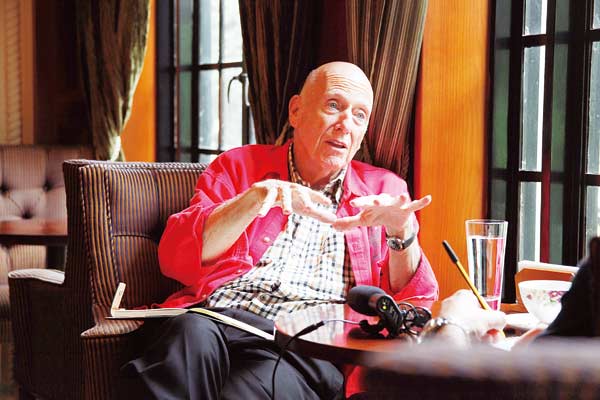
Aitken is wearing a red jacket bearing the insignia of Anasazi Indians from New Mexico on the day we meet and is full of energy. He says he hits the gym every day, and has done so for the past 40 years. Having already come out of retirement once, he has no plans to stop what he is doing now.
He can speak in haltering Mandarin, having studied the language back in the 1980s at the University of California-Los Angeles (UCLA) for an exchange program in Taiwan that never materialized.
In 2007, Aitken was inducted to the Jazz Educators Hall of Fame alongside such luminaries as Ella Fitzgerald, Count Basie and Duke Ellington.
He recently retired as director of the Yong Siew Toh Conservatory of Music at the National University of Singapore and often holds concerts in Shanghai, Beijing and Guangzhou.
Now on his eighth official trip to China this year, he has been helping get jazz bands up and running at local schools in second-tier cities like Wuxi in Jiangsu province.
"The level of jazz musicians here in China is now equal to or better than the US or England," he says, citing jazz guitarist Lawrence Hu and saxophone player Zhang Xiaolu among the top local talents. Zhang runs the Jazz Studies Program at the Shanghai Conservatory of Music.
Never one to rest on his laurels, Aitken has launched, or is launching, new jazz festivals in Thailand and China. But Shanghai has a special place in his heart because of its creativity, architecture and rich jazz history.
"You see things here that you just don't see in other cities in Europe or the US," he says. "One of the professors recently organized a summer saxophone camp here and it drew 120 students. You never hear of that anywhere else."
The dance halls, jazz clubs and big bands added to the color and glamour of Shanghai in the 1930s, before the government banned jazz as a symbol of decadent American culture.
It also went underground in the US for decades after being branded a threat to the morals of American youth. The Beatles helped trigger a renaissance of interest in the 1960s with their jazz-infused pop songs, and jazz came back in vogue with a vengeance from around the 1990s.
What we do
SAFEA is responsible for certifying foreign experts to work in the Chinese mainland and organizing overseas training for Chinese technical and managerial professionals.