
Cultural riviera in Qingdao
By Erik Nilsson ( China Daily USA )
Updated: 2015-11-09
|
|||||||||


The city has grown as a sailing hub since its designation as the 2008 Olympics maritime-sports venue, but it also draws visitors with its history, and colonial-era architecture. Erik Nilsson reports in Qingdao.
The ancient Taoist leapt through the wall.
He could - because he was sinless.
He was pure of heart during his studies at Taiqinggong (Supreme Purity) temple.
But when he tried the trick again upon returning to his hometown, this time to rob a rich neighbor - splat!
Thus, people today stand before the temple wall in Qingdao city's Laoshan Mountains - where the follower made his leap of faith - as a reminder that few, if any, of us are pure enough to pass through it.
(Nobody since has.)
Let's face it. Even if we believed in metaphysics, we wouldn't dare.
The wall becomes a mirror reflecting our consciences.
The temple founded in 140 BC by Zhang Lianfu, an official who renounced his title to devote himself to piety, peaked in the 10th century. It continues to occupy a prominent place among the pantheon of Taoist sites.
Legend has it that Buddhists and Taoists hoped to set up camp in Laoshan because of its feng shui. (Pine-crested mountains flank three sides, sealing out cold, dry northern winds, while the ocean laps the east.)
Their respective leaders debated. The Taoist won.
The Buddhists headed for other hills.
Taiqinggong's early legacy lives on - literally, as many of the trees planted in the temple's formative days continue to grow.
And they jut skyward as main attractions.
One served as the inspiration for the fairy trapped in a tree in author Pu Songling's (1640-1715) story about his star-crossed love with a human.
Pu lived in the temple for two years.
Visitors also "pet" the 1,200-year-old Dragon Head Tree - anthropomorphically named after its shape - for good luck.
Another tree, twice as old, is actually three species that have twisted together over two millennia. (Three represents eternity in Taoist thought.)
A different living legacy of Taiqinggong's first pilgrims is that it still functions as a religious establishment. Monks' chants reverberate through the forests.
Near the temple, visitors can eat farm-fresh meals, seated on ancient kang beds in stone village houses that roll down Laoshan, while gazing at the sparkling sea.
Another shoreline rock structure is the Old Stone Man, a rock formation not only named for its shape but also for its folklore.
The fable says that the Dragon King abducted a farm girl as his concubine. Her father was so distressed that he sat gazing at the whitecaps, awaiting her return, until he fossilized. His daughter was so distraught that she committed suicide.
(Incidentally, Tian'anmen's Monument to the People's Heroes is sculpted from Laoshan rock.)
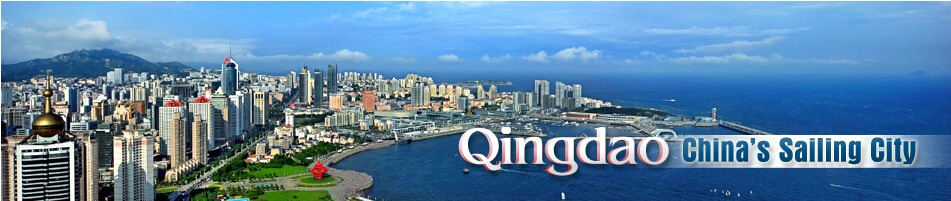
While Laoshan is the most famous alp fringing Qingdao, downtown's Xiaoyu (Small Fish) Mount offers the most panoramic view of the city smashing into the seashore.
The 18-meter-high tower atop the hill offers vistas of red roofs, green trees and blue skies and seas.
Downtown is roughly divided into east and west by an abrupt cutoff of skyscrapers delineated by a canopy of trees punctuated with older, red-tiled roofs.
While projecting a Mediterranean feel, the buildings hail to the German-concession period.
Yet the architectural texture becomes more complex in the bayside Badaguan, or Eight Roads historical zone. (Actually, there are 10 lanes, each lined with a different tree species.)
It houses structures erected in the first three decades of the 20th century, when wealthy people from 20 countries constructed houses in their national styles.
Or didn't.
Take the Granite Castle built in ancient Greek and Roman styles in 1931 for a Russian aristocrat that was later home to a British businessman and used for formal receptions after liberation.
Or the Princess House - known mostly for Denmark's prince Axel's 1930 visit with his wife, Margaretha - rendered in Nordic style by a Russian designer.
It has been repurposed - perhaps oddly but happily - as a Chinese shrine to fairy-tale virtuoso Hans Christian Andersen. That is, with a gallery, themed coffee shop and statues of pink castles and (of course?) Minnie Mouse.
The question becomes: Why not?
The answer is: The place is literally crawling with kids.
Antiquated architecture is usually a pretty tough sell for tykes young enough that their bedtime story diets are heavy on royals and magic.
Not here. This is a classic come true for them.
Badaguan's fairy-tale mystique causes a problem for shutterbugs. It's virtually impossible to snap a photo without newlyweds - who, in turn, are there to shoot portraits.
The grandiose concession-era architecture jutting into the Huiquan and Taiping bays attracts busloads of brides and grooms from other provinces, photographers in tow.
Hence, heart sculptures have been set up outside the Granite Castle. (The Chinese name, Huashi, literally translates as Fossil, rather than granite).
Perhaps Qingdao's most eminent castle is the Governor's House Museum.
The 4,000-square-meter mansion was the abode and base of two German governors and later of a Japanese commander.
Mao spent a month here in 1957, sleeping on a plank bed with a bookshelf custom-built in the smoking room. He presided over a Politburo meeting with Zhu De, Zhou Enlai and Deng Xiaoping in the Golden Hall.
The hall is named for its color scheme and is replete with a one-way mirror.
But beyond history, Qingdao's cultural legacy as a port city is tied up in its reputation as a beach town.
It's a holiday destination - and, as such, recently hosted the World Leisure Games. The 10-day event included martial arts, breakdancing and even video-game championships - and, of course, such watersports as dragon-boat racing.
Qingdao has grown as a sailing hub since its designation as the 2008 Olympics maritime-sports venue.
Yachts bob in its main marina.
They nod to a time when Qingdao is sailing, rather than leaping, through the wall toward not only finding leisure in prosperity but also prosperity in leisure.
Contact the writer at erik_nilsson@chinadaily.com.cn

|
Top: Zhanqiao Pier, built in 1891, is among the major attractions in coastal Qingdao. Above left: A Taoist follower practices martial arts at Taiqinggong temple. Above right: Qingdao's seaside is also a popular place for newlyweds to shoot portraits, besides the bayside Badaguan area. PHOTOS BY LIU YONGLAI, Zhang Yan And Bo Keguo / For China Daily |