

Carrier of navy's pride
By Zhao Shengnan ( China Daily )
Updated: 2013-04-19
|
|||||||||


|
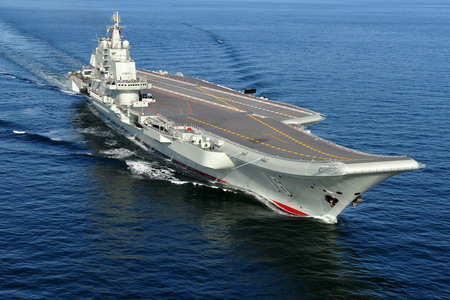 The aircraft carrier has conducted 10 sea trials since August 2011. [Photo by Li Tang / for China Daily] |
|
Chen Xiaoyong (second left), one of the two takeoff assistants, in discussions with fellow crew members. |

|
Sailors during routine training. |


Zhao Shengnan shares her experience on aircraft carrier Liaoning ahead of navy's 64th anniversary on April 23.
Zhang Zheng got his first close-up of an aircraft carrier in Portsmouth, England, in 2002.
A decade later, he was named captain of China's first carrier, Liaoning.
"A big country cannot do without aircraft carriers," said Zhang, 44.
"As captain of China's first aircraft carrier, what I care about most is accomplishing our mission and ensuring the safety of the ship," he said.
Aircraft carriers have become integral to many navies across the world. Ever since the United Kingdom launched HMS Argus in 1918, these ships have made a huge difference to the military capabilities of the countries that had them.
Apart from China, nine countries operate a combined total of 21 active-service aircraft carriers. Of the five permanent members of the United Nations Security Council, China was the last to build such a vessel.
Although Liaoning has conducted 10 sea trials since August 2011, many experts at home and abroad have said it will take a long time for the Chinese navy, which has lacked working experience of aircraft carriers, to make the ship fully combat-capable. Even a navy as experienced as the United States' usually takes two to three years to achieve that aim.
"China doesn't have to totally follow the regular path that other countries have usually taken," said First Officer Liu Zhigang. "We can refit an aircraft carrier and be fully combat-capable much faster than most experts expected."
Reborn in China
To achieve the dream of owning an aircraft carrier, China brought a half-built, empty hulk from the government of Ukraine in April 1999. The ship, called Varyag, was under construction in the former Soviet Union, but the country collapsed in 1991 before the work could be completed.
Ukraine dismantled the gun turrets and removed the engines before selling the ship to China, which refitted and rebuilt it as the Liaoning.
Lacking a full set of plans and specifications for the ship, those involved in the project were forced to improvise and formulate a "fast, Chinese way" of transforming it into a fully made-in-China product. They succeeded: Tens of thousands of pieces of electronic equipment were installed on the aircraft carrier within around 800 days of her arrival at a shipyard at Dalian Port in the northeastern province of Liaoning in 2005.
When he first saw the vessel, Huang Dongyu, a military representative charged with overseeing the refit, was concerned. "My job focused on enabling the ship to move under its own steam, but I really wasn't sure whether its heart could regain its beat because the whole vessel looked like a huge dump," he recalled.
However, Huang was just one of thousands of workers involved in the production of the Chinese navy's largest vessel to date. Yang Lei, head of the refitting work at the shipyard, said the most difficult part of the project was making every decision concerning the onboard technology. "None of us had ever worked on an aircraft carrier before, and none of us could be called an authority . . . so we just brainstormed, seeking breakthroughs," he said.
For example, almost every aircraft carrier manufacturer has experienced at least one fire. However, in China, the threat of an onboard fire was successfully averted, even though around 5,000 people were working on the vessel at the same time, many using welding equipment and other sources of naked flame.
"We arranged for at least one person with water-spraying equipment to follow every worker using a naked flame aboard the boat, so the threat of fire could be killed at source," said Yang.
The first step
Shipbuilding was only the first step in a long, complicated process. In February, Liaoning moved the navy closer to its goal of building a blue-water force by anchoring for the first time in a military port in Qingdao on the coast of the eastern province of Shandong.
The maneuver confirmed that the port, which took four years to build, has the correct logistical capacity for the carrier.
Zhang Hongwu has been involved with the construction of many types of port since his 1985 graduation from Hohai University in Nanjing. However, the largest facility he had worked on was 40 meters wide, while Liaoning required a much larger port, something Zhang Hongwu and his colleagues had never seen.
"We solved more than 40 technical problems, and finished construction in less than a decade - the average time that a project of this type usually takes," said Zhang.
The differences in logistical capability for regular warships and aircraft carriers are not just quantitative, but "often about the nature of our work", said Wang Yunming, chief of staff at the port's logistics base.
The volumes of oil, water and electricity consumed by Liaoning every day are dozens of times those required by regular warships, but it's not just about volume; when docked, the carrier has to be fed huge amounts of water adapted for specific tasks, such as clean water for drinking and untreated water for cooling purposes.
"It is exciting to see the devices we invented or modified operating on Liaoning now," said Kang Xudong, who adapted a small vehicle to deal with the cable problems caused by the carrier's immense size and high decks.
"Even though some of them can hardly be called huge breakthroughs, they are witness to our knowledge and effort. Their success encourages us to contribute more," he said.
Naval transformation
First Officer Liu said the experience gained during the development of Liaoning can serve as a guide for the transformation of the Chinese navy, from coastal defense to greater responsibilities in deep oceans.
During this year's "Two Sessions", Yin Zhuo, director of the Navy Information Expert Committee of the People's Liberation Army, said the key drivers of the naval transformation are related to the country's economic development, which is directly connected with the oceans. The navy has to protect the security of the country and its economic interests.
"An aircraft carrier can't just stay in port, it has to go out to the deep sea," said Captain Zhang.
In response to questions about the schedule of the ship's combat-capability, he declined to go into detail, but said, "Every test will take Liaoning's combat capability to a higher level. Now, our job is to conduct tests under increasingly complicated weather conditions, with different types of aircraft carrier-borne jets and a more comprehensive logistic capacity."
According to reports, Liaoning completed three sea trials in 2011, the longest lasting 13 days. The trials were intensified and prolonged in 2012; the ninth test lasted 25 days. Beijing said the trials have met the targets for technological research, experimentation and military training.
Meanwhile, Captain Zhang dismissed speculation that Liaoning will not attain full combat capability until China has at least three aircraft carriers, adding that the basic knowledge about aircraft carriers based on the Western experience "is helpful, but also a shackle" for China.
Chinese naval expert Li Jie, a professor at the PLA Naval Military Studies Research Institute, has called on the government to build more carriers, and to own at least three.
"The number of aircraft carriers is decided by a country's strategic purpose, such as the demonstration of power, non-martial military applications or preparing for a large-scale conflict," said Captain Zhang.
The US often stations several aircraft carriers in one region, when one would be enough to deal with a nearby crisis, he added. "So we cannot say a single aircraft carrier does not have combat capability."
Liu agreed with his captain, stating that the Liaoning crew has conducted practice drill and experiments at the same time, something that has rarely been seen before.
"Naval forces usually reserve a specific period for training, but our schedule is always so tight that we have had to break with convention," said Liu.
This urgent approach was necessary because "the Chinese navy needs to reach every place that other countries can reach to support the country's growth. The navy has to be able to compete with any naval force from any country in any area," he said.
"The world has been impressed by the navy's anti-piracy efforts in the Gulf of Aden and in Somalian waters, so the role Liaoning will play will further improve China's influence and lead the direction of its naval development."
Since 2008, China has sent 14 naval task forces on escort missions in the Gulf of Aden and off the coast of Somalia. Still, both Liaoning and the Chinese navy have a long way to go, said Captain Zhang.
"It's only natural that the political commissar and I are under pressure in the face of this task and I dare not make any mistakes," he said. "I hope that I will not fail my country and her people," he added modestly.
Contact the writer at zhaoshengnan@chinadaily.com.cn.