Renewable energy closes gap on use of fossil fuel
By Alpha Daffae Senkpeni in Hohhot (China Daily)
Updated: 2017-07-21
Renewable energy is gradually reducing the heavy dependence on traditional power supply in the Inner Mongolia autonomous region as 30 percent of the total power grid is now being generated from solar and wind energy.
The cut in coal-fired energy is a significant progress for the region, experts say.
Elion Resources Group and Beijing Energy Company are pouring billions into the sector, making green power hit new heights in the northern Chinese region.
In 2013 the Chinese government imposed a ban on the construction of new coal plants in three industrial regions, and in 2014 it set a national objective of reducing the use of coal in 12 provinces and regions before the end of 2017.
Without hydro power supply, the autonomous region relied only on coal power until the emergence and success of its renewable energy projects. In 2016, the total output of coal power production amounted to 845.5 million metric tons.
The local government said 30 percent renewable energy now compliments the total energy grid with wind power accounting for 25.56 million kilowatts installed capacity from a total output of 46.4 million kilowatts. This is 17 percent of the total wind power capacity of the entire country.
A wind power farm located in Khuitenxil, 135 km from Hohhot, contributes 260 megawatts to the region's power grid.
The project by Beijing Energy Co was launched last November, and has 144 giant wind fans covering more than 50 square kilometers.
The technicality of its power generation system is monitor on sight, converted into 3.5 kilowatts and then to 220 kilovolts before supply to end users, an engineer working for Beijing Energy Co told a group of African journalists during a recent tour of the facility.
Meanwhile, the region's installed photovoltaic power capacity has also reached 6.36 million kilohertz from an output capacity of 8.3 billion kilohertz.
By the end of 2016, Elion Resources Group said, it had invested about $146.9 million in the project with 650,000 solar panels covering 9,000 hectares in the Khubchi Desert.
The solar energy project by the private Chinese firm, also heavily investing in ecological restoration in Khubchi Desert, has the potential to generate 1,000 megawatts of solar energy, but for now 310 megawatts is being generated with 350,000 kilowatts produced per hour.
"This is part of our poverty alleviation project here because we sub lease the land from the owners for this solar panel field and also create 1,000 new jobs for them - households are contracted to clean under these solar panels," said Zhao Yong, vice-president of Elion Resources.
"We are looking to install more solar panels across more land space to supply more power to the national power grid but this will be based on the government's approval," Zhao said.
It took Inner Mongolia almost 10 years to acquire this amount of renewable energy, and experts working in the sector said a complete transition to green energy must be done meticulously.
The shift to cleaner energy in Inner Mongolia is part of China's 13th Five-Year Plan (2016-20). The momentum now epitomizes the impact of cleaner energy on reducing the capacity of coal power plants at 1,100 GW by the end of 2020.
Ten major environmental targets have been set in the strategy, including energy consumption per unit of GDP and emission levels of Co2 per unit of GDP.
The country's coal energy consumption also dropped by 4.7 percent by the end of 2016, according to the National Bureau of Statistics, while the central government pledged to further reduce it by 50 million kilowatts and shift to more renewable and clean energy.
Alpha Daffae Senkpeni is a journalist with FrontPage Africa, based in Liberia, who is visiting China Daily as part of a 10-month China-Africa Press Centre fellowship
(China Daily 07/21/2017 page14)
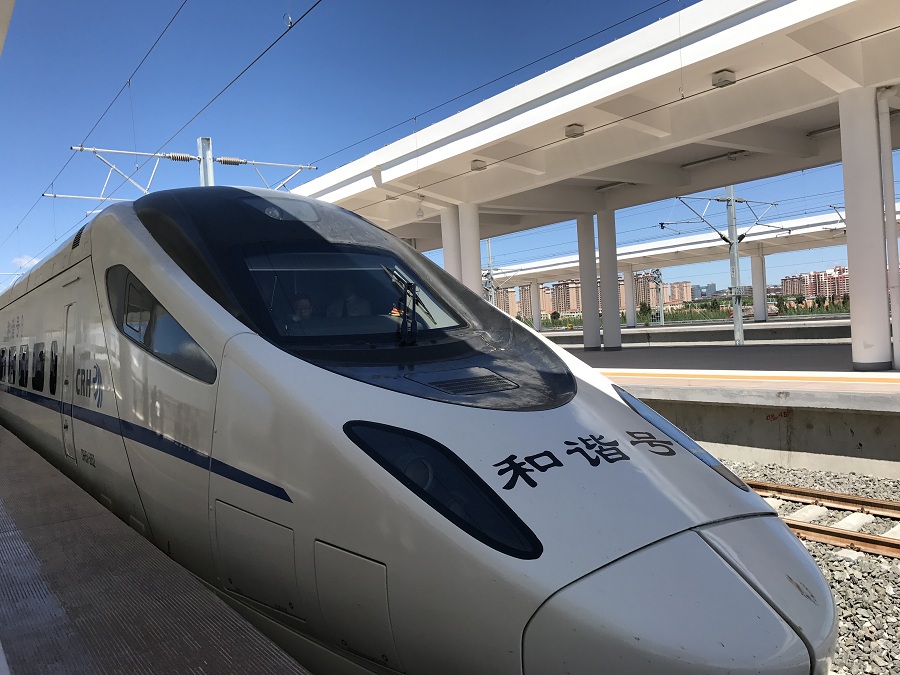
High-speed train debuts in Inner Mongolia
A bullet train departed Hohhot East Railway Station for Ulanqab marking the start of high-speed rail services using Inner Mongolia’s first newly-laid high-speed railway on Aug 3.
