Inner Mongolia focuses on stable growth
By Yuan Hui and Du Juan in Hohhot (China Daily)
Updated: 2015-10-26
Editor's note: Despite China's economic slowdown, the Inner Mongolia autonomous region recorded better-than-average economic growth over the last two years thanks to the opportunities provided by the Belt and Road Initiative. The region is becoming more open to the world, especially to Russia and Mongolia in the north. China Daily spoke recently to Wang Jun, Inner Mongolia's Party chief, to find out more.
The Inner Mongolia autonomous region has realized stable economic growth despite the general economic slowdown over the past two years. How did the region achieve this result?
Wang: The new economic situation requires new policies to cope. Inner Mongolia is traditionally a region based on the energy industry. Thus, we have been making efforts to adjust the industrial structure to ensure stable growth when commodities prices are falling. At the same time, the local government has put a focus on improving efficiency and quality, and enhancing reform.
For the first half of the year, the region's GDP growth was 7 percent. The region's fixed investment grew by 14.4 percent compared to the same period last year. The income of urban and rural residents increased by 7.7 percent and 8.3 percent year-on-year, respectively.
Those performance indicators are better than neighboring provinces and autonomous regions, a credit to policies the authority has maintained.
Besides the energy industry, in which sectors has Inner Mongolia made progress?
Wang: In recent years, the high-tech industry, livestock product processing and equipment manufacturing sectors all achieved higher than average growth in the region.
Meanwhile, the tourist industry, logistics and financial information sectors are developing rapidly.
In the past, Inner Mongolia's major economic growth contributor was the coal industry and the others lagged behind. However, the structure is quickly shifting to a more healthy and reasonable one.
What are the key sectors to be developed in the future?
Wang: We will build Inner Mongolia into a major clean energy provider to other places in the country by developing the coal chemical industry. Meanwhile, we will develop nonferrous metal processing, equipment manufacturing, livestock product processing and cultural tourist industries aimed at improving our economic structure.
After 60 years of development, Inner Mongolia has had much experience in those sectors, and we have confidence that the region can make a bigger contribution by accelerating the development of those industries. For instance, clean energy will help the country to reduce carbon emissions. Livestock product processing and tourism will meet the growing demand from consumers and improve living standards.
By developing those industries, there will be more jobs in the region, which will greatly increase the income of our residents.
Inner Mongolia is a frontier for the country's openness to the north. You have visited Mongolia and Russia in the last year. What did the visit achieve?
Wang: Inner Mongolia will become more open to those countries. We agreed on cooperation in mainly three sectors. First, we will strengthen cooperation on energy exploration and development. Second, all sides would like to improve infrastructure construction to increase communication. Third, we will promote cross-border tourism.
In the last year, the region's import and export volume grew by 21.4 percent compared to the previous year.
What specific plans does the government have in terms of being more open to Mongolia and Russia?
Wang: Inner Mongolia has 16 inland ports, which is responsible for about 65 percent of land freight volume between China and Russia and up to 95 percent freight volume between China and Mongolia. Inner Mongolia owns the geological advantages in terms of openness to Mongolia and Russia.
The government will seize the opportunities provided by the national strategy to deepen our cooperation with Russia and Mongolia. We have prepared several official documents on accelerating cooperation, which provide guidelines for future actions.
The local government also established platforms for cooperation. In March, the central government listed Manzhouli, the biggest inland port to Russia, and Erenhot, the biggest inland port to Mongolia, as the national-level pilot free trade zone when the Inner Mongolia was listed into the key regions during the construction of Belt and Road Initiative.
The authority will establish the zone with a faster pace. The next move is to expand cooperative agreements. Make them solid. During the process, we will be more actively seeking cooperation with and openness to Mongolia and Russia.
Inner Mongolia has paid much attention to improving people's livelihoods in the recent years. How do you view those moves?
Wang: We indeed did lots of work on this. We have organized a series of projects to provide support to the poor and create jobs.
For example, the local government decided to provide one metric ton of thermal coal per person annually to low-income residents each winter. We also offer a 10,000 yuan ($1,587) study subsidy for each college student from a poor family every year. The government also provides at least one job to every family without any income. We hope all those measures can improve the lives of residents in the region.
In the last year, the entire region spent 244 billion yuan on improving people's livelihoods. For the first half this year, we still spent 110.5 billion yuan on the sector even though financial conditions were tight.
Authorities at all levels have kept the share of spending on livelihoods at more than 70 percent of the overall government finances.
The latest move is that we plan to invest 80 billion yuan over three years on improving living conditions, healthcare, water quality, electricity and TV service, as well as increasing the number of convenience stores in rural areas. We believe the investment will improve the lives of rural residents.
Better public service will contribute to stability of urban and rural areas and create a basic foundation for healthy economic development in the future.
Inner Mongolia has a fragile ecological system, facing some environmental problems such as desertification. However, the region is a draw for both domestic and foreign tourists. How can the region balance economic growth and environmental protection?
Wang: Inner Mongolia is the biggest and most comprehensive ecological system in northern China with diversified landscapes from forests to deserts. Its ecologic safety doesn't only concern its own development, but also the ecological stability of China's northeastern, northern and northwestern areas.
A good natural environment is the best situation for the residents in the region. Thus, we respect nature and protect it. During the development of big projects, we strictly follow codes to protect the environment.
Last year, the region planted more than 672,000 hectares of forest. The area of the forest covers 21 percent of the whole region.
Contact the writers at dujuan@chinadaily.com.cn
|
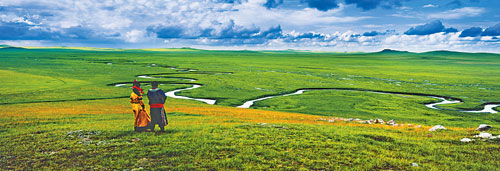
A river runs through the prairie in Dong Ujimqin Banner, the Inner Mongolia autonomous region. Hasbagena Borjigin / for China Daily |


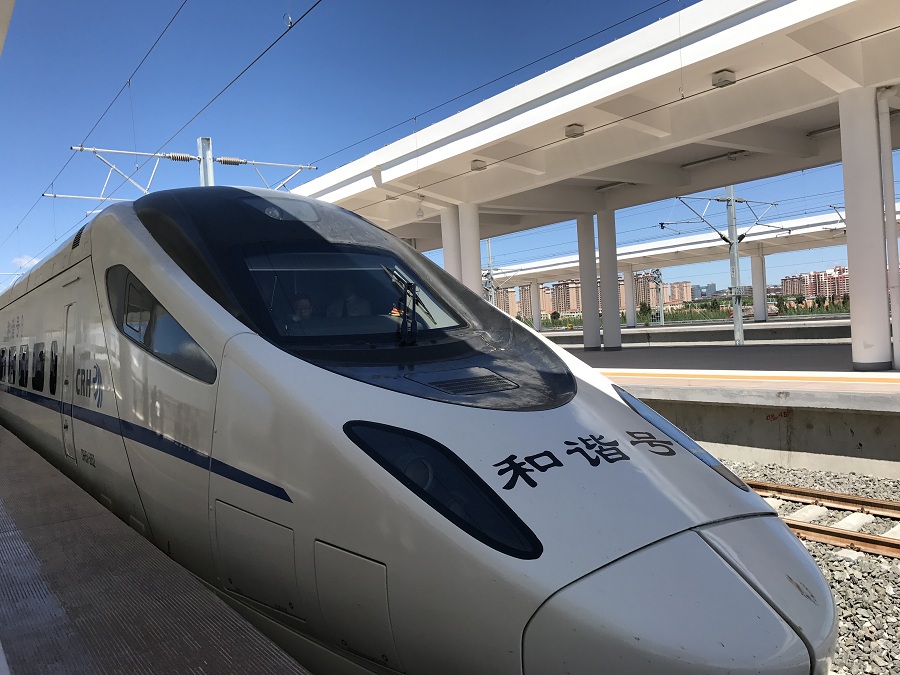
High-speed train debuts in Inner Mongolia
A bullet train departed Hohhot East Railway Station for Ulanqab marking the start of high-speed rail services using Inner Mongolia’s first newly-laid high-speed railway on Aug 3.
