Desert control expert safeguards Silk Road
By Jiang Wei (chinadaily.com.cn)
Updated: 2015-10-14
 |
|
Qu Jianjun explains sediment prevention measures to reporters, Sept 24, 2015. [Photo by Wang Xueying/cri.cn] |
After China's strategic conception of building the "Silk Road Economic Belt" and "21st Century Maritime Silk Road", known as the Belt and Road Initiative, was put forward by President Xi Jinping in 2013, elites from eight democratic parties have been offering advice and suggestions. One of them is Qu Jianjun, a member of Jiusan Society Central Committee, a well-known expert on desertification control.
In March, Qu proposed to build a belt along Silk Road oases to prevent sand from blowing in. "The Silk Road Economic Belt is actually a belt connected by oases," he said. "There used to be a dam to block sand along the belt, but its function has been lost due to improper use. Sand has entered oases and invaded farmland. I think the most important thing right now is to restore the belt."
Qu is glad to hear that the State Forestry Bureau decided to push forward the sediment prevention work in June along the Silk Road. He believes that the decision will also benefit Beijing, which suffers from sand storms every year.
"In the past, the State Forestry Bureau established parks in Inner Mongolia and Hebei to fend off sand. Gansu, Ningxia Hui autonomous region and Xinjiang Uygur autonomous region in the west were excluded. But Beijing's sand storms don't just come from surrounding areas. More of them are from northwest China," he said. "The key is to stop the sand from its source."
Qu is applying for a program to build the sediment prevention belt. He said he considers it as one of his two major working plans in the next few years. The other one is a sediment prevention project along the Lanzhou-Xinjiang High Speed Railway.
The railway, opened in 2014, runs from Lanzhou, capital of northwest China's Gansu province, to Urumqi, capital of northwest China's Xinjiang Uygur autonomous region. It is 1,776 kilometers long, the longest high speed railway in China. It cuts the traveling time from Lanzhou to Urumqi by nearly half, greatly facilitating freight transportation along the Silk Road Economic Belt.
However, due to the harsh sandy and wind-blown environment, the railway tracks are sometimes buried by sand, leading to train delays or cancellations. Qu's project application has been approved and he has got 3 million yuan from Chinese Academy of Sciences to do it.
"My lifelong ambition is to prevent sand from destroying the environment," he said. His previous endeavors and success has made him the chief scientist on sediment prevention.
Saving the Mogao Grottoes from sand strikes
Located in Dunhuang, a city in northwest China's Gansu Province, the Mogao Grottoes are surrounded by the Gobi Desert. For a long time, as long as there was wind blowing, sand drifted down from the cliff in which the Mogao Grottoes are carved, eroding both indoor and outdoor murals and sculptures.
In 1987, the Mogao Grottoes were added to the World Heritage List. Grotto protection became an urgent problem. In 1989, Qu Jianjun and his teacher were invited to Dunhuang to deal with sand problems. He was considered crazy by local people because he would go out as soon as wind started to blow. Qu knew wind was the key to control sand. He had to observe it.
In 1991, Qu built an A-shaped belt one kilometers east of the Mogao Grottoes to fend off the wind. The volume of sand that reached the grottoes decreased by 60-70 percent. In the following 20 years, Qu expanded the belt into a comprehensive protection system. Now sand volume has been reduced by 90 percent. He saved the Mogao Grottoes.
In 2008, Science magazine interviewed Qu and published his tactics of fending off sand.
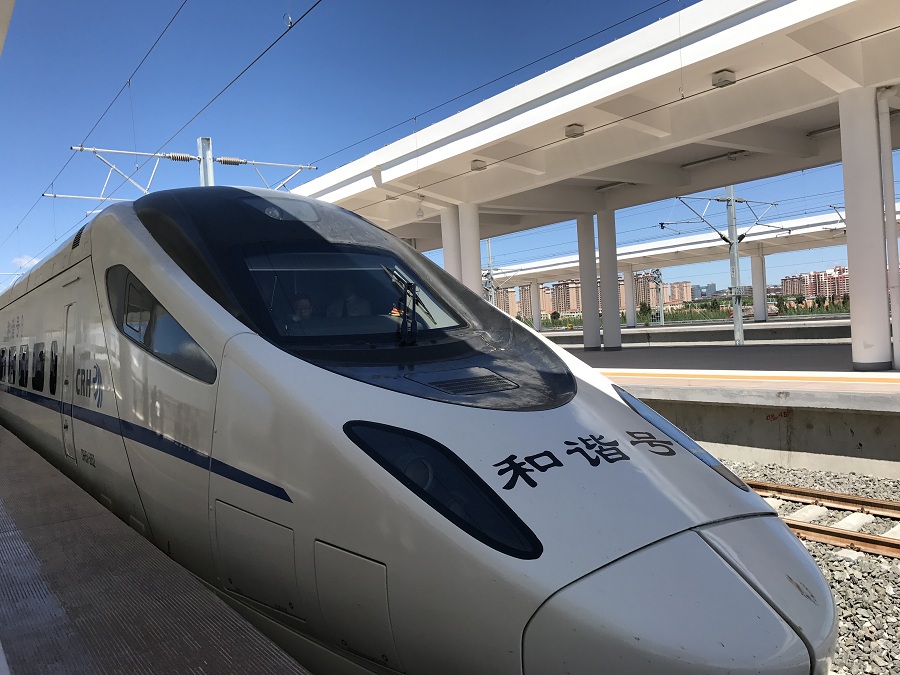
High-speed train debuts in Inner Mongolia
A bullet train departed Hohhot East Railway Station for Ulanqab marking the start of high-speed rail services using Inner Mongolia’s first newly-laid high-speed railway on Aug 3.
